Understanding the Parsha according to the Rebbe
Ben Chamesh L'Mikra | July 01, 2024
Print This Article
View Original PDF

Understanding the Parsha according to the Rebbe

Ben Chamesh L'Mikra | June 27, 2025

QUESTION: What was the inner disagreement of Korach against Moshe?

ANSWER: Korach argued on the essence of Moshe and his Torah. Korach maintained that all Jews were holy and their spirituality was not affected by Mitzvos (house full of books, garment completely Techeles, all Jews were as good as one Cohen Gadol). The essence of the Torah of Moshe was that the lower worlds exist, yet they need to be led by the upper worlds, and need a desire to elevate themselves. Mitzvos are the expression of the drive to improve spiritually. (לקוטי שיחות כרך ח, עמ' 110)

QUESTION: How does the name of Korach reflect his opposition with Moshe?

ANSWER: Three letters in Korach’s name with differing distortions of the left leg (compared to the letter ה) reflect distortions in the understanding of the role of Mitzvos.
ק Long leg – inner service not needed to affect one’s deeds
תכלת
ר Leg missing completely - no need for deeds
מזוזה
ח Leg closed – fulfilled; no further need to grow spiritually
אהרן
(לקוטי שיחות כרך ח, עמ' 110)

QUESTION: What is the distinction G-d made between separation of the rest of the Jews from the Cohanim and their separation from the Leviim?

ANSWER: Two different opinions, Rashi and Rambam. According to Rashi, HaShem set aside the Cohanim for the service of HaShem, with the Leviim to assist them. According to Rambam, the entire tribe of the Leviim was set aside for the service of HaShem. And the Cohanim were set aside for the service of the Korbanos. (לקוטי שיחות כרך כח, עמ' 151)

QUESTION: What is the understanding of the concept that a Shliach is like the person himself?

ANSWER: Three levels reflected in the three methods of becoming a shliach of Hashem.
Only concerning the outcome – the object
The person has own will, but bends his will to HaShem to do this action
Shliach’s deed as if done by the sender – the action
Inner bitul - one’s actions are a direct expression of HaShem’s Will
The body of the Shliach is like the body of the sender
Complete bitul-whole existence to HaShem (לקוטי שיחות כרך לג, עמ' 131)

QUESTION: In the law of bitul of Terumah, the amount of knowledge of the one doing the action affects the outcome of the law. Why should knowledge affect the legal status?

ANSWER: The power of thought by a person is very important. Thought can affect positive influences or negative influences in others or in matter. Therefore, one must be careful to think only good of others to lead to positive influences. (לקוטי שיחות כרך לח, עמ' 60)
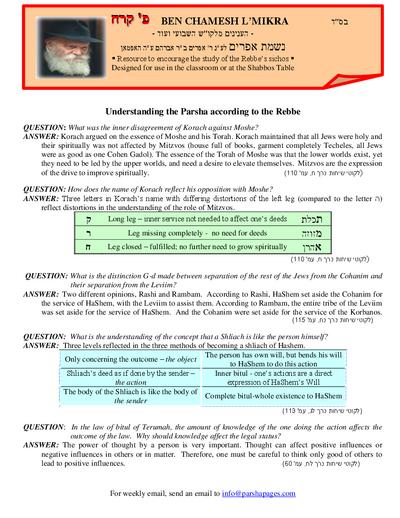
QUESTION: What was the inner disagreement of Korach against Moshe?

ANSWER: Korach argued on the essence of Moshe and his Torah. Korach maintained that all Jews were holy and their spirituality was not affected by Mitzvos (house full of books, garment completely Techeles, all Jews were as good as one Cohen Gadol). The essence of the Torah of Moshe was that the lower worlds exist, yet they need to be led by the upper worlds, and need a desire to elevate themselves. Mitzvos are the expression of the drive to improve spiritually. (לקוטי שיחות כרך ח, עמ' 110)

QUESTION: How does the name of Korach reflect his opposition with Moshe?

ANSWER: Three letters in Korach’s name with differing distortions of the left leg (compared to the letter ה) reflect distortions in the understanding of the role of Mitzvos.
ק Long leg – inner service not needed to affect one’s deeds
תכלת
ר Leg missing completely - no need for deeds
מזוזה
ח Leg closed – fulfilled; no further need to grow spiritually
אהרן
(לקוטי שיחות כרך ח, עמ' 110)

QUESTION: What is the distinction G-d made between separation of the rest of the Jews from the Cohanim and their separation from the Leviim?

ANSWER: Two different opinions, Rashi and Rambam. According to Rashi, HaShem set aside the Cohanim for the service of HaShem, with the Leviim to assist them. According to Rambam, the entire tribe of the Leviim was set aside for the service of HaShem. And the Cohanim were set aside for the service of the Korbanos. (לקוטי שיחות כרך כח, עמ' 151)

QUESTION: What is the understanding of the concept that a Shliach is like the person himself?

ANSWER: Three levels reflected in the three methods of becoming a shliach of Hashem.
Only concerning the outcome – the object
The person has own will, but bends his will to HaShem to do this action
Shliach’s deed as if done by the sender – the action
Inner bitul - one’s actions are a direct expression of HaShem’s Will
The body of the Shliach is like the body of the sender
Complete bitul-whole existence to HaShem (לקוטי שיחות כרך לג, עמ' 131)

QUESTION: In the law of bitul of Terumah, the amount of knowledge of the one doing the action affects the outcome of the law. Why should knowledge affect the legal status?

ANSWER: The power of thought by a person is very important. Thought can affect positive influences or negative influences in others or in matter. Therefore, one must be careful to think only good of others to lead to positive influences. (לקוטי שיחות כרך לח, עמ' 60)

PDF Preview