Understanding the Parsha according to the Rebbe
Ben Chamesh L'Mikra | October 22, 2023
Print This Article
View Original PDF

Understanding the Parsha according to the Rebbe

Ben Chamesh L'Mikra | December 31, 2025

QUESTION: How could Avrom be concerned about the gifts at the time that Sarai and himself were in physical danger?

ANSWER: Avrom knew that in the merit of Sarai, their safety was assured. Even more so, in the merit of Sarai they would obtain the great wealth (elevation of the holy sparks) of Egypt, which were the gifts that she received. )38, עמ' כלקוטי שיחות כרך (

QUESTION: What is the lesson that the first command to the father of the Jews was that he should move from one land to another?

ANSWER: The command by G-d through Avrohom for all the Jews to leave the land of physical materialism and go towards a land of spirituality. Our purpose given by G-d is to rise above our physical limitations and reach for spiritual avenues and a relationship with HaShem. )96 תש"נ, כרך א, עמ' ספר השיחות (

QUESTION: If Avrohom did all the Mitzvos, even though not yet commanded, why did he wait to do the bris milah until commanded?

ANSWER: The Avos observed the mitzvos in deed, but the holiness did not permeate the physical articles; yet, their mitzvos makes it possible for us to have holiness permeate the material realm. However, one mitzvah (Milah) needed to be done in a way to make a connection within the physical realm due only to the command of HaShem. Thus, Avrohom waited to do this mitzvah until he was commanded. This mitzvah draws down spirituality into the physical world (a onetime act that affects the physical flesh) and lasts a lifetime (remains circumcised). )757, עמ' ג לקוטי שיחות כרך (

QUESTION: Chasidus explains that Lech Lecha is a concept of constant ascent in spiritual growth. How does the descent of Avrohom in Egypt (which is part of the Parsha) fit into this concept?

ANSWER: The name of the Parsha implies a constant spiritual climbing. However, even a descent (like going to Egypt) is for the sake of the subsequent ascent and is included in the concept of ascent. Thus, one should not despair at any current distressed situation. This current concealment is really only external, and is a part of the future ascent. )57 , עמ'הלקוטי שיחות כרך (

QUESTION: HaShem promised the land of Israel to Avrohom’s descendents, but only after much toil and striving. Why can’t Hashem provide this good (and all the possible good) without all labor?

ANSWER: HaShem is the true source of good. If we were handed the benefits without toil, we would not have an active part in the acquisition. Rather, He established the “system” of toil and labor to reach our goals, so we could fully participate and become partners in the outcome. )93, עמ' יטטי שיחות כרך לקו(

QUESTION: Why does the Torah wait until Avrom was 75 years old to tell us about the details of his life without mentioning the earlier occurrences (discovering HaShem, being thrown in the fire, etc.)?

ANSWER: Avrohom’s mission (the start of Judaism) begins with the command from HaShem of Lech Lecha. Thus, no need to know about any prior activities of Avrohom since that would distract from the main concept that the connection to HaShem begins with doing Mitzvos. )47 , עמ'כה לקוטי שיחות כרך (
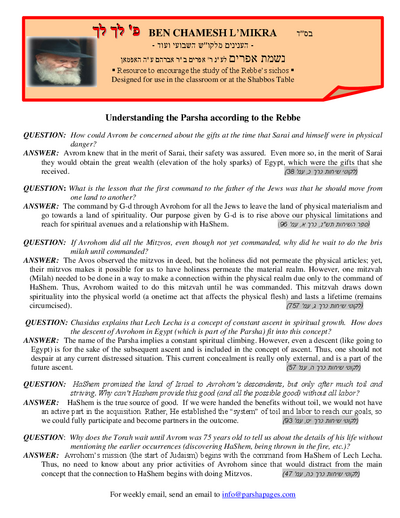
QUESTION: How could Avrom be concerned about the gifts at the time that Sarai and himself were in physical danger?

ANSWER: Avrom knew that in the merit of Sarai, their safety was assured. Even more so, in the merit of Sarai they would obtain the great wealth (elevation of the holy sparks) of Egypt, which were the gifts that she received. )38, עמ' כלקוטי שיחות כרך (

QUESTION: What is the lesson that the first command to the father of the Jews was that he should move from one land to another?

ANSWER: The command by G-d through Avrohom for all the Jews to leave the land of physical materialism and go towards a land of spirituality. Our purpose given by G-d is to rise above our physical limitations and reach for spiritual avenues and a relationship with HaShem. )96 תש"נ, כרך א, עמ' ספר השיחות (

QUESTION: If Avrohom did all the Mitzvos, even though not yet commanded, why did he wait to do the bris milah until commanded?

ANSWER: The Avos observed the mitzvos in deed, but the holiness did not permeate the physical articles; yet, their mitzvos makes it possible for us to have holiness permeate the material realm. However, one mitzvah (Milah) needed to be done in a way to make a connection within the physical realm due only to the command of HaShem. Thus, Avrohom waited to do this mitzvah until he was commanded. This mitzvah draws down spirituality into the physical world (a onetime act that affects the physical flesh) and lasts a lifetime (remains circumcised). )757, עמ' ג לקוטי שיחות כרך (

QUESTION: Chasidus explains that Lech Lecha is a concept of constant ascent in spiritual growth. How does the descent of Avrohom in Egypt (which is part of the Parsha) fit into this concept?

ANSWER: The name of the Parsha implies a constant spiritual climbing. However, even a descent (like going to Egypt) is for the sake of the subsequent ascent and is included in the concept of ascent. Thus, one should not despair at any current distressed situation. This current concealment is really only external, and is a part of the future ascent. )57 , עמ'הלקוטי שיחות כרך (

QUESTION: HaShem promised the land of Israel to Avrohom’s descendents, but only after much toil and striving. Why can’t Hashem provide this good (and all the possible good) without all labor?

ANSWER: HaShem is the true source of good. If we were handed the benefits without toil, we would not have an active part in the acquisition. Rather, He established the “system” of toil and labor to reach our goals, so we could fully participate and become partners in the outcome. )93, עמ' יטטי שיחות כרך לקו(

QUESTION: Why does the Torah wait until Avrom was 75 years old to tell us about the details of his life without mentioning the earlier occurrences (discovering HaShem, being thrown in the fire, etc.)?

ANSWER: Avrohom’s mission (the start of Judaism) begins with the command from HaShem of Lech Lecha. Thus, no need to know about any prior activities of Avrohom since that would distract from the main concept that the connection to HaShem begins with doing Mitzvos. )47 , עמ'כה לקוטי שיחות כרך (

PDF Preview