Belief in the Coming of Moshiach and Awaiting Salvation
Limuday Moshe | August 01, 2024
Print This Article
View Original PDF

Belief in the Coming of Moshiach and Awaiting Salvation

Limuday Moshe | June 25, 2025

The chiddushim attributed to the Ran (Shabbos 31a) quotes the Ba’alei HaTosfos who explain that when one is asked after 120, צפית לישועה – “Did you await salvation?”, he is not simply being asked: צפית שתבוא ישועה לישרא ל – “Did you wait for a salvation to come to Klal Yisroel”, as one who doesn’t await that is simply a heretic. Rather, what one is being asked is: צפית לישועה בימיך – “Did you wait for the salvation to happen in your days”, i.e. did you wait for the geulah, as an imminent reality.

Along the same lines, the Brisker Rav reads into the Rambam’s words two obligations – believing that the Moshiach will come, and awaiting his imminent arrival: “Anyone who does not believe in him or does not await his coming...”. Thus, in addition to believing in the coming of Moshiach there is the obligation to await his arrival, at any time, and the Rambam designates one who fails to do so as a heretic.

Many await and daven for the arrival of the Moshiach, but at the same time behave like the peasant woman in Poland who wants Moshiach to come so the world will be “fixed”, but once it reaches that point, he should go on to Yerusholayim without her, leaving her in Poland with the “fixed” world and the chickens and ducks.

People are, at times, quite comfortable in their exile – the economy is good, the house is spacious and career successful. The children are doing well in school and life is, in general, good. Why would such a person await such an upheaval as the arrival of the Moshiach? Yes, the world needs Moshiach, but practically speaking... maybe not really. Most people prefer the present, uncomfortable as it may be, to the unknown future, no matter how promising it seems. These feelings are normal and natural and without intensive internal work, impossible to let go of and plant instead a throbbing, yearning hope for redemption. This is the subject of the question one is asked upon arriving for judgement – did you actively engage in correcting your worldview and your hopes for the future? You planned how to marry your children, invested your nest egg for your retirement years. How did you plan for the coming of Moshiach? Was his arrival even on your charts or does “Bayom hahu yihiye Hashem echad U’Shemo echod” remain in your siddur leaving nary a dent in your psyche?

Hopefully after reading this week’s sheet, the reader will see just how real anticipating the arrival of Moshiach, and how this makes a number of differences in practical halachah. Iy’H Moshiach will arrive before we get to the end of this discussion.
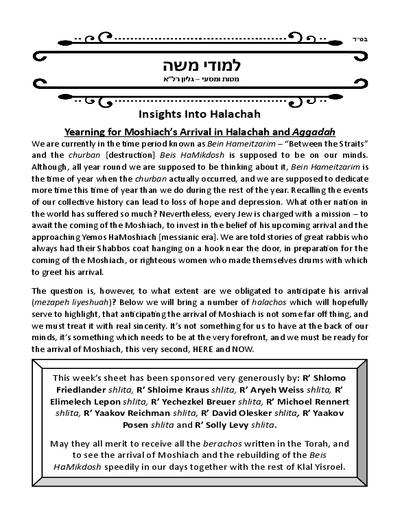
The chiddushim attributed to the Ran (Shabbos 31a) quotes the Ba’alei HaTosfos who explain that when one is asked after 120, צפית לישועה – “Did you await salvation?”, he is not simply being asked: צפית שתבוא ישועה לישרא ל – “Did you wait for a salvation to come to Klal Yisroel”, as one who doesn’t await that is simply a heretic. Rather, what one is being asked is: צפית לישועה בימיך – “Did you wait for the salvation to happen in your days”, i.e. did you wait for the geulah, as an imminent reality.

Along the same lines, the Brisker Rav reads into the Rambam’s words two obligations – believing that the Moshiach will come, and awaiting his imminent arrival: “Anyone who does not believe in him or does not await his coming...”. Thus, in addition to believing in the coming of Moshiach there is the obligation to await his arrival, at any time, and the Rambam designates one who fails to do so as a heretic.

Many await and daven for the arrival of the Moshiach, but at the same time behave like the peasant woman in Poland who wants Moshiach to come so the world will be “fixed”, but once it reaches that point, he should go on to Yerusholayim without her, leaving her in Poland with the “fixed” world and the chickens and ducks.

People are, at times, quite comfortable in their exile – the economy is good, the house is spacious and career successful. The children are doing well in school and life is, in general, good. Why would such a person await such an upheaval as the arrival of the Moshiach? Yes, the world needs Moshiach, but practically speaking... maybe not really. Most people prefer the present, uncomfortable as it may be, to the unknown future, no matter how promising it seems. These feelings are normal and natural and without intensive internal work, impossible to let go of and plant instead a throbbing, yearning hope for redemption. This is the subject of the question one is asked upon arriving for judgement – did you actively engage in correcting your worldview and your hopes for the future? You planned how to marry your children, invested your nest egg for your retirement years. How did you plan for the coming of Moshiach? Was his arrival even on your charts or does “Bayom hahu yihiye Hashem echad U’Shemo echod” remain in your siddur leaving nary a dent in your psyche?

Hopefully after reading this week’s sheet, the reader will see just how real anticipating the arrival of Moshiach, and how this makes a number of differences in practical halachah. Iy’H Moshiach will arrive before we get to the end of this discussion.

PDF Preview



