A Thought on Bitachon
Hashgacha Pratis | December 26, 2024
Print This Article
View Original PDF

A Thought on Bitachon

Hashgacha Pratis | June 27, 2025

A Tzaddik Needs to Be Doubly Careful

One who has perfected his trust in Hashem must be extremely careful to avoid placing any trust in human beings. This will prove to be a tremendous challenge. Yosef certainly did not place his trust in the sar hamashkim, but still, he should not have asked him for his help.

However, only a great tzaddik on Yosef’s level would be faulted for what Yosef did.

(Sefas Emes, Parshas Mikeitz, 5637)

Don’t Let Your Bitachon Slacken

Sometimes a person trusts in Hashem initially, but he sees that even though he trusted in Hashem, no yeshuah came his way, and then he turns to people and seeks other ways to solve his problems. That’s why it says, “Blessed is the man who trusts in Hashem and for whom Hashem is his Source of trust” – forever. Meaning, he does not trust Hashem any less even if he was not saved, but he remains strong in his bitachon. This man is blessed...

(Kesav Sofer, Parshas Mikeitz)

There Is No Need for Any Hishtadlus

The Baal Shem Tov explains that there is a boteiach – the one who trusts, a mavtiach – the one who makes the promise, and a muvtach – the means through which the person trusts that he will reach his goal.

In this mashal, Hashem is the mavtiach, Who promises to provide the person with all his needs; the person is the boteiach, the one who trusts that this will happen, and the muvtach refers to the means by which he is sure Hashem will send him his parnassah.

A muvtach, be it a job or career or some other source of parnassah, is necessary only when the boteiach has not yet reached the level of true emunah. True emunah is to believe that it is Hashem alone, and there is none other than Him, and that even if a person would do nothing in the way of business or any other form of hishtadlus, Hashem in His great chessed could provide for him.

This is the meaning of, “Blessed is the man who trusts in Hashem, and for whom Hashem is his Source of trust – mivtacho.” This means that his muvtach will be Hashem Himself, without any need for an intermediary, for that will not be necessary. And even when he does achieve something through some intermediary, he believes with complete faith that it came directly from Hashem, Who wanted to provide for him using these means. He does not feel it necessary for his parnassah to come about specifically in that way. He trusts only in Hashem. And this is a great madreigah.

(Degel Machaneh Ephrayim, Parshas Beshalach)
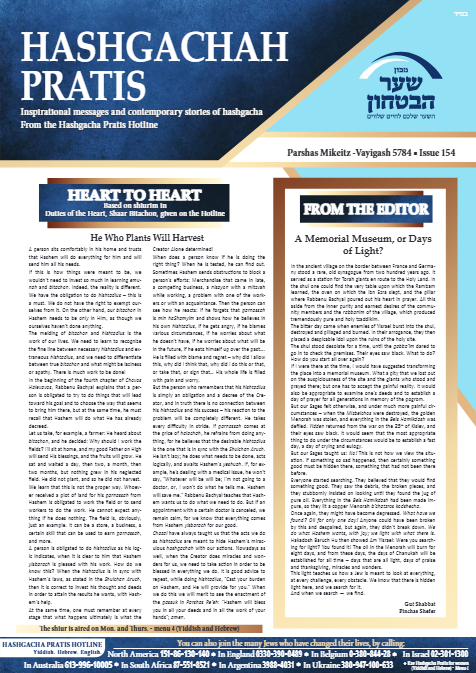
A Tzaddik Needs to Be Doubly Careful

One who has perfected his trust in Hashem must be extremely careful to avoid placing any trust in human beings. This will prove to be a tremendous challenge. Yosef certainly did not place his trust in the sar hamashkim, but still, he should not have asked him for his help.

However, only a great tzaddik on Yosef’s level would be faulted for what Yosef did.

(Sefas Emes, Parshas Mikeitz, 5637)

Don’t Let Your Bitachon Slacken

Sometimes a person trusts in Hashem initially, but he sees that even though he trusted in Hashem, no yeshuah came his way, and then he turns to people and seeks other ways to solve his problems. That’s why it says, “Blessed is the man who trusts in Hashem and for whom Hashem is his Source of trust” – forever. Meaning, he does not trust Hashem any less even if he was not saved, but he remains strong in his bitachon. This man is blessed...

(Kesav Sofer, Parshas Mikeitz)

There Is No Need for Any Hishtadlus

The Baal Shem Tov explains that there is a boteiach – the one who trusts, a mavtiach – the one who makes the promise, and a muvtach – the means through which the person trusts that he will reach his goal.

In this mashal, Hashem is the mavtiach, Who promises to provide the person with all his needs; the person is the boteiach, the one who trusts that this will happen, and the muvtach refers to the means by which he is sure Hashem will send him his parnassah.

A muvtach, be it a job or career or some other source of parnassah, is necessary only when the boteiach has not yet reached the level of true emunah. True emunah is to believe that it is Hashem alone, and there is none other than Him, and that even if a person would do nothing in the way of business or any other form of hishtadlus, Hashem in His great chessed could provide for him.

This is the meaning of, “Blessed is the man who trusts in Hashem, and for whom Hashem is his Source of trust – mivtacho.” This means that his muvtach will be Hashem Himself, without any need for an intermediary, for that will not be necessary. And even when he does achieve something through some intermediary, he believes with complete faith that it came directly from Hashem, Who wanted to provide for him using these means. He does not feel it necessary for his parnassah to come about specifically in that way. He trusts only in Hashem. And this is a great madreigah.

(Degel Machaneh Ephrayim, Parshas Beshalach)

PDF Preview