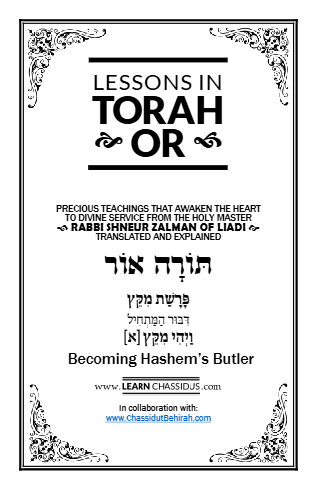
Becoming Hashems Butler
Lessons in Torah Or | December 14, 2025
Print This Article
View Original PDF

Becoming Hashems Butler

Lessons in Torah Or | December 31, 2025

In the beginning of Parshas Mikeitz, the Torah describes how Pharoh had two dreams that he felt were of great importance and needed interpretation. One was about seven skinny cows that swallowed up seven fat cows, and one was about seven thin stalks of wheat that swallowed up seven fat stalks of wheat. These dreams come after the dreams discussed in the previous Parsha, of Vayeishev. There the Torah describes the dreams of Pharoh’s baker and butler, who were in jail because there was a fly in Phraoh’s wine and a pebble in Pharoh’s bread. The butler’s dream was about three clusters of grapes that he made into wine for Pharoh. The baker’s dream was about three baskets of bread he was carrying on his head.

The butler and baker had Yosef interpret their dreams. Yosef intererpreted the baker’s dream to mean he would be killed, and the butler’s dream that he would be reinstated as Pharoh’s butler. Yosef asked the butler to remember to mention him to Pharoh after he is freed from jail and reinstated, but the butler forgot to mention him for two years. At the end of two years, Pharoh had the disturbing dreams mentioned above, and only then did the butler mention Yosef to Pharoh as a dream interpreter.

The Alter Rebbe will analyze the mystical meaning of these characters and their dreams in our service of Hashem:

Chapter 1

“And it was at the end of two years (since the butler was freed from jail), that Pharoh had a dream (and needed it interpreted, and the butler mentioned Yosef to Pharoh) ...” (Bereishis 41:1)

Now, this Parsha is connected to the (last verse of the) previous Parsha that says: “the butler did not remember Yosef” (Bereishis 40:23).

This implies that because “he did not remember (Yosef),” this caused that “it was at the end (of two years).”

The end of the last verse of Parshas Vayeishev says that the butler forgot about Yosef. The beginning of the next verse, which is the first verse of Parshas Mikeitz, says how it was at the end of two years later that Pharoh had his disturbing dreams. From the flow of the verses, it would seem to imply that the fact that Pharoh had strange dreams two years after the butler was freed, was because the butler forgot about Yosef.

What possible connection could there be between these two things?

The explanation of the matter:

For, just as there is Pharoh and his butler in unholiness, so too, “Hashem has made this (unholiness) corresponding to this (holiness)” (Koheles 7:14), that there exists similarly in holiness these aspects (of Pharoh and his butler etc.).

Now, there are four spiritual elemental aspects in a person’s soul, corresponding to “fire, air, water, and earth.”

The spiritual elemental aspect of fire resides in the heart, and the source of spiritual liquid is derived from the brain, which is where the spiritual elemental aspect of water resides.

The spiritual lungs draw out the spiritual liquid and moisture from the brain through the spiritual windpipe, in order to cool off the heat of the heart.

The above statements from the maamar, which are based on a Gemara (Brachos 61b), are generally not interpreted to mean on a physical level. (At least, in the context of this maamar it does not mean on a physical level.) Rather, the spiritual aspects of fire and water are connected to the heart and the mind.

The mind is cool and analytical. The heart is fiery and passionate. The spiritual idea of the “lungs” and the “windpipe” is the ability to take some of the cool and analytical power of the mind and use it to harness and control the emotions so they do not “overheat” and bring the person to do something foolish because of his intense emotions.

The windpipe and lungs are what connect the head and the heart, bringing oxygen through mouth in the head into the blood in the heart. Similarly, the spiritual “windpipe and lungs” are the aspects that connects the mind and the heart, allowing the cool and calm mind to control the passionate emotions.

This ability of the spiritual “windpipe and lungs” to cool off the emotions using the cool and calm mind, is true even regarding physical matters. For example, a person whose job entails working with customers sometimes deals with people who say inappropriate or insulting things. If they would let their emotions go uncontrolled, they would probably lose their job by responding angrily at the customers. The worker uses their spiritual lungs and windpipe to draw cool and calmness from their mind to cool off their emotions so they can respond professionally.

Similarly, in the Divine soul there is the dynamic of the mind and heart, and the connection between them:

So too in the Divine soul:

The spiritual elemental aspect of water is in the brain, meaning, in the aspect of Chochma-Wisdom and knowledge in the service of Hashem using his brain and thoughts (to contemplate on Hashem’s greatness).

Even though “no thought can grasp Him at all” (Tikunei Zohar 92a),

So how can one use his thoughts and mind to connect to the unknowable Hashem?

Is it not written (Mishlei 31:23) “Her (the Jewish People’s) Husband (Hashem) is known at the ‘gates’”?

Meaning, as it is explained in the Zohar (I, 103b), “to each person according to his own ‘measure’ of intellect.”

The Zohar explains the verse to mean that Hashem, who is the “Husband” of the Jewish People, makes Himself known to each Jew according the measure of effort on his part to connect his mind to Hashem.

This refers to the contemplation on the idea of Hashem’s greatness, that from the infinitely highest level to the lowest possible level “there is nothing besides for Him.” (See Devarim 4:35)

For, “with the breath of His mouth He created all of their hosts” (Tehillim 33:6), and “everything else is insignificant before Hashem.”

For example, a person’s speech has no separate importance other the person, and is insignificant in comparison to the person himself.

This is what each person can understand and grasp according to his level, that “there is nothing other than Hashem, in the Heavens Above, and on the earth below,” and all the created beings in the higher spiritual levels, and in the lower spiritual levels, are derived from the “breath of His mouth,” as it were, and therefore, there is nothing separate from Him. And because of this, they are considered absolutely insignificant compared to Hashem.

This awareness of Hashem in our mind is the aspect of “water” in the Divine soul. This is when the concept is “seen” in the mind’s eye, and brings a person to great enjoyment and pleasure. Just as water binds things together, like flour into dough, this pleasure in perceiving Hashem’s greatness binds the person to Hashem. This is connected to the level called “Chochma,” which is the aspect of the mind that “sees” the entire picture all at once, and causes the person to “lose himself” in an idea and experiencing it with great enjoyment.

However, the elemental spiritual aspect of fire in the Divine soul is the yearning in the heart for Hashem, when it understands and contemplates in a way of Bina about the greatness of Hashem, how “everything is insignificant before Him.”

The aspect of “fire” in the Divine soul is related to the aspect of Bina-Understanding.

As mentioned above, Chochma allows the person to “see” the entire picture of the idea, as it were, and have great enjoyment in losing oneself in the concept.

By contrast, however, Bina is the aspect that focuses on each detail separately, and analyzes everything. This is similar to “hearing” an idea, where you can only process one bit of information at a time, and only after hearing many details can string it together into a complete idea.

Since Hashem’s true greatness is beyond the limits of any logical comprehension, the more details we try to grasp the more we realize how Hashem is beyond our understanding. At some point a person realizes that Hashem and His Light are so exalted, so real, that relative to Him our perception and experience of reality is literally like a dream of utter vanity, and at that point we get “lit on fire” to want to experience His True reality.

Chochma and Bina (can) both process the exact same information, in this case, the greatness of Hashem, yet one, Chochma, will produce a relaxed and enjoyable love of Hashem like water, and one, Bina, will produce a fiery yearning for Hashem.

And therefore, his soul will yearn for Hashem with an intense fiery love, like a flame that rises to its source, to yearn to become part of the experience of the Light and Oneness of Hashem, and it does not want to remain below in this worldly experience, like the nature of fire, that is naturally pulled towards it source from below to above.

Which is not the case with the spiritual aspect of “water,” which is like water that flows down from a high place to a low place, meaning, that he draws down onto himself the Light of Hashem, which is the Torah and Mitzvos, to shine on his soul even as he exists below in this world, in a manner that “against his will he lives” in this world, just as water extinguishes fire, so too, through this Light of Torah and Mitzvos he will quench the yearning of his soul for Hashem, as it is written (Yeshaya 55:1) “Behold, whoever is thirsty for Hashem, should go to the waters of the Torah,” as explained elsewhere.

This is accomplished through the aspect that connects the aspect of “water” in the mind with the aspect of “fire” in the heart, which is referred to by way of analogy as “the windpipe,” which is the source of the letters of the Torah,

Just as the windpipe is the source of letters of speech through the air coming through it and striking the vocal-cords etc, so too, this level of “the windpipe” is the aspect that brings down the letters of the Torah from Hashem’s Wisdom.

as it is written (Mishlei 4:5): “acquire wisdom, and acquire understanding.”

The same word “קנה” can mean a pipe, like the windpipe, or it can mean to acquire something, whether physical or spiritual, like wisdom. The fact that the verse uses the word “קנה” in the context of obtaining wisdom, the wisdom of the Torah, implies that the acquisition of Torah wisdom is connected to the “windpipe.” The connection is that one needs to physically say the words of Torah in order to acquire its wisdom.

In other types of wisdom, one can read the information with his eyes or listen to a lecture on the topic, without saying over the ideas verbally. In the case of the wisdom of the Torah, however, one needs to verbally recite the words in order to “acquire” the Torah’s wisdom.

This aspect is called “the officer in charge of serving drinks,” since through it, the “windpipe,” the “lungs” draw out “liquid” from the “moisture of the brain,” i.e., from the spiritual aspect of water in it, in the mind, and uses it to cool off the overexcitement of the heart.

In other words, the overheating of the emotions of the heart, the “aspect of fire,” needs to be balanced by the “waters” of knowledge of wisdom of Hashem.

Even though we said that in prayer itself it is possible to attain a level of love of Hashem like water (through the aspect of Chochma of the soul), nonetheless, this does not fully “quench” the fiery yearning for Hashem. The only way to fully “quench the thirst” for Hashem is through the “waters” of Torah wisdom. However, this is only possible when the words of Torah are actually recited. This is the idea of the “windpipe” that “draws out liquid,” i.e., when one says words of Torah (and understands them), this draws down a revelation from Hashem that cools off the fiery yearning in the heart for Him.

Chapter 2

This is the idea of the dream of Pharoh’s butler: “Behold, there was a grape-vine before me... and I squeezed the grapes [into wine, which flowed into Pharoh’s cup] and I placed the cup on the palm of Pharoh’s hand.”

The meaning of a “grape-vine” is a reference to the level of Malchus of Atzilus, which is called “the Gathering of Yisroel,” since it includes in itself all of the souls of the Jewish People.

The “grapes” refer to the “sparks” of each specific soul, and each “spark,” i.e., each Divine soul, is like one grape.

For, in each “spark,” in each soul, there is contained “wine,” which “causes Hashem and people to be happy” (see Shoftim 9:13).

This “wine” is the hidden love for rejoicing in Hashem,

This “wine” is an inheritance from our ancestors, Avraham, Yitzchok, and Yaakov, however, it is very much hidden, like wine is hidden in grapes.

Since the grape is completely round, and covers the wine inside of it from all sides, therefore it is impossible to take out the wine except through squeezing and pressing it in a wine-press, in order to remove the “shell” that covers over the wine.

So too, it is impossible to reveal the hidden love for Hashem except through crushing the ego, as it says (Pirkei Avos 4:10): “make yourself humble before every man.”

The meaning of the above statement of the Sages is not that other people should humble you, rather “make yourself humble” through your own efforts, and as we ask Hashem in the end of the Amidah prayer: “let my soul be like dust to all,” like a doormat that everyone steps on, i.e., egoless, in order to remove the “thick covering” that surrounds the heart, meaning, the coarse ego that desensitizes the heart from feeling passionate about Hashem.

Meaning, that even one who has not actually been defiled through “the sins of the youth,” i.e., immoral acts that are usually committed when one is young and foolish, nonetheless, he needs to “circumcise (open) his heart,” as it is written (Devarim 10:16): “and you should circumcise the covering of your heart,” meaning, to remove the fact his heart has a strong desire for things that he does not need, i.e., for physical objects or enjoyments that are not needed, this (desire for physical indulgence) is called “the thick covering” that covers over and conceals the revelation of Hashem, so that it conceals Hashem’s Presence, the person needs to work on himself so that his physical desires should not conceal Hashem’s Presence, and there should be no barrier whatsoever dividing him from Hashem’s revelation, even a thin covering, which is like how in the physical circumcision one needs to cut off even the thin layer of skin covering the place of circumcision.

Through this, “and I placed the cup on the palm of Pharoh’s hand,” as it is written (Yeshaya 49:16): “[Hashem says:] I have engraved you [the Jewish People] on the ‘palms’ of My ‘hands,’”

In the beginning of Parshas Mikeitz, the Torah describes how Pharoh had two dreams that he felt were of great importance and needed interpretation. One was about seven skinny cows that swallowed up seven fat cows, and one was about seven thin stalks of wheat that swallowed up seven fat stalks of wheat. These dreams come after the dreams discussed in the previous Parsha, of Vayeishev. There the Torah describes the dreams of Pharoh’s baker and butler, who were in jail because there was a fly in Phraoh’s wine and a pebble in Pharoh’s bread. The butler’s dream was about three clusters of grapes that he made into wine for Pharoh. The baker’s dream was about three baskets of bread he was carrying on his head.

The butler and baker had Yosef interpret their dreams. Yosef intererpreted the baker’s dream to mean he would be killed, and the butler’s dream that he would be reinstated as Pharoh’s butler. Yosef asked the butler to remember to mention him to Pharoh after he is freed from jail and reinstated, but the butler forgot to mention him for two years. At the end of two years, Pharoh had the disturbing dreams mentioned above, and only then did the butler mention Yosef to Pharoh as a dream interpreter.

The Alter Rebbe will analyze the mystical meaning of these characters and their dreams in our service of Hashem:

Chapter 1

“And it was at the end of two years (since the butler was freed from jail), that Pharoh had a dream (and needed it interpreted, and the butler mentioned Yosef to Pharoh) ...” (Bereishis 41:1)

Now, this Parsha is connected to the (last verse of the) previous Parsha that says: “the butler did not remember Yosef” (Bereishis 40:23).

This implies that because “he did not remember (Yosef),” this caused that “it was at the end (of two years).”

The end of the last verse of Parshas Vayeishev says that the butler forgot about Yosef. The beginning of the next verse, which is the first verse of Parshas Mikeitz, says how it was at the end of two years later that Pharoh had his disturbing dreams. From the flow of the verses, it would seem to imply that the fact that Pharoh had strange dreams two years after the butler was freed, was because the butler forgot about Yosef.

What possible connection could there be between these two things?

The explanation of the matter:

For, just as there is Pharoh and his butler in unholiness, so too, “Hashem has made this (unholiness) corresponding to this (holiness)” (Koheles 7:14), that there exists similarly in holiness these aspects (of Pharoh and his butler etc.).

Now, there are four spiritual elemental aspects in a person’s soul, corresponding to “fire, air, water, and earth.”

The spiritual elemental aspect of fire resides in the heart, and the source of spiritual liquid is derived from the brain, which is where the spiritual elemental aspect of water resides.

The spiritual lungs draw out the spiritual liquid and moisture from the brain through the spiritual windpipe, in order to cool off the heat of the heart.

The above statements from the maamar, which are based on a Gemara (Brachos 61b), are generally not interpreted to mean on a physical level. (At least, in the context of this maamar it does not mean on a physical level.) Rather, the spiritual aspects of fire and water are connected to the heart and the mind.

The mind is cool and analytical. The heart is fiery and passionate. The spiritual idea of the “lungs” and the “windpipe” is the ability to take some of the cool and analytical power of the mind and use it to harness and control the emotions so they do not “overheat” and bring the person to do something foolish because of his intense emotions.

The windpipe and lungs are what connect the head and the heart, bringing oxygen through mouth in the head into the blood in the heart. Similarly, the spiritual “windpipe and lungs” are the aspects that connects the mind and the heart, allowing the cool and calm mind to control the passionate emotions.

This ability of the spiritual “windpipe and lungs” to cool off the emotions using the cool and calm mind, is true even regarding physical matters. For example, a person whose job entails working with customers sometimes deals with people who say inappropriate or insulting things. If they would let their emotions go uncontrolled, they would probably lose their job by responding angrily at the customers. The worker uses their spiritual lungs and windpipe to draw cool and calmness from their mind to cool off their emotions so they can respond professionally.

Similarly, in the Divine soul there is the dynamic of the mind and heart, and the connection between them:

So too in the Divine soul:

The spiritual elemental aspect of water is in the brain, meaning, in the aspect of Chochma-Wisdom and knowledge in the service of Hashem using his brain and thoughts (to contemplate on Hashem’s greatness).

Even though “no thought can grasp Him at all” (Tikunei Zohar 92a),

So how can one use his thoughts and mind to connect to the unknowable Hashem?

Is it not written (Mishlei 31:23) “Her (the Jewish People’s) Husband (Hashem) is known at the ‘gates’”?

Meaning, as it is explained in the Zohar (I, 103b), “to each person according to his own ‘measure’ of intellect.”

The Zohar explains the verse to mean that Hashem, who is the “Husband” of the Jewish People, makes Himself known to each Jew according the measure of effort on his part to connect his mind to Hashem.

This refers to the contemplation on the idea of Hashem’s greatness, that from the infinitely highest level to the lowest possible level “there is nothing besides for Him.” (See Devarim 4:35)

For, “with the breath of His mouth He created all of their hosts” (Tehillim 33:6), and “everything else is insignificant before Hashem.”

For example, a person’s speech has no separate importance other the person, and is insignificant in comparison to the person himself.

This is what each person can understand and grasp according to his level, that “there is nothing other than Hashem, in the Heavens Above, and on the earth below,” and all the created beings in the higher spiritual levels, and in the lower spiritual levels, are derived from the “breath of His mouth,” as it were, and therefore, there is nothing separate from Him. And because of this, they are considered absolutely insignificant compared to Hashem.

This awareness of Hashem in our mind is the aspect of “water” in the Divine soul. This is when the concept is “seen” in the mind’s eye, and brings a person to great enjoyment and pleasure. Just as water binds things together, like flour into dough, this pleasure in perceiving Hashem’s greatness binds the person to Hashem. This is connected to the level called “Chochma,” which is the aspect of the mind that “sees” the entire picture all at once, and causes the person to “lose himself” in an idea and experiencing it with great enjoyment.

However, the elemental spiritual aspect of fire in the Divine soul is the yearning in the heart for Hashem, when it understands and contemplates in a way of Bina about the greatness of Hashem, how “everything is insignificant before Him.”

The aspect of “fire” in the Divine soul is related to the aspect of Bina-Understanding.

As mentioned above, Chochma allows the person to “see” the entire picture of the idea, as it were, and have great enjoyment in losing oneself in the concept.

By contrast, however, Bina is the aspect that focuses on each detail separately, and analyzes everything. This is similar to “hearing” an idea, where you can only process one bit of information at a time, and only after hearing many details can string it together into a complete idea.

Since Hashem’s true greatness is beyond the limits of any logical comprehension, the more details we try to grasp the more we realize how Hashem is beyond our understanding. At some point a person realizes that Hashem and His Light are so exalted, so real, that relative to Him our perception and experience of reality is literally like a dream of utter vanity, and at that point we get “lit on fire” to want to experience His True reality.

Chochma and Bina (can) both process the exact same information, in this case, the greatness of Hashem, yet one, Chochma, will produce a relaxed and enjoyable love of Hashem like water, and one, Bina, will produce a fiery yearning for Hashem.

And therefore, his soul will yearn for Hashem with an intense fiery love, like a flame that rises to its source, to yearn to become part of the experience of the Light and Oneness of Hashem, and it does not want to remain below in this worldly experience, like the nature of fire, that is naturally pulled towards it source from below to above.

Which is not the case with the spiritual aspect of “water,” which is like water that flows down from a high place to a low place, meaning, that he draws down onto himself the Light of Hashem, which is the Torah and Mitzvos, to shine on his soul even as he exists below in this world, in a manner that “against his will he lives” in this world, just as water extinguishes fire, so too, through this Light of Torah and Mitzvos he will quench the yearning of his soul for Hashem, as it is written (Yeshaya 55:1) “Behold, whoever is thirsty for Hashem, should go to the waters of the Torah,” as explained elsewhere.

This is accomplished through the aspect that connects the aspect of “water” in the mind with the aspect of “fire” in the heart, which is referred to by way of analogy as “the windpipe,” which is the source of the letters of the Torah,

Just as the windpipe is the source of letters of speech through the air coming through it and striking the vocal-cords etc, so too, this level of “the windpipe” is the aspect that brings down the letters of the Torah from Hashem’s Wisdom.

as it is written (Mishlei 4:5): “acquire wisdom, and acquire understanding.”

The same word “קנה” can mean a pipe, like the windpipe, or it can mean to acquire something, whether physical or spiritual, like wisdom. The fact that the verse uses the word “קנה” in the context of obtaining wisdom, the wisdom of the Torah, implies that the acquisition of Torah wisdom is connected to the “windpipe.” The connection is that one needs to physically say the words of Torah in order to acquire its wisdom.

In other types of wisdom, one can read the information with his eyes or listen to a lecture on the topic, without saying over the ideas verbally. In the case of the wisdom of the Torah, however, one needs to verbally recite the words in order to “acquire” the Torah’s wisdom.

This aspect is called “the officer in charge of serving drinks,” since through it, the “windpipe,” the “lungs” draw out “liquid” from the “moisture of the brain,” i.e., from the spiritual aspect of water in it, in the mind, and uses it to cool off the overexcitement of the heart.

In other words, the overheating of the emotions of the heart, the “aspect of fire,” needs to be balanced by the “waters” of knowledge of wisdom of Hashem.

Even though we said that in prayer itself it is possible to attain a level of love of Hashem like water (through the aspect of Chochma of the soul), nonetheless, this does not fully “quench” the fiery yearning for Hashem. The only way to fully “quench the thirst” for Hashem is through the “waters” of Torah wisdom. However, this is only possible when the words of Torah are actually recited. This is the idea of the “windpipe” that “draws out liquid,” i.e., when one says words of Torah (and understands them), this draws down a revelation from Hashem that cools off the fiery yearning in the heart for Him.

Chapter 2

This is the idea of the dream of Pharoh’s butler: “Behold, there was a grape-vine before me... and I squeezed the grapes [into wine, which flowed into Pharoh’s cup] and I placed the cup on the palm of Pharoh’s hand.”

The meaning of a “grape-vine” is a reference to the level of Malchus of Atzilus, which is called “the Gathering of Yisroel,” since it includes in itself all of the souls of the Jewish People.

The “grapes” refer to the “sparks” of each specific soul, and each “spark,” i.e., each Divine soul, is like one grape.

For, in each “spark,” in each soul, there is contained “wine,” which “causes Hashem and people to be happy” (see Shoftim 9:13).

This “wine” is the hidden love for rejoicing in Hashem,

This “wine” is an inheritance from our ancestors, Avraham, Yitzchok, and Yaakov, however, it is very much hidden, like wine is hidden in grapes.

Since the grape is completely round, and covers the wine inside of it from all sides, therefore it is impossible to take out the wine except through squeezing and pressing it in a wine-press, in order to remove the “shell” that covers over the wine.

So too, it is impossible to reveal the hidden love for Hashem except through crushing the ego, as it says (Pirkei Avos 4:10): “make yourself humble before every man.”

The meaning of the above statement of the Sages is not that other people should humble you, rather “make yourself humble” through your own efforts, and as we ask Hashem in the end of the Amidah prayer: “let my soul be like dust to all,” like a doormat that everyone steps on, i.e., egoless, in order to remove the “thick covering” that surrounds the heart, meaning, the coarse ego that desensitizes the heart from feeling passionate about Hashem.

Meaning, that even one who has not actually been defiled through “the sins of the youth,” i.e., immoral acts that are usually committed when one is young and foolish, nonetheless, he needs to “circumcise (open) his heart,” as it is written (Devarim 10:16): “and you should circumcise the covering of your heart,” meaning, to remove the fact his heart has a strong desire for things that he does not need, i.e., for physical objects or enjoyments that are not needed, this (desire for physical indulgence) is called “the thick covering” that covers over and conceals the revelation of Hashem, so that it conceals Hashem’s Presence, the person needs to work on himself so that his physical desires should not conceal Hashem’s Presence, and there should be no barrier whatsoever dividing him from Hashem’s revelation, even a thin covering, which is like how in the physical circumcision one needs to cut off even the thin layer of skin covering the place of circumcision.

Through this, “and I placed the cup on the palm of Pharoh’s hand,” as it is written (Yeshaya 49:16): “[Hashem says:] I have engraved you [the Jewish People] on the ‘palms’ of My ‘hands,’”

PDF Preview