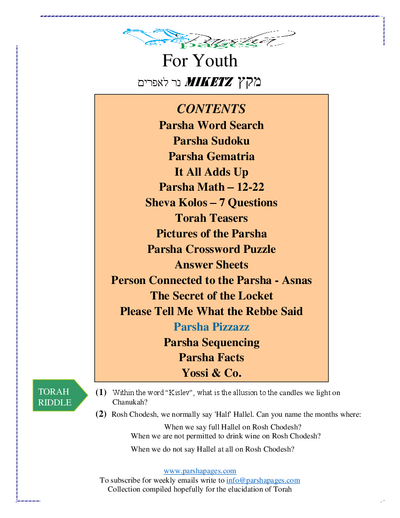
Person Connected to the Parsha Asnas
Parsha Pages Youth | December 10, 2023
Print This Article
View Original PDF

Person Connected to the Parsha Asnas

Parsha Pages Youth | December 31, 2025

וַיִּקְרָא פַרְ עֹה שֵׁם-יוֹסֵׁף צָפְנַת פַעְנֵׁחַ וַיִּתֶּן-לוֹ אֶּת-אָסְנַת בַת-פוֹטִּי פֶּרַע כֹהֵׁן אֹן לְאִּשָה וַיֵׁצֵׁא יוֹסֵׁף עַל-אֶּרֶּץ מִּצְרָיִּם
And Pharaoh called Yosef's name Tzanfas Paneach; and he gave him to wife Asnas the daughter of Potiphar priest of On. And Yosef went out over the land of Egypt (Bereshis 41, 45)

The Medrash says that Asnas was actually the daughter of Dinah and Shechem. When the sons of Yaacov sought to kill her after birth, Yaacov wrote the four-letter name of HaShem (or the words “daughter of Yaacov”) on a paper and placed in a locket on a necklace on the neck of Asnas. She was miraculously brought down to Egypt to the house of Potiphar, where she was brought up as his daughter. Later when Potiphar intended to kill Yosef after the incident with his wife, Asnas sworn to Potiphar on the merits of Yosef, and Potiphar only placed Yosef in prison. HaShem reward Asnas that her two sons became official tribes of Israel.

How did Yosef merit Asnas as a soul mate? Me'am Lo'eiz explains that although Yaakov was punished for hiding Dinah from Eisav's gaze, nevertheless, there was a positive aspect to this, as he was afraid that Eisav might forcibly take her and turn her into a bad person. Dinah’s child thus remained as part of his family. Similarly, when Eisav looked upon Yaakov's family, Yosef stretched himself in front of his mother Rochel as best as he could to shield her from Eisav's view. None of his brothers did this for their mothers. As a reward Yosef merited to marry Asnas.

Connection between Yosef’s new name and marrying Asnas: Beer Mayim Chaim questions how could Yosef think to take an Egyptian wife, when the family tradition was very negative about this concept. He thus explains that Yosef’s new name of Tzanfas Paneach (in the same verse which mentions marrying Asnas) indicates that he had the ability to clarify the hidden. He thus knew that Asnas was not an Egyptian but in fact was from the family of Yaacov and thus fitting to become his wife.

Why did Paroh become a match-maker? (This question is exacerbated with the knowledge that Yosef had just emerged from jail and there was no hope of receiving even one penny for shadchanus.) The Rokeiach gives three answers. (The non-shadchanus payment is not part of his question.)

  1. So that Potiphar should not take him back as a slave. He would never do such a thing to his son-in-law. He adds that Potiphar gave Yosef a writ of freedom, emancipating him from further slavery.
  2. This would remove any vestiges of negative rumors that Yosef was guilty of making advances to the wife of Potiphar. If it were true, the last thing Potiphar would want is to have Yosef as a son-in-law, giving him ample opportunity to spend time in his in-laws' home and again assault Potiphar's wife.
  3. So that people would accept Yosef's leadership. Since he was known as a slave until now, it would be unbefitting for them to have him as a ruler. By marrying the daughter of such a highly placed minister, people would realize that Yosef was of a high social stratum and was incorrectly sold as a slave.
  4. The Oznayim laTorah offers answers 1 and 2 above and also offers another answer; to create the aura of Yosef being a local citizen. The people would not readily accept Yosef as a person of authority if he was considered a foreigner. This would be alleviated if he were married to a local woman. This is indicated by the last words of this verse, "va'yeitzei al eretz Mitzrayim," after having married Asnas, a girl who grew up locally, Yosef was able to rule over the land of Egypt.

Story: Approximately 150 years ago, there lived in Vilna the great Torah scholar R' Shmuel Strashon, who wrote the well-known commentary "Chiddushei hoReshash" on the Talmud. Because of his meticulous honesty he was entrusted with administrating the Vilner Gemach (free loan society). A local merchant once borrowed a few hundred rubles from the gemach to be paid back at a prescribed time. He set aside small amounts to repay his debt, and finally amassed the total amount on the day it was due. The Reshash had set hours during which he conducted the gemach business. Our merchant had to leave on a business trip on the due date before the time that the Reshash attended to the gemach. Not wanting to repay the debt upon his return and be late with the payment, he decided that he would enter the Beis Hamedrash where the Reshash was studying. He indeed found the Reshash very deeply engrossed in his Talmudic studies. Trying to keep the disruption to a minimum, he just placed the money into the Reshash's hand and left. The Reshash was almost unaware of what happened and just stuffed the bills between the last page of his Gemara and the back cover. The payment did not register in the Reshash's mind.

When thirty days beyond the due date came, the gemach office sent out a reminder to the merchant that the payment was overdue. Knowing full well that he had paid, he came to the gemach office and stated his position to the Reshash, reminding him of the circumstances under which the payment had taken place. The Reshash, to whom the whole incident did not register, replied that he was sure that he received no payment. Upon the merchant's insisting otherwise, the Reshash responded that he was not in a position to overlook the matter, as the money was communal property. He warned the merchant that he faced a possible din Torah.

Indeed, a short while later there was a din Torah. The issue of an extra repayment of the debt paled in comparison to the bad reputation the merchant developed by standing up against the sterling reputation of the Reshash. People shied away from him and his business plummeted. Even worse was the ridicule that his son received in Yeshiva. It reached a point where he stopped attending, and became depressed.

One day the Reshash was learning from the Gemara in which he had placed the money. Upon finding the money placed behind the last pages of the Gemara, he immediately was struck by the realization of what had occurred, and ran to beg for forgiveness from the merchant. He offered to publicize his mistake in shul to the entire community. The merchant responded that it would be of no avail, as people would assume that he was guilty, but that the Reshash made up this story in order to restore the merchant's reputation. Lastly, he said, that nothing could help to reverse the biggest tragedy of all, his son's broken spirit. The Reshash was at a loss. After some contemplation, he said with a smile to the merchant, "I have the answer, Mazel Tov! Your son will become my son-in-law! It will then be abundantly clear to everyone that you are innocent."

How did the Reshash come up with this brilliant idea? Most likely, he learned from our verse. Yosef had a marred reputation because of the incident with Potifar's wife. Since Paroh wanted Yosef to become viceroy of Egypt, Paroh had to clear Yosef of any wrongdoing. The only way this could be accomplished was by Yosef marrying Potifar's daughter. The public would think that if Yosef had been guilty, Potifar would never have him as a son-in-law. Likewise, by taking the merchant's son as his son-in-law, the Reshash undid all the damage that was inadvertently done.

Asnas’ wedding documents: Rashi (Bereshis 48,9) mentions that Yosef showed Yaacov his documents of irusim (engagement) and his kesuvah to establish that his two sons were fitting to be blessed. Why did Yaacov question about the two grandsons and what did Yosef respond by showing the documents? The Lubavitcher Rebbe posits that kiddushin was a novel concept that did not exist prior to the Giving of the Torah. Therefore, the Avos could not practice this mitzvah since it did not exist yet. Nevertheless, Yosef who was forced to live in a depraved Egyptian culture sanctified himself in a similar fashion by making a “note” of the marriage to Asnas. Then, when Yaacov questioned at the time of the blessing how could the two grandchildren (Menasheh and Efraim) could be worthy of the blessings, Yosef was able to demonstrate the additional degrees of purity that he established for himself and his family.

Chassidus explains that only with the Giving of the Torah did the ability to bring down holiness into the physicality of the world. The Giving of the Torah established the possibility for the holiness and connection in the relationship of a man and a woman (as evidenced by the title of Kiddushin). Thus, Yosef due to his exalted spiritual level was able to imitate this concept of bringing holiness into the physical world by putting “pen onto paper” (engaging in a physical action symbolizing the spiritual matter).

וַיִּקְרָא פַרְ עֹה שֵׁם-יוֹסֵׁף צָפְנַת פַעְנֵׁחַ וַיִּתֶּן-לוֹ אֶּת-אָסְנַת בַת-פוֹטִּי פֶּרַע כֹהֵׁן אֹן לְאִּשָה וַיֵׁצֵׁא יוֹסֵׁף עַל-אֶּרֶּץ מִּצְרָיִּם
And Pharaoh called Yosef's name Tzanfas Paneach; and he gave him to wife Asnas the daughter of Potiphar priest of On. And Yosef went out over the land of Egypt (Bereshis 41, 45)

The Medrash says that Asnas was actually the daughter of Dinah and Shechem. When the sons of Yaacov sought to kill her after birth, Yaacov wrote the four-letter name of HaShem (or the words “daughter of Yaacov”) on a paper and placed in a locket on a necklace on the neck of Asnas. She was miraculously brought down to Egypt to the house of Potiphar, where she was brought up as his daughter. Later when Potiphar intended to kill Yosef after the incident with his wife, Asnas sworn to Potiphar on the merits of Yosef, and Potiphar only placed Yosef in prison. HaShem reward Asnas that her two sons became official tribes of Israel.

How did Yosef merit Asnas as a soul mate? Me'am Lo'eiz explains that although Yaakov was punished for hiding Dinah from Eisav's gaze, nevertheless, there was a positive aspect to this, as he was afraid that Eisav might forcibly take her and turn her into a bad person. Dinah’s child thus remained as part of his family. Similarly, when Eisav looked upon Yaakov's family, Yosef stretched himself in front of his mother Rochel as best as he could to shield her from Eisav's view. None of his brothers did this for their mothers. As a reward Yosef merited to marry Asnas.

Connection between Yosef’s new name and marrying Asnas: Beer Mayim Chaim questions how could Yosef think to take an Egyptian wife, when the family tradition was very negative about this concept. He thus explains that Yosef’s new name of Tzanfas Paneach (in the same verse which mentions marrying Asnas) indicates that he had the ability to clarify the hidden. He thus knew that Asnas was not an Egyptian but in fact was from the family of Yaacov and thus fitting to become his wife.

Why did Paroh become a match-maker? (This question is exacerbated with the knowledge that Yosef had just emerged from jail and there was no hope of receiving even one penny for shadchanus.) The Rokeiach gives three answers. (The non-shadchanus payment is not part of his question.)

  1. So that Potiphar should not take him back as a slave. He would never do such a thing to his son-in-law. He adds that Potiphar gave Yosef a writ of freedom, emancipating him from further slavery.
  2. This would remove any vestiges of negative rumors that Yosef was guilty of making advances to the wife of Potiphar. If it were true, the last thing Potiphar would want is to have Yosef as a son-in-law, giving him ample opportunity to spend time in his in-laws' home and again assault Potiphar's wife.
  3. So that people would accept Yosef's leadership. Since he was known as a slave until now, it would be unbefitting for them to have him as a ruler. By marrying the daughter of such a highly placed minister, people would realize that Yosef was of a high social stratum and was incorrectly sold as a slave.
  4. The Oznayim laTorah offers answers 1 and 2 above and also offers another answer; to create the aura of Yosef being a local citizen. The people would not readily accept Yosef as a person of authority if he was considered a foreigner. This would be alleviated if he were married to a local woman. This is indicated by the last words of this verse, "va'yeitzei al eretz Mitzrayim," after having married Asnas, a girl who grew up locally, Yosef was able to rule over the land of Egypt.

Story: Approximately 150 years ago, there lived in Vilna the great Torah scholar R' Shmuel Strashon, who wrote the well-known commentary "Chiddushei hoReshash" on the Talmud. Because of his meticulous honesty he was entrusted with administrating the Vilner Gemach (free loan society). A local merchant once borrowed a few hundred rubles from the gemach to be paid back at a prescribed time. He set aside small amounts to repay his debt, and finally amassed the total amount on the day it was due. The Reshash had set hours during which he conducted the gemach business. Our merchant had to leave on a business trip on the due date before the time that the Reshash attended to the gemach. Not wanting to repay the debt upon his return and be late with the payment, he decided that he would enter the Beis Hamedrash where the Reshash was studying. He indeed found the Reshash very deeply engrossed in his Talmudic studies. Trying to keep the disruption to a minimum, he just placed the money into the Reshash's hand and left. The Reshash was almost unaware of what happened and just stuffed the bills between the last page of his Gemara and the back cover. The payment did not register in the Reshash's mind.

When thirty days beyond the due date came, the gemach office sent out a reminder to the merchant that the payment was overdue. Knowing full well that he had paid, he came to the gemach office and stated his position to the Reshash, reminding him of the circumstances under which the payment had taken place. The Reshash, to whom the whole incident did not register, replied that he was sure that he received no payment. Upon the merchant's insisting otherwise, the Reshash responded that he was not in a position to overlook the matter, as the money was communal property. He warned the merchant that he faced a possible din Torah.

Indeed, a short while later there was a din Torah. The issue of an extra repayment of the debt paled in comparison to the bad reputation the merchant developed by standing up against the sterling reputation of the Reshash. People shied away from him and his business plummeted. Even worse was the ridicule that his son received in Yeshiva. It reached a point where he stopped attending, and became depressed.

One day the Reshash was learning from the Gemara in which he had placed the money. Upon finding the money placed behind the last pages of the Gemara, he immediately was struck by the realization of what had occurred, and ran to beg for forgiveness from the merchant. He offered to publicize his mistake in shul to the entire community. The merchant responded that it would be of no avail, as people would assume that he was guilty, but that the Reshash made up this story in order to restore the merchant's reputation. Lastly, he said, that nothing could help to reverse the biggest tragedy of all, his son's broken spirit. The Reshash was at a loss. After some contemplation, he said with a smile to the merchant, "I have the answer, Mazel Tov! Your son will become my son-in-law! It will then be abundantly clear to everyone that you are innocent."

How did the Reshash come up with this brilliant idea? Most likely, he learned from our verse. Yosef had a marred reputation because of the incident with Potifar's wife. Since Paroh wanted Yosef to become viceroy of Egypt, Paroh had to clear Yosef of any wrongdoing. The only way this could be accomplished was by Yosef marrying Potifar's daughter. The public would think that if Yosef had been guilty, Potifar would never have him as a son-in-law. Likewise, by taking the merchant's son as his son-in-law, the Reshash undid all the damage that was inadvertently done.

Asnas’ wedding documents: Rashi (Bereshis 48,9) mentions that Yosef showed Yaacov his documents of irusim (engagement) and his kesuvah to establish that his two sons were fitting to be blessed. Why did Yaacov question about the two grandsons and what did Yosef respond by showing the documents? The Lubavitcher Rebbe posits that kiddushin was a novel concept that did not exist prior to the Giving of the Torah. Therefore, the Avos could not practice this mitzvah since it did not exist yet. Nevertheless, Yosef who was forced to live in a depraved Egyptian culture sanctified himself in a similar fashion by making a “note” of the marriage to Asnas. Then, when Yaacov questioned at the time of the blessing how could the two grandchildren (Menasheh and Efraim) could be worthy of the blessings, Yosef was able to demonstrate the additional degrees of purity that he established for himself and his family.

Chassidus explains that only with the Giving of the Torah did the ability to bring down holiness into the physicality of the world. The Giving of the Torah established the possibility for the holiness and connection in the relationship of a man and a woman (as evidenced by the title of Kiddushin). Thus, Yosef due to his exalted spiritual level was able to imitate this concept of bringing holiness into the physical world by putting “pen onto paper” (engaging in a physical action symbolizing the spiritual matter).

PDF Preview