Biographical Notes on Torah Commentators and Chassidic Leaders
Parsha B'Iyun | December 19, 2025
Print This Article
View Original PDF

Biographical Notes on Torah Commentators and Chassidic Leaders

Parsha B'Iyun | December 31, 2025

Meshech Chochma - Rav Meir Simcha HaKohen of Dvinsk (1843-1926), Lithuania; Prominent leader of Orthodox Judaism in Eastern Europe in the early 20th century. Known for his writings on Rambam’s Mishneh Torah, which he titled Ohr Somayach, as well as his novellae on the Torah, titled Meshech Chochma. He reputedly turned down offers for the rabbinate in various large cities, including Jerusalem, New York City and Kovno, and died in a hotel in Riga, Latvia, while seeking medical treatment.

Rashi - R’ Shlomo Yitzchaki (1040-1105), Troyes, France. "Rabban Shel Yisrael" - The great Rishon who wrote commentary on all areas of Torah.

Ibn Ezra - R’ Avraham ben Meir ibn Ezra (1089-1164), Spain; Wrote on grammar, philosophy, astronomy, medicine, and mathematics, but most famous for his Torah commentary. His commentaries focus on grammatical explanations and the "peshat" (plain-sense) meaning of the text.

Satmar Rebbe - Rav Yoel Teitelbaum (1887-1979), Austria-Hungary, New York; Founder of the Satmar Chassidic dynasty, espousing a strictly conservative and isolationist line while rejecting modernity.

Megaleh Amukot - R’ Natan Nota Spira, (1585–1633), Poland. Chief Rabbi of Krakow. Descendant of a rabbinical family which traced its lineage as far back to Rashi. Megaleh Amukot is a commentary containing 252 explanations of Moshe’s prayer referenced in the first pasuk of Vaetchanan.

Mahar"a of Belz - Rabbi Aharon Rokeach, also known as the Belzer Rav (1880-1957); Son of Rabbi Yissachar Dov Rokeach, and the fourth Rebbe of the Belz Chassidus. Re-established Belz Chassidus in Eretz Yisrael after the Holocaust. During his time, the chassidim grew to thousands and tens of thousands, and his influence reached far and wide. Served as Rebbe in Belz, Galicia for thirteen years, until World War II. After losing his entire family in the Holocaust, he was forced to flee, on the night of Simchas Torah 1940, he fled, and for four years wandered on his way to Eretz Yisrael, passing through Skohl, Premishlan, Vizhnitz, Buchnia Ghetto, Budapest, Romania, Bulgaria, Greece, Turkey, Syria, and Lebanon, until 9 Shevat 1944, when he arrived in Israel. Rebuilt Belz Chassidus while simultaneously working to strengthen Yiddishkeit in the land.

Rav Naftali Zvi Horowitz of Ropshitz - (1760–1827), Galicia; The first Ropshitzer rebbe. Became attracted to the Hasidic movement and traveled to the court of R' Elimelech of Lizhensk. Because of R' Horowitz's illustrious lineage, R' Elimelech at first refused to admit him, as was his custom, but finally acquiesced. Upon the death of R' Elimelech, became a student of his disciple, Reb Menachem Mendel of Rimanov. Reputed to have had tens of thousands of followers and is a crucial figure in the development of Galician Hassidism. There are many minhagei Ropshitz which are followed by Galician Hasidim. Was known for his profound wisdom, sharp sense of humor, and musical gifts.

Asicha B'chukecha - R' Avraham Zvi Kluger (born 1968), Beit Shemesh; Prominent Breslov Chassidic teacher and spiritual mentor, and the head of the Nezer Yisrael community in Beit Shemesh. A Sanz chassid, in ~1995 began studying Breslov Chassidut under Rabbi Nissan Dovid Kivak, eventually broadening his learning to include Chabad teachings, general Chassidic works, and Kabbalah. By the early 2000s, began delivering shiurim and public talks, leading to the establishment of his Beit Midrash and Kollel Nezer Yisrael in Beit Shemesh, a community that today numbers several hundred followers worldwide.

Ba’al HaTurim - Rabbi Jacob ben Asher (1269-1343), Spain; Composer of Arba’ah Turim, tracing Halacha from the Torah through Talmud and early Poskim. Many commentaries were written on the Tur, including R’ Yosef Karo’s “Beit Yosef” which formed the basis of the Shulchan Arukh.

Chatam Sofer - R’ Moshe Sofer of Pressburg (1785–1835), Germany, Austria, Czechoslovakia, Ukraine. Studied under R’ Nathan Adler and R’ Pinchas Horowitz (Hafla’ah). In 1807 was appointed as Rabbi of Pressburg (Bratislava), where he also founded a large Yeshiva that produced many noted rabbis. Had 10 children with his second wife, who was the daughter of R’ Akiva Eiger. The eldest, Avraham Shmuel Binyamin (Ketav Sofer), inherited his father’s position as rabbi of Pressburg. His second son, Shimon (Michtav Sofer), was the rabbi of Krakow.

Shiltei Giborim - R' Yehoshua Boaz ben Shimon Baruch (died 1557), also known as the Shiltei Giborim after a work he authored (a selection of critical notes on Alfasi's compendium of the Talmud, and on the Mordechai), was a prominent Talmudist who lived in Sabbioneta and Savigliano (Italy). He was a descendant of an old Judeo-Spanish family, and settled in Italy after the banishment of the Jews from Spain.

Imrei Noam - Rabbi Meir Horowitz of Dzikov (1819-1877), Poland; Rabbi of Tarnobrzeg (Dzhikov) concurrently with his father's being rebbe there. He succeeded his father as rebbe also. He died in Karlsbad.

Tiferet Yisrael - Rav Yisrael Lifschitz (1782-186), Germany; Prominent Ashkenazi rabbi and commentator, who served in Dessau and later Danzig. Best known for his classic Mishnah commentary, Tiferes Yisrael - also called Mishnayos Yachin u’Boaz, widely studied to this day. A deeply ascetic scholar, he was known for fasting and constant Torah study. His ethical will, printed in Königsberg (1860-61), offers moral and spiritual guidance. Also authored Derush Ohr HaChayim, exploring the eternity of the soul and the creation of the universe, and left extensive manuscripts on Halachah and the Rambam.

Targum Yonatan ben Uziel - Aramaic translation to Nevii’im; One of 80 tannaim who studied under Hillel HaZaken during era of Roman rule.

Arizal - Ari HaKadosh, Rabbi Isaac Luria (1534-1572), Yerushalayim, Egypt, Tzefat; Considered the forefather of modern Kabbalah.

Tzror Hamor - R’ Avraham Sabah (1440-1508), Spain, Portugal, and Morocco; Spanish scholar who spent much of his life fleeing persecution. With the expulsion of Jews from Spain in 1492, fled to Portugal, only to be expelled again in 1497. His two sons were taken from him and forcibly baptized as Christians. He was arrested in Lisbon and tortured, but eventually escaped to Fez in Morocco, having to flee without being able to recover his writings. He later rewrote from memory the works he had to abandon.

Akeidat Yitzchak - R' Yitzchak ben Moshe Arama (c. 1420–1494), Spain; A collection of philosophical sermons on the Torah. The book is composed of 105 “gates” each containing a sermon. Each sermon discusses a philosophical idea that comes from the chosen texts and a commentary that tries to solve the problems in the text. The work was first published in 1522 in Salonica.

Ben Ish Chai - R’ Yosef Hayyim (1834-1909), Baghdad; Chacham of the Baghdad Jewish community for over 50 years. Prominent authority on halacha and a master kabbalist. His work is based on his classes on the weekly parsha, containing both kabbalistic insights as well as practical laws for everyday life. He also composed "Ben Yehoyada", a commentary on the Aggadic portions of the Talmud, and responsa entitled "Rav Pe’alim".

Hogei Sha’ashuot - R’ Yosef Moshe Adler shlit"a, Lakewood, NJ. Learned in Lakewood Yeshiva and Mir Yeshiva in Yerushalayim.

Sefat Emet - R’ Yehudah Aryeh Leib Alter of Gur (1847-1905), Poland; Gerer Rebbe, father of the Imrei Emet. Author of a monumental Torah commentary considered one of the pillars of chasidic thought. The title of the book is based on his last discourse, which ended with a verse from Mishlei: "Sefat Emet Tikon La’ad" — The lips of truth shall be established forever.

Shiltei Giborim - R' Yehoshua Boaz ben Shimon Baruch (died 1557), also known as the Shiltei Giborim after a work he authored (a selection of critical notes on Alfasi's compendium of the Talmud, and on the Mordechai), was a prominent Talmudist who lived in Sabbioneta and Savigliano (Italy). He was a descendant of an old Judeo-Spanish family, and settled in Italy after the banishment of the Jews from Spain.

Seforno - R’ Ovadiah ben Ya’akov Seforno (1470-1550), Italy; In his Tanach commentary, often cites rabbinic statements to address philosophical as well as textual issues, and offers many novel interpretations rooted in these traditions. Admired for his wide knowledge by Henry II, King of France, to whom he sent a Latin translation he prepared of his philosophical work, Or Amim.

Levush - R’ Mordechai ben Avraham Yoffe (1530–1612) Prague, Venice, Grodno, Lublin; ’The Levush’ studied under R’ Moses Isserles (Rama) and Solomon Luria (Maharshal). Best known as author of Levush Malkhus, a ten-volume codification of Jewish law that stressed customs of the Jews of Eastern Europe.

Bach - R' Yoel Sirkes (1561-1640) was a Polish rabbi, halachic scholar and Talmudic annotator. His best-known work, Bait Chadash, is one of the basic commentaries on R. Yaakov ben Asher's halachic code, the Arba'ah Turim. The Taz was his son-in-law.

Kuntras Sarati - Rav Shmuel Yitzchak Weinbaum HaLevi; Montreal, Canada.

Maor Einayim - R' Menachem Nachum Twersky of Chernobyl (1730–1797), Ukraine; Also known as the "Meor Einayim," was a student of the Baal Shem Tov and the Maggid of Mezritch. One of the earliest disseminators of Chassidism in the Ukraine. He became the maggid of Chernobyl and the founder of the Chernobyl dynasty, which includes many famous scions of the Twersky family.

Ye’arot Devash - Rav Yonatan Eybeschutz (1690-1764), Hamburg, Prague, Vienna, Lithuania; Decendent from the family of R’ Natan Neta Shapirah, The Megale Amukot. An exceptional Talmudist, Halachist and Kabbalist, he held positions as Dayan of Prague, and later rose to the position of Rabbi of the "Three Communities," Altona, Hamburg and Wandsbek. Fought allegations that he was a secret follower of the Shabbateanism, an outlawed movement centered around the false messiah Shabtai Zvi. This controversy spread to all major Jewish communities, and he was attacked by opponents until his death. A contemporary rabbinic tribunal exonerated him.

Ohr HaChaim Hakadosh - Rabbi Chaim ibn Attar (1696-1743), Salé, Morocco. Considered to be one of the most prominent Rabbis of Morocco, and in Hassidic Judaism.

Shemen Rosh - Rav Asher Anshel Katz shlit”a, Boro Park, NY; Assumed the position of Viener Rebbe in 1992 after the previous rebbe, Rav Ezriel Yehuda Lebovics, was niftar. Since then, the Rebbe has transformed the kehilla into a large chassidus with multiple Viener shuls in Boro Park, and has pubilshed numerous volumes of shiurim delivered on Torah, Pirkei Avot, and Yom Tovim.

Agra D’Kala - R’ Tzvi Elimelech Spira of Dinov (1783-1841), Poland; Author of Bnei Yissaschar, nephew of Rav Elimelech of Lizhensk. Founder of the Dinov Chassidic dynasty. He was a disciple of the Chozeh of Lublin, the Maggid of Kozhnitz, and Rabbi Mendel of Rimanov. He occupied rabbinical posts in Dinov, Struzov, Ribitsch, Lantzut, and Munkacsz.

Zohar - Central work of mystical tradition of Kabbalah. Traditionally attributed to Rabbi Shimon bar Yochai. First appeared in 13th-century Spain.
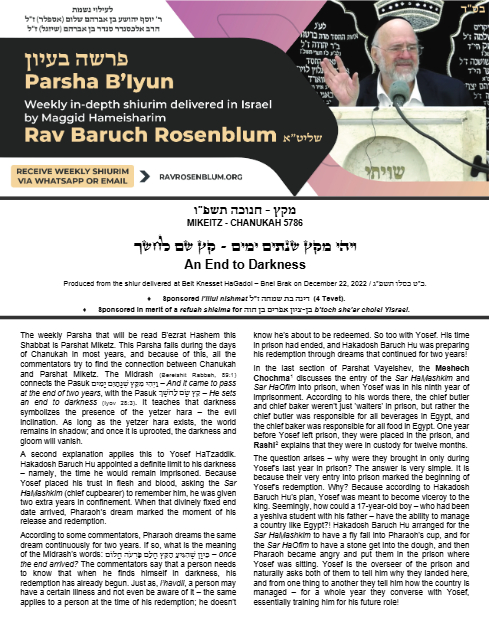
Meshech Chochma - Rav Meir Simcha HaKohen of Dvinsk (1843-1926), Lithuania; Prominent leader of Orthodox Judaism in Eastern Europe in the early 20th century. Known for his writings on Rambam’s Mishneh Torah, which he titled Ohr Somayach, as well as his novellae on the Torah, titled Meshech Chochma. He reputedly turned down offers for the rabbinate in various large cities, including Jerusalem, New York City and Kovno, and died in a hotel in Riga, Latvia, while seeking medical treatment.

Rashi - R’ Shlomo Yitzchaki (1040-1105), Troyes, France. "Rabban Shel Yisrael" - The great Rishon who wrote commentary on all areas of Torah.

Ibn Ezra - R’ Avraham ben Meir ibn Ezra (1089-1164), Spain; Wrote on grammar, philosophy, astronomy, medicine, and mathematics, but most famous for his Torah commentary. His commentaries focus on grammatical explanations and the "peshat" (plain-sense) meaning of the text.

Satmar Rebbe - Rav Yoel Teitelbaum (1887-1979), Austria-Hungary, New York; Founder of the Satmar Chassidic dynasty, espousing a strictly conservative and isolationist line while rejecting modernity.

Megaleh Amukot - R’ Natan Nota Spira, (1585–1633), Poland. Chief Rabbi of Krakow. Descendant of a rabbinical family which traced its lineage as far back to Rashi. Megaleh Amukot is a commentary containing 252 explanations of Moshe’s prayer referenced in the first pasuk of Vaetchanan.

Mahar"a of Belz - Rabbi Aharon Rokeach, also known as the Belzer Rav (1880-1957); Son of Rabbi Yissachar Dov Rokeach, and the fourth Rebbe of the Belz Chassidus. Re-established Belz Chassidus in Eretz Yisrael after the Holocaust. During his time, the chassidim grew to thousands and tens of thousands, and his influence reached far and wide. Served as Rebbe in Belz, Galicia for thirteen years, until World War II. After losing his entire family in the Holocaust, he was forced to flee, on the night of Simchas Torah 1940, he fled, and for four years wandered on his way to Eretz Yisrael, passing through Skohl, Premishlan, Vizhnitz, Buchnia Ghetto, Budapest, Romania, Bulgaria, Greece, Turkey, Syria, and Lebanon, until 9 Shevat 1944, when he arrived in Israel. Rebuilt Belz Chassidus while simultaneously working to strengthen Yiddishkeit in the land.

Rav Naftali Zvi Horowitz of Ropshitz - (1760–1827), Galicia; The first Ropshitzer rebbe. Became attracted to the Hasidic movement and traveled to the court of R' Elimelech of Lizhensk. Because of R' Horowitz's illustrious lineage, R' Elimelech at first refused to admit him, as was his custom, but finally acquiesced. Upon the death of R' Elimelech, became a student of his disciple, Reb Menachem Mendel of Rimanov. Reputed to have had tens of thousands of followers and is a crucial figure in the development of Galician Hassidism. There are many minhagei Ropshitz which are followed by Galician Hasidim. Was known for his profound wisdom, sharp sense of humor, and musical gifts.

Asicha B'chukecha - R' Avraham Zvi Kluger (born 1968), Beit Shemesh; Prominent Breslov Chassidic teacher and spiritual mentor, and the head of the Nezer Yisrael community in Beit Shemesh. A Sanz chassid, in ~1995 began studying Breslov Chassidut under Rabbi Nissan Dovid Kivak, eventually broadening his learning to include Chabad teachings, general Chassidic works, and Kabbalah. By the early 2000s, began delivering shiurim and public talks, leading to the establishment of his Beit Midrash and Kollel Nezer Yisrael in Beit Shemesh, a community that today numbers several hundred followers worldwide.

Ba’al HaTurim - Rabbi Jacob ben Asher (1269-1343), Spain; Composer of Arba’ah Turim, tracing Halacha from the Torah through Talmud and early Poskim. Many commentaries were written on the Tur, including R’ Yosef Karo’s “Beit Yosef” which formed the basis of the Shulchan Arukh.

Chatam Sofer - R’ Moshe Sofer of Pressburg (1785–1835), Germany, Austria, Czechoslovakia, Ukraine. Studied under R’ Nathan Adler and R’ Pinchas Horowitz (Hafla’ah). In 1807 was appointed as Rabbi of Pressburg (Bratislava), where he also founded a large Yeshiva that produced many noted rabbis. Had 10 children with his second wife, who was the daughter of R’ Akiva Eiger. The eldest, Avraham Shmuel Binyamin (Ketav Sofer), inherited his father’s position as rabbi of Pressburg. His second son, Shimon (Michtav Sofer), was the rabbi of Krakow.

Shiltei Giborim - R' Yehoshua Boaz ben Shimon Baruch (died 1557), also known as the Shiltei Giborim after a work he authored (a selection of critical notes on Alfasi's compendium of the Talmud, and on the Mordechai), was a prominent Talmudist who lived in Sabbioneta and Savigliano (Italy). He was a descendant of an old Judeo-Spanish family, and settled in Italy after the banishment of the Jews from Spain.

Imrei Noam - Rabbi Meir Horowitz of Dzikov (1819-1877), Poland; Rabbi of Tarnobrzeg (Dzhikov) concurrently with his father's being rebbe there. He succeeded his father as rebbe also. He died in Karlsbad.

Tiferet Yisrael - Rav Yisrael Lifschitz (1782-186), Germany; Prominent Ashkenazi rabbi and commentator, who served in Dessau and later Danzig. Best known for his classic Mishnah commentary, Tiferes Yisrael - also called Mishnayos Yachin u’Boaz, widely studied to this day. A deeply ascetic scholar, he was known for fasting and constant Torah study. His ethical will, printed in Königsberg (1860-61), offers moral and spiritual guidance. Also authored Derush Ohr HaChayim, exploring the eternity of the soul and the creation of the universe, and left extensive manuscripts on Halachah and the Rambam.

Targum Yonatan ben Uziel - Aramaic translation to Nevii’im; One of 80 tannaim who studied under Hillel HaZaken during era of Roman rule.

Arizal - Ari HaKadosh, Rabbi Isaac Luria (1534-1572), Yerushalayim, Egypt, Tzefat; Considered the forefather of modern Kabbalah.

Tzror Hamor - R’ Avraham Sabah (1440-1508), Spain, Portugal, and Morocco; Spanish scholar who spent much of his life fleeing persecution. With the expulsion of Jews from Spain in 1492, fled to Portugal, only to be expelled again in 1497. His two sons were taken from him and forcibly baptized as Christians. He was arrested in Lisbon and tortured, but eventually escaped to Fez in Morocco, having to flee without being able to recover his writings. He later rewrote from memory the works he had to abandon.

Akeidat Yitzchak - R' Yitzchak ben Moshe Arama (c. 1420–1494), Spain; A collection of philosophical sermons on the Torah. The book is composed of 105 “gates” each containing a sermon. Each sermon discusses a philosophical idea that comes from the chosen texts and a commentary that tries to solve the problems in the text. The work was first published in 1522 in Salonica.

Ben Ish Chai - R’ Yosef Hayyim (1834-1909), Baghdad; Chacham of the Baghdad Jewish community for over 50 years. Prominent authority on halacha and a master kabbalist. His work is based on his classes on the weekly parsha, containing both kabbalistic insights as well as practical laws for everyday life. He also composed "Ben Yehoyada", a commentary on the Aggadic portions of the Talmud, and responsa entitled "Rav Pe’alim".

Hogei Sha’ashuot - R’ Yosef Moshe Adler shlit"a, Lakewood, NJ. Learned in Lakewood Yeshiva and Mir Yeshiva in Yerushalayim.

Sefat Emet - R’ Yehudah Aryeh Leib Alter of Gur (1847-1905), Poland; Gerer Rebbe, father of the Imrei Emet. Author of a monumental Torah commentary considered one of the pillars of chasidic thought. The title of the book is based on his last discourse, which ended with a verse from Mishlei: "Sefat Emet Tikon La’ad" — The lips of truth shall be established forever.

Shiltei Giborim - R' Yehoshua Boaz ben Shimon Baruch (died 1557), also known as the Shiltei Giborim after a work he authored (a selection of critical notes on Alfasi's compendium of the Talmud, and on the Mordechai), was a prominent Talmudist who lived in Sabbioneta and Savigliano (Italy). He was a descendant of an old Judeo-Spanish family, and settled in Italy after the banishment of the Jews from Spain.

Seforno - R’ Ovadiah ben Ya’akov Seforno (1470-1550), Italy; In his Tanach commentary, often cites rabbinic statements to address philosophical as well as textual issues, and offers many novel interpretations rooted in these traditions. Admired for his wide knowledge by Henry II, King of France, to whom he sent a Latin translation he prepared of his philosophical work, Or Amim.

Levush - R’ Mordechai ben Avraham Yoffe (1530–1612) Prague, Venice, Grodno, Lublin; ’The Levush’ studied under R’ Moses Isserles (Rama) and Solomon Luria (Maharshal). Best known as author of Levush Malkhus, a ten-volume codification of Jewish law that stressed customs of the Jews of Eastern Europe.

Bach - R' Yoel Sirkes (1561-1640) was a Polish rabbi, halachic scholar and Talmudic annotator. His best-known work, Bait Chadash, is one of the basic commentaries on R. Yaakov ben Asher's halachic code, the Arba'ah Turim. The Taz was his son-in-law.

Kuntras Sarati - Rav Shmuel Yitzchak Weinbaum HaLevi; Montreal, Canada.

Maor Einayim - R' Menachem Nachum Twersky of Chernobyl (1730–1797), Ukraine; Also known as the "Meor Einayim," was a student of the Baal Shem Tov and the Maggid of Mezritch. One of the earliest disseminators of Chassidism in the Ukraine. He became the maggid of Chernobyl and the founder of the Chernobyl dynasty, which includes many famous scions of the Twersky family.

Ye’arot Devash - Rav Yonatan Eybeschutz (1690-1764), Hamburg, Prague, Vienna, Lithuania; Decendent from the family of R’ Natan Neta Shapirah, The Megale Amukot. An exceptional Talmudist, Halachist and Kabbalist, he held positions as Dayan of Prague, and later rose to the position of Rabbi of the "Three Communities," Altona, Hamburg and Wandsbek. Fought allegations that he was a secret follower of the Shabbateanism, an outlawed movement centered around the false messiah Shabtai Zvi. This controversy spread to all major Jewish communities, and he was attacked by opponents until his death. A contemporary rabbinic tribunal exonerated him.

Ohr HaChaim Hakadosh - Rabbi Chaim ibn Attar (1696-1743), Salé, Morocco. Considered to be one of the most prominent Rabbis of Morocco, and in Hassidic Judaism.

Shemen Rosh - Rav Asher Anshel Katz shlit”a, Boro Park, NY; Assumed the position of Viener Rebbe in 1992 after the previous rebbe, Rav Ezriel Yehuda Lebovics, was niftar. Since then, the Rebbe has transformed the kehilla into a large chassidus with multiple Viener shuls in Boro Park, and has pubilshed numerous volumes of shiurim delivered on Torah, Pirkei Avot, and Yom Tovim.

Agra D’Kala - R’ Tzvi Elimelech Spira of Dinov (1783-1841), Poland; Author of Bnei Yissaschar, nephew of Rav Elimelech of Lizhensk. Founder of the Dinov Chassidic dynasty. He was a disciple of the Chozeh of Lublin, the Maggid of Kozhnitz, and Rabbi Mendel of Rimanov. He occupied rabbinical posts in Dinov, Struzov, Ribitsch, Lantzut, and Munkacsz.

Zohar - Central work of mystical tradition of Kabbalah. Traditionally attributed to Rabbi Shimon bar Yochai. First appeared in 13th-century Spain.

PDF Preview