The Lesson of the Cows in Pharaoh's Dream
“And behold, seven other cows came up after them, ugly and gaunt, and they stood near the cows on the bank of the river.” (Beraishis 41:3)
Pharaoh’s dreams were very specific, intended to convey a message, as Yosef explained. Being that this was so, each detail in them is important. In this case, the Torah tells us the seven thin cows that came from the Nile stood next to the seven fat cows.
The commentaries discuss this and offer numerous approaches, some even contradictory. The fact that they were standing together indicates that there would not be a break between the years of plenty and those of famine. Rather, it would be an overnight change, not a gradual one. This is indicated by them standing on the shore together.
Others say this is an indication that the years of plenty and famine would co-exist, as we find that there was a famine in all the lands but in Egypt there was food, while others say the famine was only in Egypt, but other lands further away did not suffer from a famine.
It is also possible to explain that the years of famine would not immediately consume all the remnants of the years of plenty, as indeed, we find that the grain Yosef prepared enabled them to survive for some time before the famine truly took hold.
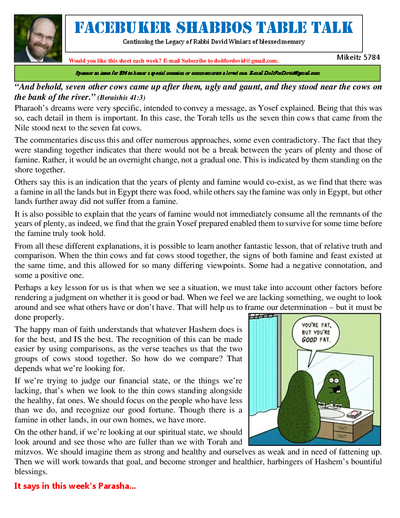
From all these different explanations, it is possible to learn another fantastic lesson, that of relative truth and comparison. When the thin cows and fat cows stood together, the signs of both famine and feast existed at the same time, and this allowed for so many differing viewpoints. Some had a negative connotation, and some a positive one.
Perhaps a key lesson for us is that when we see a situation, we must take into account other factors before rendering a judgment on whether it is good or bad. When we feel we are lacking something, we ought to look around and see what others have or don’t have. That will help us to frame our determination – but it must be done properly.
The happy man of faith understands that whatever Hashem does is for the best, and IS the best. The recognition of this can be made easier by using comparisons, as the verse teaches us that the two groups of cows stood together. So how do we compare? That depends what we’re looking for.
If we’re trying to judge our financial state, or the things we’re lacking, that’s when we look to the thin cows standing alongside the healthy, fat ones. We should focus on the people who have less than we do, and recognize our good fortune. Though there is a famine in other lands, in our own homes, we have more.
On the other hand, if we’re looking at our spiritual state, we should look around and see those who are fuller than we with Torah and mitzvos. We should imagine them as strong and healthy and ourselves as weak and in need of fattening up. Then we will work towards that goal, and become stronger and healthier, harbingers of Hashem’s bountiful blessings.