Yosef Cast His Lot Only on Hashem
Vechol Maaminim | December 24, 2024
Print This Article
View Original PDF

Yosef Cast His Lot Only on Hashem

Vechol Maaminim | June 27, 2025

על אנחנו אשמים אבל אחיו אל איש ויאמרו” ולא אלינו בתחננו נפשו צרת ראינו אשר אחינו (בכא מ) “הזאת הצרה אלינו באה כן על שמענו

If indeed Yosef pleaded for his life when they sold him, why did the Torah not mention this in the description of the sale? And moreover, why did the brothers console only for not listening to Yosef’s pleas, and not about the actual sale?

Rav Menachem Mendel of Vorka explained this passuk beautifully, and based on his explanation these questions are reconciled:

When the brothers saw the suffering and pain that came upon them from the ruler of Egypt, they introspected into their deeds and realized that they were being brought to task for the sale of Yosef. Through this, they reached the conclusion that Yosef’s behavior towards was not, as they had through, the result of bad intentions, and that on the contrary, he was a tzaddik. And they said, “but we are to blame for our brother” that we sold him because we thought he was trying to cause us trouble, and now we understand that we erred and that he is a great man, because although we stood next to him during his sale “and we saw the pain of his heart” and still “when he pleaded with us we didn’t hear,” we didn’t hear from his mouth any requests or pleas that were directed at us. So it emerges that Yosef’s bitachon in Hashem was so strong that even though he had the possibility during his time of trouble to ask for help from a human being, he did not do so, and instead, turned and prayed solely to his Creator.

Sheloshah Seforim Niftachim [Rav Y. Mandelkorn, copied form the manuscript of Harav Y. Levinstein, the Rav of Srutzk] p. 20
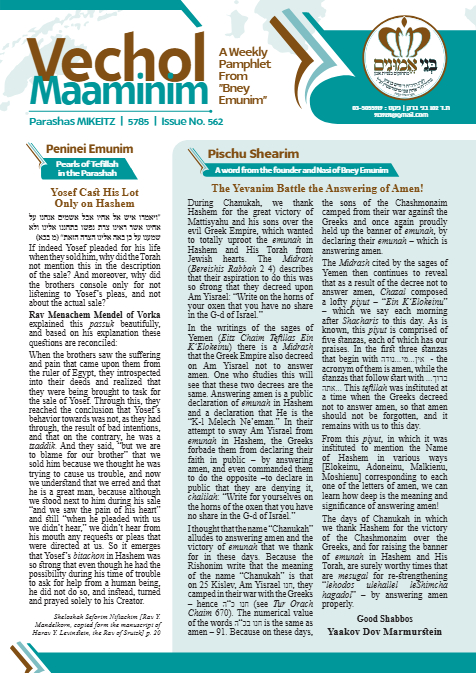

על אנחנו אשמים אבל אחיו אל איש ויאמרו” ולא אלינו בתחננו נפשו צרת ראינו אשר אחינו (בכא מ) “הזאת הצרה אלינו באה כן על שמענו

If indeed Yosef pleaded for his life when they sold him, why did the Torah not mention this in the description of the sale? And moreover, why did the brothers console only for not listening to Yosef’s pleas, and not about the actual sale?

Rav Menachem Mendel of Vorka explained this passuk beautifully, and based on his explanation these questions are reconciled:

When the brothers saw the suffering and pain that came upon them from the ruler of Egypt, they introspected into their deeds and realized that they were being brought to task for the sale of Yosef. Through this, they reached the conclusion that Yosef’s behavior towards was not, as they had through, the result of bad intentions, and that on the contrary, he was a tzaddik. And they said, “but we are to blame for our brother” that we sold him because we thought he was trying to cause us trouble, and now we understand that we erred and that he is a great man, because although we stood next to him during his sale “and we saw the pain of his heart” and still “when he pleaded with us we didn’t hear,” we didn’t hear from his mouth any requests or pleas that were directed at us. So it emerges that Yosef’s bitachon in Hashem was so strong that even though he had the possibility during his time of trouble to ask for help from a human being, he did not do so, and instead, turned and prayed solely to his Creator.

Sheloshah Seforim Niftachim [Rav Y. Mandelkorn, copied form the manuscript of Harav Y. Levinstein, the Rav of Srutzk] p. 20

PDF Preview