Becoming an Empty Vessel to Receive Divine Truth
Lessons in Torah Or | February 08, 2026
Print This Article
View Original PDF

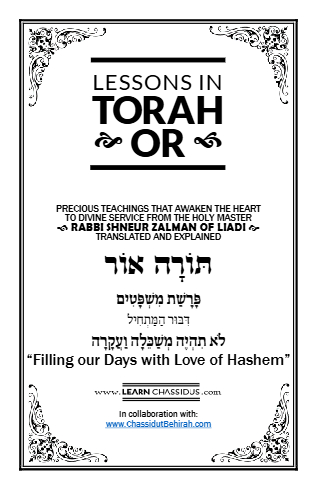
Becoming an Empty Vessel to Receive Divine Truth

Lessons in Torah Or | February 13, 2026

Since, as the Gemara (ibid.) explains that when Avraham and Sarah were born “they were tumtum,” meaning that their reproductive organs were covered and sealed off (by a layer of skin), to the point that she [Sarah] did not possess the physical capacity to receive pregnancy.

The parallel of this phenomenon in one’s divine service is when one cannot grasp the real truth of Hashem in his mind and intellect, since he is not a befitting vessel to contain it.

To elaborate: The collective Jewish people are described in the verse (Tehillim 116:13) as a “cup of salvation,” since they are vessels who receive the Kindnesses from Above.

They are also referred to as “a cup of blessings (such as the cup of wine that Birkas Hamazon is recited over),” which can receive “wine that brings one to joy,” referring to the potential joy and pleasure one achieves through contemplation on the Greatness of Hashem described previously. However, this is only possible when one is an “empty vessel,” i.e., humble, and therefore able to receive.

However, when one considers himself having his own importance (not connected to his service of Hashem), and he thinks of himself as an independent entity, (separate from Hashem), and he therefore occupies himself with his own desires, arrogantly expressing: “This is what I desire, this is good for me, this is not worthwhile for me,” and so on, of which there are endless possibilities as to how this attitude expresses itself.

Generally speaking, however, this attitude can be found in each person, whether those involved in business or those involved in learning Torah, each time someone says, “This I like and this I don’t like, etc.,” this builds up his ego. Because of this buildup of ego, his mind becomes blocked off and sealed from perceiving the real truth of Hashem.

Now, the pathway to become an ‘empty vessel,’ i.e., receptive to Hashem, is as it states in the verse (Tehillim 51:19) “A heart that is broken and crushed Hashem does not despise,” and it says (Yeshaya 57:15) “I (Hashem) dwell with someone who has a crushed and humble spirit.”

By way of analogy: A blacksmith who forms a receptacle out of a block of metal must hit around the inner surface area of the future vessel with a hammer until he creates an empty space within [the block of metal].

So too, regarding a person: He must truly humble himself, regarding himself as having no importance independent of his mission given to him from Hashem, thus forming an empty space within himself as though his ego is totally nonexistent.

Another (second) aspect needed to receive insight and inspiration from Hashem is what our Sages said (Brachos 51a): “A cup [of wine] used for blessings [i.e. reciting Birkas Hamazon while holding this cup], the inside [of the cup first] needs to be washed out [before the wine is poured into it].”

The idea behind this: Even someone who is naturally humbled, like a poor man who does not have a sense of arrogance and conceit, still needs to guard himself so that his heart should not turn to indulging even in permissible matters, to the extent that he is bound up with them with all his heart and soul. For it is always possible to perform one’s permissible material activities (such as eating etc.) without passion or indulgence.

And if one allows his heart to become strongly bound up with the vanities of the physical world, he cannot be a vessel for the Divine until he becomes purified. A love for materialism and a love for Hashem cannot coexist within man, just as fire and water cannot exist together.

This condition is analogous to a dirty vessel, which one cannot fill with wine until he washes it out. It is also analogous to a woman who cannot conceive even if she possesses a functioning womb, until she purifies herself (from her prior cycle of impurity, through immersion in a mikveh).
Since, as the Gemara (ibid.) explains that when Avraham and Sarah were born “they were tumtum,” meaning that their reproductive organs were covered and sealed off (by a layer of skin), to the point that she [Sarah] did not possess the physical capacity to receive pregnancy.

The parallel of this phenomenon in one’s divine service is when one cannot grasp the real truth of Hashem in his mind and intellect, since he is not a befitting vessel to contain it.

To elaborate: The collective Jewish people are described in the verse (Tehillim 116:13) as a “cup of salvation,” since they are vessels who receive the Kindnesses from Above.

They are also referred to as “a cup of blessings (such as the cup of wine that Birkas Hamazon is recited over),” which can receive “wine that brings one to joy,” referring to the potential joy and pleasure one achieves through contemplation on the Greatness of Hashem described previously. However, this is only possible when one is an “empty vessel,” i.e., humble, and therefore able to receive.

However, when one considers himself having his own importance (not connected to his service of Hashem), and he thinks of himself as an independent entity, (separate from Hashem), and he therefore occupies himself with his own desires, arrogantly expressing: “This is what I desire, this is good for me, this is not worthwhile for me,” and so on, of which there are endless possibilities as to how this attitude expresses itself.

Generally speaking, however, this attitude can be found in each person, whether those involved in business or those involved in learning Torah, each time someone says, “This I like and this I don’t like, etc.,” this builds up his ego. Because of this buildup of ego, his mind becomes blocked off and sealed from perceiving the real truth of Hashem.

Now, the pathway to become an ‘empty vessel,’ i.e., receptive to Hashem, is as it states in the verse (Tehillim 51:19) “A heart that is broken and crushed Hashem does not despise,” and it says (Yeshaya 57:15) “I (Hashem) dwell with someone who has a crushed and humble spirit.”

By way of analogy: A blacksmith who forms a receptacle out of a block of metal must hit around the inner surface area of the future vessel with a hammer until he creates an empty space within [the block of metal].

So too, regarding a person: He must truly humble himself, regarding himself as having no importance independent of his mission given to him from Hashem, thus forming an empty space within himself as though his ego is totally nonexistent.

Another (second) aspect needed to receive insight and inspiration from Hashem is what our Sages said (Brachos 51a): “A cup [of wine] used for blessings [i.e. reciting Birkas Hamazon while holding this cup], the inside [of the cup first] needs to be washed out [before the wine is poured into it].”

The idea behind this: Even someone who is naturally humbled, like a poor man who does not have a sense of arrogance and conceit, still needs to guard himself so that his heart should not turn to indulging even in permissible matters, to the extent that he is bound up with them with all his heart and soul. For it is always possible to perform one’s permissible material activities (such as eating etc.) without passion or indulgence.

And if one allows his heart to become strongly bound up with the vanities of the physical world, he cannot be a vessel for the Divine until he becomes purified. A love for materialism and a love for Hashem cannot coexist within man, just as fire and water cannot exist together.

This condition is analogous to a dirty vessel, which one cannot fill with wine until he washes it out. It is also analogous to a woman who cannot conceive even if she possesses a functioning womb, until she purifies herself (from her prior cycle of impurity, through immersion in a mikveh).

PDF Preview