Seventh of Adar Birthday and Yahrtzeit of Moshe Rabbeinu
Hama'aseh Hu Haikar | February 13, 2026
Print This Article
View Original PDF

Seventh of Adar Birthday and Yahrtzeit of Moshe Rabbeinu

Hama'aseh Hu Haikar | February 13, 2026

Introduction

The 7th of Adar is the anniversary of both the birth and passing of Moshe Rabbeinu. In addition to the obvious significance of such a date, the 7th of Adar also influences the entire month of Adar. Our Sages tell us that it was the enormous influence of the 7th of Adar that caused the miracle of Purim to occur and transformed Adar into a month of unrivaled joy. To explain: The supernal source of a soul—its “mazal”—is bolstered and predominant on the day of one’s birth. Being that “Moshe is considered all” of the Jewish people, the mazal that is bolstered on his birthday is that of the entire nation. Thus, we are told that during the month of Adar, the mazal of the Jews is “predominant and healthy.” Moreover, the goal of Creation is to transform the world into a dwelling for Hashem. This theme is uniquely expressed in the month of Adar, whose name is comprised of the letter Alef (representing Hashem, the “Master” of the Universe) and the word Dar (meaning “to dwell”). The number 7 signifies the natural cycle, and by extension, all of Creation which was made in 7 days. Thus, the 7th day of Adar symbolizes the details of existence being transformed into Hashem’s dwelling—the fruition of Hashem’s plan for Creation.

Each to Their Own

The 7th of Adar Rishon is a special day with unique customs. Some of these customs are stated in Shulchan Aruch, and others are recorded in subsequent works. These are the unique—and sometimes conflicting—customs that are actually practiced among the various Jewish groups, in the spirit of “each river follows its own course.”

Treat It as Befits a Holy Day

We do not find any openly publicized Chabad customs for the 7th of Adar. Nevertheless, we make particular effort to utilize this day in a fitting manner and in a spirit of holiness—by increasing in the joy of Torah and mitzvos.

Farbreng and Discuss Chassidus

Among Chassidim—particularly Chabad Chassidim—the 7th of Adar has been transformed from a day of fasting into a day of farbrengen, where we discuss matters of Chassidus and its dissemination.

No Chabad Customs

Concerning neither fasting (as many do on a yahrtzeit) nor rejoicing (as is the custom among many Jewish groups, who arrange joyful events on a yahrtzeit as a “tikkun” for the soul of the departed), Chabad Rebbes do not recite the penitential Tachanun prayer on the 7th of Adar, but the regular congregants in a Chabad shul do recite Tachanun.

Fight Darkness—Add Goodness

We should combat the effect of Yeridas HaDoros (the continuous spiritual and physical decline of each subsequent generation) and the ever-thickening darkness of exile (that has grown steadily oppressive all the way until our present generation, the final generation of exile) by making ever-greater efforts to utilize every opportunity and every matter to increase, with ever-growing strength, in all matters of goodness and holiness. And since this year is a “Hakhel” year as well, the year 5748—which spells the word “Tisamach,” “rejoice”—our efforts should assume additional emphasis.

Yahrtzeit—Celebrate with Joy

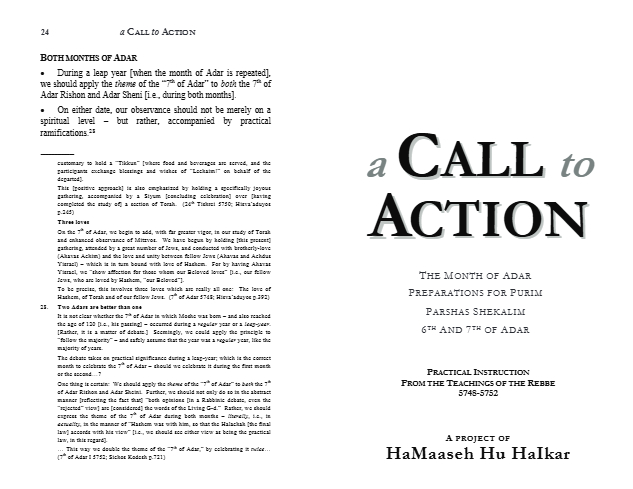
According to Chassidic custom, a yahrtzeit is not associated with undesirable practices and the like (i.e., self-affliction, fasting, etc.). Quite the opposite—it is customary to hold a “tikkun” (where food and beverages are served, and the participants exchange blessings and wishes of “Lechaim” on behalf of the departed). This positive approach is also emphasized by holding a specifically joyous gathering, accompanied by a siyum (concluding celebration) over having completed the study of a section of Torah.

Three Loves

On the 7th of Adar, we begin to add, with far greater vigor, in our study of Torah and enhanced observance of mitzvos. We have begun by holding this present gathering, attended by a great number of Jews, and conducted with brotherly love (Ahavas Achim) and the love and unity between fellow Jews (Ahavas and Achdus Yisrael)—which is in turn bound with love of Hashem. For by having Ahavas Yisrael, we “show affection for those whom our Beloved loves” (i.e., our fellow Jews, who are loved by Hashem, “our Beloved”). To be precise, this involves three loves which are really all one: the love of Hashem, of Torah, and of our fellow Jews.

Two Adars Are Better Than One

It is not clear whether the 7th of Adar in which Moshe was born—and also reached the age of 120 (i.e., his passing)—occurred during a regular year or a leap year. Rather, it is a matter of debate. Seemingly, we could apply the principle to “follow the majority” and safely assume that the year was a regular year, like the majority of years. The debate takes on practical significance during a leap year: which is the correct month to celebrate the 7th of Adar—should we celebrate it during the first month or the second? One thing is certain: We should apply the theme of the “7th of Adar” to both the 7th of Adar Rishon and Adar Sheini. Further, we should not only do so in the abstract manner (reflecting the fact that “both opinions [in a Rabbinic debate, even the ‘rejected’ view] are [considered] the words of the Living G-d”). Rather, we should express the theme of the 7th of Adar during both months—literally, i.e., in actuality, in the manner of “Hashem was with him, so that the Halachah [the final law] accords with his view” (i.e., we should see either view as being the practical law in this regard). This way, we double the theme of the “7th of Adar,” by celebrating it twice.

Introduction

The 7th of Adar is the anniversary of both the birth and passing of Moshe Rabbeinu. In addition to the obvious significance of such a date, the 7th of Adar also influences the entire month of Adar. Our Sages tell us that it was the enormous influence of the 7th of Adar that caused the miracle of Purim to occur and transformed Adar into a month of unrivaled joy. To explain: The supernal source of a soul—its “mazal”—is bolstered and predominant on the day of one’s birth. Being that “Moshe is considered all” of the Jewish people, the mazal that is bolstered on his birthday is that of the entire nation. Thus, we are told that during the month of Adar, the mazal of the Jews is “predominant and healthy.” Moreover, the goal of Creation is to transform the world into a dwelling for Hashem. This theme is uniquely expressed in the month of Adar, whose name is comprised of the letter Alef (representing Hashem, the “Master” of the Universe) and the word Dar (meaning “to dwell”). The number 7 signifies the natural cycle, and by extension, all of Creation which was made in 7 days. Thus, the 7th day of Adar symbolizes the details of existence being transformed into Hashem’s dwelling—the fruition of Hashem’s plan for Creation.

Each to Their Own

The 7th of Adar Rishon is a special day with unique customs. Some of these customs are stated in Shulchan Aruch, and others are recorded in subsequent works. These are the unique—and sometimes conflicting—customs that are actually practiced among the various Jewish groups, in the spirit of “each river follows its own course.”

Treat It as Befits a Holy Day

We do not find any openly publicized Chabad customs for the 7th of Adar. Nevertheless, we make particular effort to utilize this day in a fitting manner and in a spirit of holiness—by increasing in the joy of Torah and mitzvos.

Farbreng and Discuss Chassidus

Among Chassidim—particularly Chabad Chassidim—the 7th of Adar has been transformed from a day of fasting into a day of farbrengen, where we discuss matters of Chassidus and its dissemination.

No Chabad Customs

Concerning neither fasting (as many do on a yahrtzeit) nor rejoicing (as is the custom among many Jewish groups, who arrange joyful events on a yahrtzeit as a “tikkun” for the soul of the departed), Chabad Rebbes do not recite the penitential Tachanun prayer on the 7th of Adar, but the regular congregants in a Chabad shul do recite Tachanun.

Fight Darkness—Add Goodness

We should combat the effect of Yeridas HaDoros (the continuous spiritual and physical decline of each subsequent generation) and the ever-thickening darkness of exile (that has grown steadily oppressive all the way until our present generation, the final generation of exile) by making ever-greater efforts to utilize every opportunity and every matter to increase, with ever-growing strength, in all matters of goodness and holiness. And since this year is a “Hakhel” year as well, the year 5748—which spells the word “Tisamach,” “rejoice”—our efforts should assume additional emphasis.

Yahrtzeit—Celebrate with Joy

According to Chassidic custom, a yahrtzeit is not associated with undesirable practices and the like (i.e., self-affliction, fasting, etc.). Quite the opposite—it is customary to hold a “tikkun” (where food and beverages are served, and the participants exchange blessings and wishes of “Lechaim” on behalf of the departed). This positive approach is also emphasized by holding a specifically joyous gathering, accompanied by a siyum (concluding celebration) over having completed the study of a section of Torah.

Three Loves

On the 7th of Adar, we begin to add, with far greater vigor, in our study of Torah and enhanced observance of mitzvos. We have begun by holding this present gathering, attended by a great number of Jews, and conducted with brotherly love (Ahavas Achim) and the love and unity between fellow Jews (Ahavas and Achdus Yisrael)—which is in turn bound with love of Hashem. For by having Ahavas Yisrael, we “show affection for those whom our Beloved loves” (i.e., our fellow Jews, who are loved by Hashem, “our Beloved”). To be precise, this involves three loves which are really all one: the love of Hashem, of Torah, and of our fellow Jews.

Two Adars Are Better Than One

It is not clear whether the 7th of Adar in which Moshe was born—and also reached the age of 120 (i.e., his passing)—occurred during a regular year or a leap year. Rather, it is a matter of debate. Seemingly, we could apply the principle to “follow the majority” and safely assume that the year was a regular year, like the majority of years. The debate takes on practical significance during a leap year: which is the correct month to celebrate the 7th of Adar—should we celebrate it during the first month or the second? One thing is certain: We should apply the theme of the “7th of Adar” to both the 7th of Adar Rishon and Adar Sheini. Further, we should not only do so in the abstract manner (reflecting the fact that “both opinions [in a Rabbinic debate, even the ‘rejected’ view] are [considered] the words of the Living G-d”). Rather, we should express the theme of the 7th of Adar during both months—literally, i.e., in actuality, in the manner of “Hashem was with him, so that the Halachah [the final law] accords with his view” (i.e., we should see either view as being the practical law in this regard). This way, we double the theme of the “7th of Adar,” by celebrating it twice.

PDF Preview