Higher and Lower Teshuva
Living Jewish | September 17, 2025
Print This Article
View Original PDF

Higher and Lower Teshuva

Living Jewish | December 10, 2025

“Nothing can stand in the way of teshuvah.” Even the gravest sin can be corrected through teshuvah. Yet, we also find in the Torah that for certain sins, teshuvah “does not help.” How can both be true?

It is explained (see at length in Iggeret HaTeshuvah in Tanya, ch. 4 onward) that when our Sages said that teshuvah does not help for certain sins, they were referring to teshuvah tata’ah (lower teshuvah). However, there exists a higher teshuvah—teshuvah ila’ah —which has the power to rectify even those sins.

Sin and transgression are likened to dirt that accumulates on a vessel. One does not place food or drink in a filthy vessel. Likewise, in a spiritual sense, sin soils the “vessels” of the soul and prevents them from receiving spiritual light. Thus, first one must wash and scrub the vessels; only afterward can one move forward.

This is the first stage, teshuvah tata’ah: cleansing the blemish caused by sin. And just like physical cleaning—one must deal with the dirt itself, scrub and scour it, even if the hands get dirty. This teshuvah deals directly with the sin: the Jew must contemplate the seriousness of his wrongdoing, weep and feel bitterness, and firmly resolve never again to transgress G-d’s will. This teshuvah is marked by bitterness, tears, and recalling the sin.

This is the beginning—for when the vessel is filthy, nothing can be placed inside it. Therefore, it must first be purified through remorse, pain, tears, and firm resolve. This teshuvah scours the vessels of the soul, removes the grime of sin, and makes them fit to receive the light of holiness.

The next stage of teshuvah is to fill the vessels with light. After a Jew has fully repented and his soul has been cleansed of its blemishes, he now feels an immense thirst to fill his soul with light. He yearns for spirituality, longs to cleave to G-d, and to experience Divine holiness. He senses the lack, what he missed when he failed to fulfill the mitzvot of the Torah. This is the higher stage of teshuvah—teshuvah ila’ah.

The defining quality of teshuvah ila’ah is that it does not deal with the sin at all. It is teshuvah in another sense—the return of the soul to its source, as in the verse: “And the spirit shall return to G-d Who gave it.” This teshuvah is filled with joy, for the soul is returning to its origin—like a prince coming home to his father, the king.

The first stage of teshuvah is characterized by, “a broken and crushed heart” (Psalms 51:19). The higher stage of teshuvah is expressed in the following verse: “Make me hear joy and gladness...” (51:10)

Teshuvah ila’ah leads a person to devote his entire heart and soul to Torah study, since through Torah one unites with G-d’s wisdom. He feels an unquenchable thirst for holiness, and gives himself over entirely to Torah and mitzvot, through which a person cleaves to the Divine Presence. In this sense, this teshuvah never ends—for there is no limit to how deeply a person can cleave to his Creator.

And in truth, even within teshuvah tata’ah lies a spark of teshuvah ila’ah. Without some yearning for holiness, a person would not even sense the lack caused by sin. One who has never seen light does not know how terrible it is to live in darkness. That inner spark of teshuvah ila’ah is what drives a person to want to break free of sin and return in teshuvah.

Adapted from Rabbi Menachem Brod, Sichat HaShevua

G-dly Awareness

When Moshiach comes, every creation in this world will understand and recognize that there is a G-dly power within which makes it exist and gives it its life force. This is the meaning of the line from the Amida prayer which we say on Rosh Hashana. We beseech G-d to reveal His Kingship in this world - "May everything that has been made, know that You made it" - because in truth nothing exists without G-dliness. (the Alter Rebbe, Rabbi Shneur Zalman of Liadi, reprinted from LchaimWeekly.org - LYO / NYC )
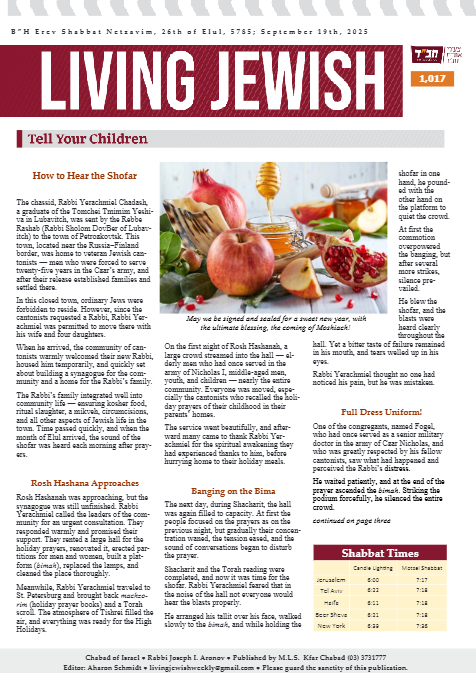

“Nothing can stand in the way of teshuvah.” Even the gravest sin can be corrected through teshuvah. Yet, we also find in the Torah that for certain sins, teshuvah “does not help.” How can both be true?

It is explained (see at length in Iggeret HaTeshuvah in Tanya, ch. 4 onward) that when our Sages said that teshuvah does not help for certain sins, they were referring to teshuvah tata’ah (lower teshuvah). However, there exists a higher teshuvah—teshuvah ila’ah —which has the power to rectify even those sins.

Sin and transgression are likened to dirt that accumulates on a vessel. One does not place food or drink in a filthy vessel. Likewise, in a spiritual sense, sin soils the “vessels” of the soul and prevents them from receiving spiritual light. Thus, first one must wash and scrub the vessels; only afterward can one move forward.

This is the first stage, teshuvah tata’ah: cleansing the blemish caused by sin. And just like physical cleaning—one must deal with the dirt itself, scrub and scour it, even if the hands get dirty. This teshuvah deals directly with the sin: the Jew must contemplate the seriousness of his wrongdoing, weep and feel bitterness, and firmly resolve never again to transgress G-d’s will. This teshuvah is marked by bitterness, tears, and recalling the sin.

This is the beginning—for when the vessel is filthy, nothing can be placed inside it. Therefore, it must first be purified through remorse, pain, tears, and firm resolve. This teshuvah scours the vessels of the soul, removes the grime of sin, and makes them fit to receive the light of holiness.

The next stage of teshuvah is to fill the vessels with light. After a Jew has fully repented and his soul has been cleansed of its blemishes, he now feels an immense thirst to fill his soul with light. He yearns for spirituality, longs to cleave to G-d, and to experience Divine holiness. He senses the lack, what he missed when he failed to fulfill the mitzvot of the Torah. This is the higher stage of teshuvah—teshuvah ila’ah.

The defining quality of teshuvah ila’ah is that it does not deal with the sin at all. It is teshuvah in another sense—the return of the soul to its source, as in the verse: “And the spirit shall return to G-d Who gave it.” This teshuvah is filled with joy, for the soul is returning to its origin—like a prince coming home to his father, the king.

The first stage of teshuvah is characterized by, “a broken and crushed heart” (Psalms 51:19). The higher stage of teshuvah is expressed in the following verse: “Make me hear joy and gladness...” (51:10)

Teshuvah ila’ah leads a person to devote his entire heart and soul to Torah study, since through Torah one unites with G-d’s wisdom. He feels an unquenchable thirst for holiness, and gives himself over entirely to Torah and mitzvot, through which a person cleaves to the Divine Presence. In this sense, this teshuvah never ends—for there is no limit to how deeply a person can cleave to his Creator.

And in truth, even within teshuvah tata’ah lies a spark of teshuvah ila’ah. Without some yearning for holiness, a person would not even sense the lack caused by sin. One who has never seen light does not know how terrible it is to live in darkness. That inner spark of teshuvah ila’ah is what drives a person to want to break free of sin and return in teshuvah.

Adapted from Rabbi Menachem Brod, Sichat HaShevua

G-dly Awareness

When Moshiach comes, every creation in this world will understand and recognize that there is a G-dly power within which makes it exist and gives it its life force. This is the meaning of the line from the Amida prayer which we say on Rosh Hashana. We beseech G-d to reveal His Kingship in this world - "May everything that has been made, know that You made it" - because in truth nothing exists without G-dliness. (the Alter Rebbe, Rabbi Shneur Zalman of Liadi, reprinted from LchaimWeekly.org - LYO / NYC )

PDF Preview