The Mitzvah of Teshuva
למודי משה | September 18, 2025
Print This Article
View Original PDF

The Mitzvah of Teshuva

למודי משה | December 10, 2025

Being that we are deep into the month of Elul, and Rosh Hashanah is just around the corner, together with the fact that according to a number of Rishonim the mitzvah of teshuva is in this week’s parsha, we will take this week’s opportunity to discuss a number of fascinating aspects related to the mitzvah of teshuva.

Introduction

R’ Leib Chasman would often relate, that regarding all the Yomim Tovim there is a mitzvah to learn the various halachos related to the upcoming Yom Tov from 30 days prior to the Yom Tov. This is especially applicable to bnei Torah, who are particular to learn all the ins and outs and understand everything that there is behind the mitzvos related to the upcoming Yom Tov. Although, in regard to the mitzvah of teshuva there is no particular time, and one must busy himself with the mitzvah of teshuva day and night, throughout one’s entire life, in the days leading up to the Yomim Noraim, one should learn the Halachos of Teshuva. R’ Leib Chasman would quote a Pirkei D’Rabbi Eliezer from where it is clear, that even though the primary time for teshuva is on Rosh Hashanah and Yom Kippur, one must prepare for at least 30 days prior.

Similarly, R’ Shlomah Zalman Auerbach would often bemoan the fact, that in the days leading up to Rosh Hashanah and Yom Kippur people would ask him many questions regarding Hilchos Tekias Shofar, and Hilchos Ta’anis, however, rarely would he be asked about Hilchos Teshuva.

Machlokes Rishonim If Teshuva Is One Of the 613 Mitzvos

It’s clear and obvious that one who commits an aveirah is obligated to do teshuva, however, the Rishonim argue over whether there is a special mitzvas aseh [positive commandment] to do teshuva. In this week’s parsha (30:2) we have the pasuk which says: ושבת עד ה 'אלוקיך ושמעת בקולו - “And you will return to Hashem, your G-d, and listen to His voice.” The Ramban (30:11) understands that this pasuk is a mitzvas aseh to do teshuva. The Ramban further explains that the pasukim:כי המצוה הזאת אשר אנכי מצוך היום לא נפלאת היא ממך ולא רחוקה היא ...כי קרוב אליך הדבר מאוד בפיך ובלבבך לעשותו – “For this commandment that I command you today, it is not hidden from you and it is not distant...Rather, the matter is very close to you, in your mouth and in your heart, so that you can fulfill it” (Devorim 30:11-14), also refer to the mitzvah of teshuva, and they are saying that the mitzvah of teshuva is very easy and simple to do. When the pasuk says: בפיך ובלבבך לעשותו – “in your mouth and in your heart, so that you can fulfill it”, the Ramban understands “in your mouth” refers to the mitzvah of viduy which is performed with one’s mouth, and “in your heart” refers to teshuva which one does in his heart. Rabbeinu Yonah (Sha’arei Teshuvah 1:1) and the Chareidim also both understand that there is a mitzvas aseh to do teshuva.

However, the Rambam in both Sefer HaMitzvos (Esin 73) and in Hilchos Teshuva (1:1) makes no mention of there being a mitzvah to do teshuva. The Rambam writes that teshuva must include saying viduy [confessing past sins], and that the mitzvah is the viduy. The Rambam doesn’t seem to think there is an overarching general mitzvah to do teshuva, which seems odd.

The Opinion of the Rambam

Below we will bring a number of peshotim [interpretations] to explain the Rambam, which will also hopefully serve to clarify some basic concepts of teshuvah:

The Minchas Chinuch (Mitzvah 364) explains that the Rambam in fact holds that there is no mitzvah to do teshuva. According to the Rambam, if someone wants to do teshuva, the required process is viduy and that is the mitzvah. He equates this to the mitzvah of divorce, where there is no mitzvah to divorce a wife, but if the need arises the method and mitzvah is to write a get [divorce document]. Similarly, if one wants to do teshuva, the method and mitzvah is using viduy. However, how could the Rambam hold that there is no mitzvah to do teshuva? Furthermore, when discussing the mitzvah of gerushin [divorce], the Rambam (Sefer HaMitzvos, esin 222) clearly states: הוא שצונו לגרש בשטר עכ"פ כשתרצה לגרש – “the mitzvah is to use a get when there is a will to divorce”. The divorce clearly depends on one’s will to end the marriage. But when writing about teshuva the Rambam writes: הוא שצונו להתודות וכו 'ולאמור אותם עם התשובה – “the mitzvah is to recite viduy with teshuva”, with no mention that the teshuva depends on one’s volition.

The Meshech Chochma (Vayeilech 31:17) explains as follows: The Rambam’s opinion is that there is no separate mitzvah of teshuva. Rather, each mitzvah includes a requirement to keep that mitzvah, and if someone violated that mitzvah he needs to correct his ways and ensure not to violate that mitzvah again. Teshuva is not an independent mitzvah, but a part of every other mitzvah. The only standalone mitzvah that is associated with teshuva is viduy – confessing past misdeeds. That is why the Rambam mentions only this mitzvah when writing about teshuva.

Although this approach doesn’t answer up the Minchas Chinuch, it agrees that there is no standalone mitzvah of teshuva. The difficulty is however, that in his section preview the Rambam summarizes the mitzvos associated with the relevant Halachos, and in the preview to Hilchos Teshuva the Rambam writes:מצות עשה אחת והוא שישוב החוטא מחטאו לפני ה' ויתודה – “There is one positive mitzvah, which is to do teshuva and say viduy”. This doesn’t seem to fit with the Meshech Chochma who maintains there is no mitzvah of teshuva? It also seems to contradict the Rambam himself, who in his halachos makes no mention of the mitzvah of teshuva at all?

The Kiryas Sefer of the Mabit, tries to address all the above by saying that teshuva is one big mitzvah that is made up of two components: Teshuva and viduy, and that viduy is the completion of the act of teshuva. If one recites viduy without teshuva, it is like toveling whilst holding a sheretz [an impure creature], teshuva and viduy go together. This explains why in the preview to Hilchos Teshuva the Rambam mentions the mitzvah of teshuva, as teshuva is in fact a mitzvah, however, since teshuva must go together with viduy and viduy is the completion of the act of teshuva, in his halachos the Rambam focuses on the mitzvah of viduy.

Novel Approach to Understanding the Rambam

Perhaps we can suggest the following explanation (which I saw brought down from R’ Yechezkel Hartman):

The Rambam (Hilchos Teshuva 2:2) describes the definition of teshuva as follows: ומה היא התשובה וכו 'וכן יתנחם על שעבר וכו 'ויעיד עליו יודע תעלומות שלא ישוב לעולם החטא לזה – “Teshuva is defined as one regretting what he did in the past, such that Hashem, who knows the depth of one’s heart, will testify that he will never do this sin again!” This requirement seems almost impossible to achieve! How can one reach a level of teshuva such that he will never sin again?

Furthermore, if one did a complete teshuva, but years later “slipped” and sinned again, is his original teshuva void? That makes no sense at all, especially since we know from Gemara in Rosh Hashanah (16b) that Hashem’s judgment is only based on the present moment. The Rambam must mean that Hashem will testify about him at that moment that based on the person’s current mental state, he will never return to that sin. This is similar to what the Rambam writes earlier that complete teshuva is when one experiences the same temptation and situation he had previously, and is able to withstand the temptation to sin. The Rambam is saying that his teshuva is complete even if he is never challenged that way again, as long as Hashem can testify that his current mindset would prevent him from succumbing in the future.

Thus, we have a better understating of how the Rambam understands teshuva: Teshuva is not an act of regret or feeling bad for the past. Teshuva is a state of mind, wherein the person has fully decided he will not sin again going forward.

Addressing our original question: The Rambam in Sefer HaMitzvos (Shoresh 9) defines that a mitzvah must be some sort of purposeful act, and it can be physical, thought, or behavior. If so, although teshuva is certainly a Torah goal, it cannot be counted as a mitzvah because teshuva is not an act. It is a state of mind – a situational outcome. The only “act” associated with teshuva is the viduy and that is why viduy is the “ma’aseh mitzvah” of teshuva. Therefore, the Rambam tells us in the preview to Hilchos Teshuva: There is a mitzvah to do teshuva and viduy, meaning the mitzvah is to reach teshuva through the act of viduy. When he discusses teshuva in Sefer HaMitzvos and in the Halachos he only mentions viduy, because it’s the only action associated with teshuva.

This may also answer another question of the Rishonim. The Gemara in Kiddushin (49b) says: “If one says to a woman: Be betrothed to me on the condition that I am a righteous man, then even if he was a completely wicked man she is betrothed, as perhaps in the meantime he had thoughts of repentance in his mind and is now righteous.” How would that work according to the Rambam, who requires an act of viduy? Based on our new understanding that teshuva can be a state-of-mind, the question evaporates. He may not have done viduy, but he could still have repented completely in his mind, such that Hashem could testify as to its effectiveness.

The Ramban, who says there is a separate teshuva mitzvah, may also agree with the above, and define a mitzvah not only as an act but as a state of mind as well. This would explain why teshuva is called, “hamitzvah hazois”. The Gemara in Eruvin says it refers to Torah. How does that fit with the Ramban? According to the above, teshuva is a state of mind of deciding to keep the entire Torah going forward, and therefore teshuva is in essence equivalent to fulfilling the entire Torah.

Teshuva – Easy or Hard?

In this week’s parsha the Torah writes in regard to a certain mitzvah that it is easy to fulfill, according to the Ramban this refers to the mitzvah of teshuva. But how can we say the mitzvah of teshuva is very easy, surely it is one of the most difficult mitzvos there is?

The answer seemingly lies in the following story:

Rabbi Aber shlita in his sefer (Yesharim Darkei Hashem, Maamar HaTeshuva) tells the story of a person who was asked to serve as the chazan for Yomim Noraim in his shul and he was experiencing heightened anxiety. How could he, a person so filled with sin, represent his kehillah before Hashem? He took his distress to Rabbi Aharon Leib Steinman zt”l. After hearing him out, Rav Steinman looked at him quizzically, “What’s the problem? Do teshuva!” The man was dumbfounded. “When will I have time to do so much teshuva?” Rav Steinman calmed him, “As you walk from your place to the amud, repent and confess your sins, and then you will be free of all sins and serve as an excellent shliach tzibbur.”

Rav Steinman was expressing the concept that appears in the aforementioned Gemara in Kiddushin (49b): “If one says to a woman: Be betrothed to me on the condition that I am a righteous man, then even if he was a completely wicked man she is betrothed, as perhaps in the meantime he had thoughts of repentance in his mind and is now righteous.” The Shulchan Aruch brings this down l’halachah (Even HaEzer 38:31). All it takes is one small moment, one thought – and a total rasha becomes the greatest tzaddik. One second.

So how?

Different Kinds of Teshuva

The Rambam describes what full teshuva is: A person who is confronted with the same situation in which he sinned, when he has the potential to commit [the sin again], and, nevertheless, abstains and does not commit it because of his teshuva alone and not because of fear or a lack of strength he has reached the level of full teshuva.

On the other hand, the Rambam continues and writes that even one who repented in old age after his life-force is spent, or when he technically has no ability to sin — and even one who repents on his deathbed is considered to have repented and is called a ba’al teshuva, and has his sins erased.

On the one hand for beginner’s teshuva — even one thought will suffice. But full teshuva is achieved when one is confronted with the same situation and refrained from it. Or, upon reaching the level that “He who knows the hidden” will testify that he will never return to this sin again.

Rabbeinu Yonah explains the differences (Sha’arei Teshuva 1:9): There are numerous levels of teshuva, and at the level one merited to repent he will accordingly gain closeness to Hashem. Forgiveness can be attained even at the lowest level of teshuva, but the soul will not become completely purified without purifying the heart and preparing the spirit. Rabbeinu Yonah compares it to washing stained clothes – after a basic laundering the garment is clean and major dirt is removed, but with every additional washing the garment comes out cleaner and cleaner, until finally it looks as clean as new. This is his explanation of the pasukim that associate teshuva to laundering clothing: “Wash me thoroughly of my iniquity, and purify me of my sin” (Tehillim 51:4) and “Cleanse your heart of evil...” (Yirmiyohu 4:14).

This affords us a new perspective on the mitzvah of teshuva: on the one hand, one can become a ba’al teshuva in one short moment and be, as the Rambam writes: “beloved and desirable, close, and dear” (Hilchos Teshuva 7:6). But after the first repentance, we are obligated to redouble our efforts and deepen them, allowing our souls to rise to spiritual heights.

Changing Bad Habits

Rabbi Ya’akov of Lissa, the Ba’al HaNesivos (Derush l’Shabbos HaGadol 3) adds an additional dimension to this concept.

The Lechem Mishneh questions the Rambam’s words “He who knows the hidden will testify concerning him that he will never return to this sin again.” How can Hashem testify that one will not sin if there is free choice? As long as one is alive he has the choice to sin or to refrain from it – how can Hashem ever testify in advance that one will not sin?

Rabbi Ya’akov explains that before sinning for the first time, one had free choice. Only then does he have the ability to truly choose to sin or not because at that point the pull of both is equal. Only before that first cigarette did the smoker have free choice about smoking and only then could he choose unbiasedly between smoking or not. The problem starts after the first sin – after that first drag. At that point an angel of destruction has been created. This angel is the angel of temptation. It constantly tempts a person with the same sin, and free choice is seriously compromised. In repentance, one severs his connection with the angel of temptation, essentially breaking the bad habit. With that, his angel of destruction is left to shrivel up and die, and one’s free choice is restored to its primal state. Knowing if all strings were indeed broken requires knowledge of “He who knows the Hidden”, but even before that, right at the beginning the penitent is already “beloved and desirable, close, and dear”.

A Small Resolution

Rabbi Yisroel Salanter teaches that breaking bad habits cannot happen at once, but in tiny increments. That small change, however minute, must be ironclad. One who speaks lashon horah regularly, for example, might begin keeping a ledger of nice things he finds in people with the goal of changing his negative outlook on the world. As one connects himself to a positive action, his is infused with a sense of positivity as well as a sense of accomplishment. This is the inner workings of mitzvah goreres mitzvah [one mitzvah leads to another]. If until now he had a negative angel, constantly tempting him with, for example, juicy tidbits of lashon horah, he has now severed his connection with that angel and established a connection with an angel of a mitzvah that will protect and assist him. Eventually, one discovers that his habits have changed – he no longer feels tempted to repeat lashon horah. From now on, refraining from lashon horah is easy. The Sefas Emes (Devorim, Shabbos Shuva, 5638) explains that “He Who Knows the Hidden” is the only one privy to this knowledge because the process is gradual and slow, so slow that even the person himself is not always aware of the changes taking place. He doesn’t even know that eventually he will never sin again. Only “He Who Knows the Hidden” can testify to it.

A small resolution that changes one’s direction has the power to make a complete overhaul in the end, but choose your resolutions with care. They must be resolutions that will generate change; obviously a resolution to recite birchas hachamoh with kavonah won’t do the trick.

Future Resolutions

According to the Rambam (Hilchos Teshuva 2:2), the mitzvah of teshuva consists of four stages: regret, cessation, confession and a future resolution. Regret and remorse may fill our hearts but how can we predict the future? How can one promise not to repeat past mistakes?

The Rambam (Hilchos Teshuva 1:1) provides the text for viduy:

How does one confess: He states: “I implore You, Hashem, I sinned, I transgressed, I committed iniquity before You by doing the following. Behold, I regret and am embarrassed for my deeds. I promise never to repeat this act again.”

This formula appears in other Rishonim as well: Smag (mitzvas aseh 16); Sefer Chassidim (chapter 20); Orchos Tzaddikim (Sha’ar HaTeshuva); Maharam Mi’Rottenburg (siman alef, 23).

The Aderes (Bnei Binyomin 1:1) questions why almost all poskim fail to mention the required future resolution, so much so, that it is not mentioned in the viduy of any siddur or machzor!

Indeed, the various meforshim wonder from where the Rambam learned this obligation. They indicate to two possible sources:

Rabbi Yosef Albo (Sefer HaIkrim, ma’amar 4:26) and Ma’aseh Rokeach (Teshuva 1:1) indicate that the source is the pasuk in Hoshea (14:3-4) read on Shabbos Shuva:קחו עמכם דברים ושובו אל ה 'אמרו אליו כל תשא עון וקח טוב ונשלמה פרים שפתינו . אשור לא יושיענו על סוס לא נרכב ולא נאמר עוד אלקינו למעשה ידינו וכו' – “Take words with yourselves and return to Hashem. Say, “You shall forgive all iniquity and teach us [the] good [way], and let us render [for] bulls [the offering of] our lips. Assyria shall not save us; we will not ride on horses, nor will we say any longer, our gods, to the work of our hands...”. Not returning to the previous sin is part of the teshuva process as described in these pasukim.

Many other meforshim on the Rambam (Da’as Kedoshim, Tziyunei Maharan, Keser Hamelech, Avodas Hamelech) explain that this approach is also found in the Yerushalmi (Yoma 8:7): “How does he confess... I sinned, and did evil, and I was situated in an evil state of mind, and in a faraway place I was walking, and as I did [in the past], I will not do. May it be Your Will... to forgive all my sins...”.

This Yerushalmi explicitly mentions the need for a future resolution as part of the teshuva process. Why was this dropped from the machzor?

The Future Vow – Integral or Not?

From most Rishonim it seems that the commitment not to repeat the sin is dropped intentionally. Even the Rambam in Sefer HaMitzvos (mitzvos aseh 73) spells out the viduy text without mentioning a promise to never repeat the aveirah. A similar text is also found in Sefer HaChinuch (Mitzvah 364). Therefore, it seems that the Rambam didn’t see the future resolution as binding l’halachah, without which teshuva is not accepted. The future vow, though an appropriate part of the main confession, in no way prevents teshuva from being accepted.

L’halachah, in the Shulchan Aruch (607) this obligation does not appear at all. The Magen Avraham (156:2) and Mishnah Berurah (156:4) when detailing the obligation to confess every sin, do not mention an obligation to explicitly state one’s intention not to repeat that sin. Therefore, it seems that even one who repented and fully regretted his sins, but cannot promise never to repeat it has fulfilled the mitzvah of teshuva. This seems especially true since this halachah is not mentioned in the Bavli.

Different Teshuva Approaches

To further clarify this point, the Yerushalmi (there) quotes Rabbi Yehuda ben Beseira’s approach to viduy: One must specify exactly which sins he committed – I ate milk with meat; I didn’t give tzedokah; I transgressed Hilchos Borer on Shabbos. This is contrary to Rabbi Akiva’s approach that only obligates one to state a general proclamation: “I sinned, I transgressed, I committed iniquity before You”. Superficially, this seems like a disagreement on the wording of the viduy formula, but in truth, this dispute illustrates a difference in approach to the entire concept of teshuva.

Rabbi Yehuda ben Beseira’s approach sees teshuva as the obligation to correct every sin individually – learn Hilchos Shabbos so you never are mechalel Shabbos again; learn Hilchos Shemiras Halashon so you never again tell lashon horah. Rabbi Akiva sees teshuva as a path in life, a direction. Teshuva according to Rabbi Akiva is a change in direction, a recalibration of our focus in life. Rabbi Akiva sees viduy as a general proclamation of having strayed from the direction of spiritual pursuit and requires expression of those things that caused us to stray from Hashem.

The obligation or lack thereof, of a future resolution, follows accordingly. According to Rabbi Yehuda ben Beseira teshuva is an individual process for every particular sin, therefore correction is made when one takes a vow to never repeat the deed. But Rabbi Akiva maintains that teshuva must focus on the general direction in life, as Yeshayahu describes (55:7): “The wicked shall give up his way, and the man of iniquity his thoughts, and he shall return to Hashem, Who shall have mercy upon him, and to our G-d, for He will freely pardon.” Repentance is not for a particular inequity, a specific aveirah, but for the way — the general mindset that caused sin. When one focuses on recalibrating his mindset — abandoning the thought patterns that caused sin, and finding a small act that he can do to solidify his change of direction – that is a vow for the future.
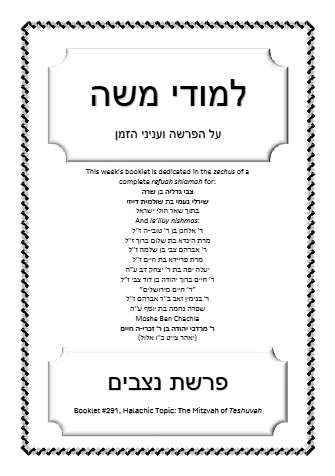
Being that we are deep into the month of Elul, and Rosh Hashanah is just around the corner, together with the fact that according to a number of Rishonim the mitzvah of teshuva is in this week’s parsha, we will take this week’s opportunity to discuss a number of fascinating aspects related to the mitzvah of teshuva.

Introduction

R’ Leib Chasman would often relate, that regarding all the Yomim Tovim there is a mitzvah to learn the various halachos related to the upcoming Yom Tov from 30 days prior to the Yom Tov. This is especially applicable to bnei Torah, who are particular to learn all the ins and outs and understand everything that there is behind the mitzvos related to the upcoming Yom Tov. Although, in regard to the mitzvah of teshuva there is no particular time, and one must busy himself with the mitzvah of teshuva day and night, throughout one’s entire life, in the days leading up to the Yomim Noraim, one should learn the Halachos of Teshuva. R’ Leib Chasman would quote a Pirkei D’Rabbi Eliezer from where it is clear, that even though the primary time for teshuva is on Rosh Hashanah and Yom Kippur, one must prepare for at least 30 days prior.

Similarly, R’ Shlomah Zalman Auerbach would often bemoan the fact, that in the days leading up to Rosh Hashanah and Yom Kippur people would ask him many questions regarding Hilchos Tekias Shofar, and Hilchos Ta’anis, however, rarely would he be asked about Hilchos Teshuva.

Machlokes Rishonim If Teshuva Is One Of the 613 Mitzvos

It’s clear and obvious that one who commits an aveirah is obligated to do teshuva, however, the Rishonim argue over whether there is a special mitzvas aseh [positive commandment] to do teshuva. In this week’s parsha (30:2) we have the pasuk which says: ושבת עד ה 'אלוקיך ושמעת בקולו - “And you will return to Hashem, your G-d, and listen to His voice.” The Ramban (30:11) understands that this pasuk is a mitzvas aseh to do teshuva. The Ramban further explains that the pasukim:כי המצוה הזאת אשר אנכי מצוך היום לא נפלאת היא ממך ולא רחוקה היא ...כי קרוב אליך הדבר מאוד בפיך ובלבבך לעשותו – “For this commandment that I command you today, it is not hidden from you and it is not distant...Rather, the matter is very close to you, in your mouth and in your heart, so that you can fulfill it” (Devorim 30:11-14), also refer to the mitzvah of teshuva, and they are saying that the mitzvah of teshuva is very easy and simple to do. When the pasuk says: בפיך ובלבבך לעשותו – “in your mouth and in your heart, so that you can fulfill it”, the Ramban understands “in your mouth” refers to the mitzvah of viduy which is performed with one’s mouth, and “in your heart” refers to teshuva which one does in his heart. Rabbeinu Yonah (Sha’arei Teshuvah 1:1) and the Chareidim also both understand that there is a mitzvas aseh to do teshuva.

However, the Rambam in both Sefer HaMitzvos (Esin 73) and in Hilchos Teshuva (1:1) makes no mention of there being a mitzvah to do teshuva. The Rambam writes that teshuva must include saying viduy [confessing past sins], and that the mitzvah is the viduy. The Rambam doesn’t seem to think there is an overarching general mitzvah to do teshuva, which seems odd.

The Opinion of the Rambam

Below we will bring a number of peshotim [interpretations] to explain the Rambam, which will also hopefully serve to clarify some basic concepts of teshuvah:

The Minchas Chinuch (Mitzvah 364) explains that the Rambam in fact holds that there is no mitzvah to do teshuva. According to the Rambam, if someone wants to do teshuva, the required process is viduy and that is the mitzvah. He equates this to the mitzvah of divorce, where there is no mitzvah to divorce a wife, but if the need arises the method and mitzvah is to write a get [divorce document]. Similarly, if one wants to do teshuva, the method and mitzvah is using viduy. However, how could the Rambam hold that there is no mitzvah to do teshuva? Furthermore, when discussing the mitzvah of gerushin [divorce], the Rambam (Sefer HaMitzvos, esin 222) clearly states: הוא שצונו לגרש בשטר עכ"פ כשתרצה לגרש – “the mitzvah is to use a get when there is a will to divorce”. The divorce clearly depends on one’s will to end the marriage. But when writing about teshuva the Rambam writes: הוא שצונו להתודות וכו 'ולאמור אותם עם התשובה – “the mitzvah is to recite viduy with teshuva”, with no mention that the teshuva depends on one’s volition.

The Meshech Chochma (Vayeilech 31:17) explains as follows: The Rambam’s opinion is that there is no separate mitzvah of teshuva. Rather, each mitzvah includes a requirement to keep that mitzvah, and if someone violated that mitzvah he needs to correct his ways and ensure not to violate that mitzvah again. Teshuva is not an independent mitzvah, but a part of every other mitzvah. The only standalone mitzvah that is associated with teshuva is viduy – confessing past misdeeds. That is why the Rambam mentions only this mitzvah when writing about teshuva.

Although this approach doesn’t answer up the Minchas Chinuch, it agrees that there is no standalone mitzvah of teshuva. The difficulty is however, that in his section preview the Rambam summarizes the mitzvos associated with the relevant Halachos, and in the preview to Hilchos Teshuva the Rambam writes:מצות עשה אחת והוא שישוב החוטא מחטאו לפני ה' ויתודה – “There is one positive mitzvah, which is to do teshuva and say viduy”. This doesn’t seem to fit with the Meshech Chochma who maintains there is no mitzvah of teshuva? It also seems to contradict the Rambam himself, who in his halachos makes no mention of the mitzvah of teshuva at all?

The Kiryas Sefer of the Mabit, tries to address all the above by saying that teshuva is one big mitzvah that is made up of two components: Teshuva and viduy, and that viduy is the completion of the act of teshuva. If one recites viduy without teshuva, it is like toveling whilst holding a sheretz [an impure creature], teshuva and viduy go together. This explains why in the preview to Hilchos Teshuva the Rambam mentions the mitzvah of teshuva, as teshuva is in fact a mitzvah, however, since teshuva must go together with viduy and viduy is the completion of the act of teshuva, in his halachos the Rambam focuses on the mitzvah of viduy.

Novel Approach to Understanding the Rambam

Perhaps we can suggest the following explanation (which I saw brought down from R’ Yechezkel Hartman):

The Rambam (Hilchos Teshuva 2:2) describes the definition of teshuva as follows: ומה היא התשובה וכו 'וכן יתנחם על שעבר וכו 'ויעיד עליו יודע תעלומות שלא ישוב לעולם החטא לזה – “Teshuva is defined as one regretting what he did in the past, such that Hashem, who knows the depth of one’s heart, will testify that he will never do this sin again!” This requirement seems almost impossible to achieve! How can one reach a level of teshuva such that he will never sin again?

Furthermore, if one did a complete teshuva, but years later “slipped” and sinned again, is his original teshuva void? That makes no sense at all, especially since we know from Gemara in Rosh Hashanah (16b) that Hashem’s judgment is only based on the present moment. The Rambam must mean that Hashem will testify about him at that moment that based on the person’s current mental state, he will never return to that sin. This is similar to what the Rambam writes earlier that complete teshuva is when one experiences the same temptation and situation he had previously, and is able to withstand the temptation to sin. The Rambam is saying that his teshuva is complete even if he is never challenged that way again, as long as Hashem can testify that his current mindset would prevent him from succumbing in the future.

Thus, we have a better understating of how the Rambam understands teshuva: Teshuva is not an act of regret or feeling bad for the past. Teshuva is a state of mind, wherein the person has fully decided he will not sin again going forward.

Addressing our original question: The Rambam in Sefer HaMitzvos (Shoresh 9) defines that a mitzvah must be some sort of purposeful act, and it can be physical, thought, or behavior. If so, although teshuva is certainly a Torah goal, it cannot be counted as a mitzvah because teshuva is not an act. It is a state of mind – a situational outcome. The only “act” associated with teshuva is the viduy and that is why viduy is the “ma’aseh mitzvah” of teshuva. Therefore, the Rambam tells us in the preview to Hilchos Teshuva: There is a mitzvah to do teshuva and viduy, meaning the mitzvah is to reach teshuva through the act of viduy. When he discusses teshuva in Sefer HaMitzvos and in the Halachos he only mentions viduy, because it’s the only action associated with teshuva.

This may also answer another question of the Rishonim. The Gemara in Kiddushin (49b) says: “If one says to a woman: Be betrothed to me on the condition that I am a righteous man, then even if he was a completely wicked man she is betrothed, as perhaps in the meantime he had thoughts of repentance in his mind and is now righteous.” How would that work according to the Rambam, who requires an act of viduy? Based on our new understanding that teshuva can be a state-of-mind, the question evaporates. He may not have done viduy, but he could still have repented completely in his mind, such that Hashem could testify as to its effectiveness.

The Ramban, who says there is a separate teshuva mitzvah, may also agree with the above, and define a mitzvah not only as an act but as a state of mind as well. This would explain why teshuva is called, “hamitzvah hazois”. The Gemara in Eruvin says it refers to Torah. How does that fit with the Ramban? According to the above, teshuva is a state of mind of deciding to keep the entire Torah going forward, and therefore teshuva is in essence equivalent to fulfilling the entire Torah.

Teshuva – Easy or Hard?

In this week’s parsha the Torah writes in regard to a certain mitzvah that it is easy to fulfill, according to the Ramban this refers to the mitzvah of teshuva. But how can we say the mitzvah of teshuva is very easy, surely it is one of the most difficult mitzvos there is?

The answer seemingly lies in the following story:

Rabbi Aber shlita in his sefer (Yesharim Darkei Hashem, Maamar HaTeshuva) tells the story of a person who was asked to serve as the chazan for Yomim Noraim in his shul and he was experiencing heightened anxiety. How could he, a person so filled with sin, represent his kehillah before Hashem? He took his distress to Rabbi Aharon Leib Steinman zt”l. After hearing him out, Rav Steinman looked at him quizzically, “What’s the problem? Do teshuva!” The man was dumbfounded. “When will I have time to do so much teshuva?” Rav Steinman calmed him, “As you walk from your place to the amud, repent and confess your sins, and then you will be free of all sins and serve as an excellent shliach tzibbur.”

Rav Steinman was expressing the concept that appears in the aforementioned Gemara in Kiddushin (49b): “If one says to a woman: Be betrothed to me on the condition that I am a righteous man, then even if he was a completely wicked man she is betrothed, as perhaps in the meantime he had thoughts of repentance in his mind and is now righteous.” The Shulchan Aruch brings this down l’halachah (Even HaEzer 38:31). All it takes is one small moment, one thought – and a total rasha becomes the greatest tzaddik. One second.

So how?

Different Kinds of Teshuva

The Rambam describes what full teshuva is: A person who is confronted with the same situation in which he sinned, when he has the potential to commit [the sin again], and, nevertheless, abstains and does not commit it because of his teshuva alone and not because of fear or a lack of strength he has reached the level of full teshuva.

On the other hand, the Rambam continues and writes that even one who repented in old age after his life-force is spent, or when he technically has no ability to sin — and even one who repents on his deathbed is considered to have repented and is called a ba’al teshuva, and has his sins erased.

On the one hand for beginner’s teshuva — even one thought will suffice. But full teshuva is achieved when one is confronted with the same situation and refrained from it. Or, upon reaching the level that “He who knows the hidden” will testify that he will never return to this sin again.

Rabbeinu Yonah explains the differences (Sha’arei Teshuva 1:9): There are numerous levels of teshuva, and at the level one merited to repent he will accordingly gain closeness to Hashem. Forgiveness can be attained even at the lowest level of teshuva, but the soul will not become completely purified without purifying the heart and preparing the spirit. Rabbeinu Yonah compares it to washing stained clothes – after a basic laundering the garment is clean and major dirt is removed, but with every additional washing the garment comes out cleaner and cleaner, until finally it looks as clean as new. This is his explanation of the pasukim that associate teshuva to laundering clothing: “Wash me thoroughly of my iniquity, and purify me of my sin” (Tehillim 51:4) and “Cleanse your heart of evil...” (Yirmiyohu 4:14).

This affords us a new perspective on the mitzvah of teshuva: on the one hand, one can become a ba’al teshuva in one short moment and be, as the Rambam writes: “beloved and desirable, close, and dear” (Hilchos Teshuva 7:6). But after the first repentance, we are obligated to redouble our efforts and deepen them, allowing our souls to rise to spiritual heights.

Changing Bad Habits

Rabbi Ya’akov of Lissa, the Ba’al HaNesivos (Derush l’Shabbos HaGadol 3) adds an additional dimension to this concept.

The Lechem Mishneh questions the Rambam’s words “He who knows the hidden will testify concerning him that he will never return to this sin again.” How can Hashem testify that one will not sin if there is free choice? As long as one is alive he has the choice to sin or to refrain from it – how can Hashem ever testify in advance that one will not sin?

Rabbi Ya’akov explains that before sinning for the first time, one had free choice. Only then does he have the ability to truly choose to sin or not because at that point the pull of both is equal. Only before that first cigarette did the smoker have free choice about smoking and only then could he choose unbiasedly between smoking or not. The problem starts after the first sin – after that first drag. At that point an angel of destruction has been created. This angel is the angel of temptation. It constantly tempts a person with the same sin, and free choice is seriously compromised. In repentance, one severs his connection with the angel of temptation, essentially breaking the bad habit. With that, his angel of destruction is left to shrivel up and die, and one’s free choice is restored to its primal state. Knowing if all strings were indeed broken requires knowledge of “He who knows the Hidden”, but even before that, right at the beginning the penitent is already “beloved and desirable, close, and dear”.

A Small Resolution

Rabbi Yisroel Salanter teaches that breaking bad habits cannot happen at once, but in tiny increments. That small change, however minute, must be ironclad. One who speaks lashon horah regularly, for example, might begin keeping a ledger of nice things he finds in people with the goal of changing his negative outlook on the world. As one connects himself to a positive action, his is infused with a sense of positivity as well as a sense of accomplishment. This is the inner workings of mitzvah goreres mitzvah [one mitzvah leads to another]. If until now he had a negative angel, constantly tempting him with, for example, juicy tidbits of lashon horah, he has now severed his connection with that angel and established a connection with an angel of a mitzvah that will protect and assist him. Eventually, one discovers that his habits have changed – he no longer feels tempted to repeat lashon horah. From now on, refraining from lashon horah is easy. The Sefas Emes (Devorim, Shabbos Shuva, 5638) explains that “He Who Knows the Hidden” is the only one privy to this knowledge because the process is gradual and slow, so slow that even the person himself is not always aware of the changes taking place. He doesn’t even know that eventually he will never sin again. Only “He Who Knows the Hidden” can testify to it.

A small resolution that changes one’s direction has the power to make a complete overhaul in the end, but choose your resolutions with care. They must be resolutions that will generate change; obviously a resolution to recite birchas hachamoh with kavonah won’t do the trick.

Future Resolutions

According to the Rambam (Hilchos Teshuva 2:2), the mitzvah of teshuva consists of four stages: regret, cessation, confession and a future resolution. Regret and remorse may fill our hearts but how can we predict the future? How can one promise not to repeat past mistakes?

The Rambam (Hilchos Teshuva 1:1) provides the text for viduy:

How does one confess: He states: “I implore You, Hashem, I sinned, I transgressed, I committed iniquity before You by doing the following. Behold, I regret and am embarrassed for my deeds. I promise never to repeat this act again.”

This formula appears in other Rishonim as well: Smag (mitzvas aseh 16); Sefer Chassidim (chapter 20); Orchos Tzaddikim (Sha’ar HaTeshuva); Maharam Mi’Rottenburg (siman alef, 23).

The Aderes (Bnei Binyomin 1:1) questions why almost all poskim fail to mention the required future resolution, so much so, that it is not mentioned in the viduy of any siddur or machzor!

Indeed, the various meforshim wonder from where the Rambam learned this obligation. They indicate to two possible sources:

Rabbi Yosef Albo (Sefer HaIkrim, ma’amar 4:26) and Ma’aseh Rokeach (Teshuva 1:1) indicate that the source is the pasuk in Hoshea (14:3-4) read on Shabbos Shuva:קחו עמכם דברים ושובו אל ה 'אמרו אליו כל תשא עון וקח טוב ונשלמה פרים שפתינו . אשור לא יושיענו על סוס לא נרכב ולא נאמר עוד אלקינו למעשה ידינו וכו' – “Take words with yourselves and return to Hashem. Say, “You shall forgive all iniquity and teach us [the] good [way], and let us render [for] bulls [the offering of] our lips. Assyria shall not save us; we will not ride on horses, nor will we say any longer, our gods, to the work of our hands...”. Not returning to the previous sin is part of the teshuva process as described in these pasukim.

Many other meforshim on the Rambam (Da’as Kedoshim, Tziyunei Maharan, Keser Hamelech, Avodas Hamelech) explain that this approach is also found in the Yerushalmi (Yoma 8:7): “How does he confess... I sinned, and did evil, and I was situated in an evil state of mind, and in a faraway place I was walking, and as I did [in the past], I will not do. May it be Your Will... to forgive all my sins...”.

This Yerushalmi explicitly mentions the need for a future resolution as part of the teshuva process. Why was this dropped from the machzor?

The Future Vow – Integral or Not?

From most Rishonim it seems that the commitment not to repeat the sin is dropped intentionally. Even the Rambam in Sefer HaMitzvos (mitzvos aseh 73) spells out the viduy text without mentioning a promise to never repeat the aveirah. A similar text is also found in Sefer HaChinuch (Mitzvah 364). Therefore, it seems that the Rambam didn’t see the future resolution as binding l’halachah, without which teshuva is not accepted. The future vow, though an appropriate part of the main confession, in no way prevents teshuva from being accepted.

L’halachah, in the Shulchan Aruch (607) this obligation does not appear at all. The Magen Avraham (156:2) and Mishnah Berurah (156:4) when detailing the obligation to confess every sin, do not mention an obligation to explicitly state one’s intention not to repeat that sin. Therefore, it seems that even one who repented and fully regretted his sins, but cannot promise never to repeat it has fulfilled the mitzvah of teshuva. This seems especially true since this halachah is not mentioned in the Bavli.

Different Teshuva Approaches

To further clarify this point, the Yerushalmi (there) quotes Rabbi Yehuda ben Beseira’s approach to viduy: One must specify exactly which sins he committed – I ate milk with meat; I didn’t give tzedokah; I transgressed Hilchos Borer on Shabbos. This is contrary to Rabbi Akiva’s approach that only obligates one to state a general proclamation: “I sinned, I transgressed, I committed iniquity before You”. Superficially, this seems like a disagreement on the wording of the viduy formula, but in truth, this dispute illustrates a difference in approach to the entire concept of teshuva.

Rabbi Yehuda ben Beseira’s approach sees teshuva as the obligation to correct every sin individually – learn Hilchos Shabbos so you never are mechalel Shabbos again; learn Hilchos Shemiras Halashon so you never again tell lashon horah. Rabbi Akiva sees teshuva as a path in life, a direction. Teshuva according to Rabbi Akiva is a change in direction, a recalibration of our focus in life. Rabbi Akiva sees viduy as a general proclamation of having strayed from the direction of spiritual pursuit and requires expression of those things that caused us to stray from Hashem.

The obligation or lack thereof, of a future resolution, follows accordingly. According to Rabbi Yehuda ben Beseira teshuva is an individual process for every particular sin, therefore correction is made when one takes a vow to never repeat the deed. But Rabbi Akiva maintains that teshuva must focus on the general direction in life, as Yeshayahu describes (55:7): “The wicked shall give up his way, and the man of iniquity his thoughts, and he shall return to Hashem, Who shall have mercy upon him, and to our G-d, for He will freely pardon.” Repentance is not for a particular inequity, a specific aveirah, but for the way — the general mindset that caused sin. When one focuses on recalibrating his mindset — abandoning the thought patterns that caused sin, and finding a small act that he can do to solidify his change of direction – that is a vow for the future.

PDF Preview