Q & A – Vayelech
OHRNET | September 27, 2024
Questions
- Moshe said, "I am 120 years old today. I am no longer able to go out and come in..." How do we know this does not refer to physical inability?
- Which of Moshe's statements to Yehoshua was later contradicted by Hashem's command?
- Why does the Torah refer to Succot of the eighth year as though it occurred during the shemita year?
- Why does the Torah command that babies be brought to the Torah reading?
- What does it mean that Hashem "hides His face?"
- What function does the song Ha'azinu serve?
- Which verse promises that the Torah will never be totally forgotten?
- What is the difference of opinion regarding the placing of the Torah scroll which Moshe gave the levi'im?
- On the day of Moshe's death, why didn't Moshe gather the people by blowing trumpets as he normally would have?
- Moshe said, "For I know that after my death you will act corruptly," but, in fact, this didn't occur until after Yehoshua's death. What does this teach us?
Answers
- 31:2. Because verse 34:7 says "His (Moshe's) eye never dimmed, and his (youthful) moisture never departed."
- 31:7 - Moshe told Yehoshua to share his leadership with the Elders. Hashem later commanded Yehoshua to rule alone.
- 31:10 - Because the laws of the seventh year still apply to the harvest.
- 31:12 - To give reward to those who bring them.
- 31:17 - He ignores their distress.
- 31:21 - It warns what will befall the Jewish People if they abandon Torah.
- 31:21 - "For (the Torah) will not be forgotten from the mouth of their offspring."
- 31:26 - Whether it was placed outside but adjacent to the Ark, or inside next to the Tablets.
- 31:28 - Blowing the trumpets expressed Moshe's dominion, and "there is no dominion on the day of death." (Kohelet 8)
- 31:29 - That a person's student is as dear to him as himself. As long as Yehoshua was alive it was as though Moshe himself was alive.
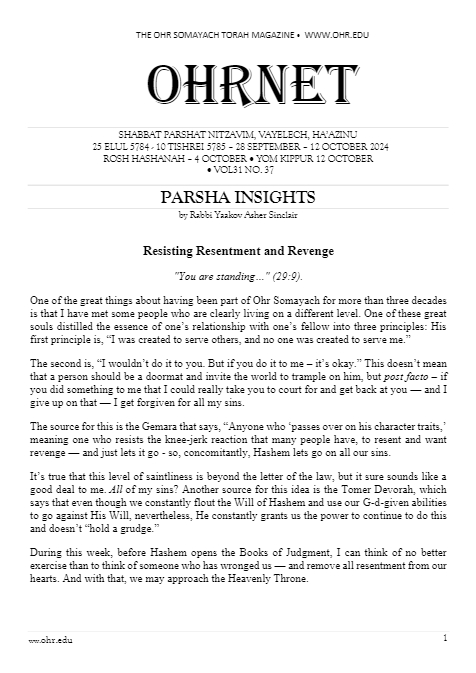
View The Full Article (PDF)
Related Articles

Understanding the Parsha according to the Rebbe
Ben Chamesh L'Mikra • Va'etchanan

THE THREE BOOKS
Parsha Pages • Ki Sisa

The Deeper Intention in the Giving of the Half Shekel
הפצת המיינות חוצה • Ki Sisa

The Extent of Reward
The Shmuz • Chukas

The Rashi of the Week Parshas Vayakhel
The Rashi of the Week • Vayak'hel