Rosh Hashanah Reflections on the Shofar
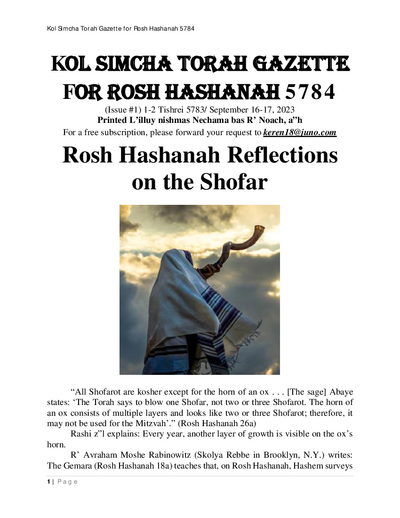
“All Shofarot are kosher except for the horn of an ox . . . [The sage] Abaye states: ‘The Torah says to blow one Shofar, not two or three Shofarot. The horn of an ox consists of multiple layers and looks like two or three Shofarot; therefore, it may not be used for the Mitzvah’.” (Rosh Hashanah 26a)
Rashi z”l explains: Every year, another layer of growth is visible on the ox’s horn.
R’ Avraham Moshe Rabinowitz (Skolya Rebbe in Brooklyn, N.Y.) writes: The Gemara (Rosh Hashanah 18a) teaches that, on Rosh Hashanah, Hashem surveys all of mankind at once, sees what is in the heart of each person, and notices all of each person’s actions. [Until here from the Gemara.]
This means, writes R’ Dovber Schneerson z”l (1773-1827; second Lubavitcher Rebbe) that Hashem’s judgment takes into account, all at once, man’s past, his present state, and even his future.
Therefore, explains the Skolya Rebbe, the horn of an ox, on which the passage of individual years is visible, is inappropriate for use as a Shofar on Rosh Hashanah. The Skolya Rebbe continues: We say in the Rosh Hashanah prayers, “This day is the beginning of Your creation,” a reference to the fact that man was created on Rosh Hashanah.
The Torah relates (Bereishit 2:7), “Hashem Elokim formed the man out of dust from the ground, and He blew into his nostrils the soul of life.” In every generation, for all time, the one who blows the Shofar is, in a sense, continuing the “breath” that Hashem “blew” on that first Rosh Hashanah. Like Hashem’s “breath,” every breath into the Shofar has an impact on all future generations, albeit unseen by us. [The person who blows connects past, present, and future through the Shofar.]
Only Hashem can be aware of everything–much less, survey it all at once. As for man, the Skolya Rebbe quotes R’ Avigdor Miller z”l (1908-2001; rabbi, educator and author; considered one of the first American-born “Gedolim”), who notes that everything a person experiences through any of his five senses is stored in his memory forever, albeit subconsciously. Moreover, a person is taking in new sensations every instant of every day. But, not all sensations are equal.
For example, the fear of G-d that one learns from a book is not comparable to the fear of G-d that he learns from watching his teacher, because the latter is a living, multi-sensory experience, while the former is not; it is merely information.
This is why the Gemara (Berachot 7b) states that serving a Torah scholar is greater than studying Torah. Man’s task, concludes R’ Miller, is to take in as many experiences as possible that strengthen his belief that Hashem directs His world, observes and considers everything, and rewards those who fear Him. [Until here from R’ Miller.]
Rambam z”l writes that the Shofar calls to a person to awaken and to remember that which he has forgotten. [Thus, the Shofar brings the past into the present and influences the future, so it should be one piece.] (Hadrat Melech p.47 - Hamaayan)
Reprinted from the Parshat Netzavim-Vayelech 5783 email of R’ Yedidya Hirtenfeld’s whY I Matter parsha sheet for the Young Israel of Midwood in Brooklyn.
Related Articles