The Second Level of Choice
זכרון יעקב | September 26, 2024
Print This Article
View Original PDF

The Second Level of Choice

זכרון יעקב | June 27, 2025

Professor Naftali Loewenthal (Chabad.org)

In this week's Torah reading, Moshe addresses the entire people standing together, whether leaders, elderly sages, or water-carriers. All were gathered to listen to what Moshe had to say.

Towards the end of his talk Moshe says: "Look, I am putting before you today life and goodness, and death and evil... You should choose life, so that you and your children should live."(30:15, 19) Moshe was saying that the path of Torah brings life and wellbeing.

There are two levels to this idea. One is that a person can see a variety of ways to live. Thinking through the possibilities and probabilities, it seems to him or her that a life guided by Torah teaching is likely to bring a more profound level of happiness, a greater degree of personal fulfillment. So he or she chooses the path of Torah, the path of life. This is one level of choice. It is guided by one's understanding, and by the feeling that Judaism brings harmony and other positive values to one's life.

The second level is when the harmony is not apparent. When there is crisis, opposition and struggle, and one's observance of authentic Jewish teaching – or simply the fact that one is a Jew – seems to lead to extra problems.

In this challenging situation, every Jew still has the power to choose the path of "life" and "goodness." However, it might well seem a choice which is higher than conventional reason and understanding. The person is choosing what they can see as true life and goodness. Other people may not understand this. Apparently well-meaning and reasonable people might advise their Jewish friend: "Why bother? Take the easy way out."

Nonetheless, Moshe tells us to choose life, authentic Judaism. His instruction is based on a wider perspective of who we are and where we are going.

Chassidic teachings explain that this choice is the expression of the essence of the soul, which is inseparably united with G‑d. It must choose the life of Torah, despite the adverse conditions of the moment. Because from the point of view of one's inner essence, no other road is possible. Why not? Because one's essence is concerned about reality. Not just what seems good at the moment, but what really is good.

Moshe’s words, telling us to "choose life," include both these levels. And this is a suitable introduction to Rosh Hashanah. For on this festival we express our dedication to G‑d as King, and He in turn "chooses" us anew, as His people.

G‑d's choice of the Jewish people is not based on our good deeds, the first level
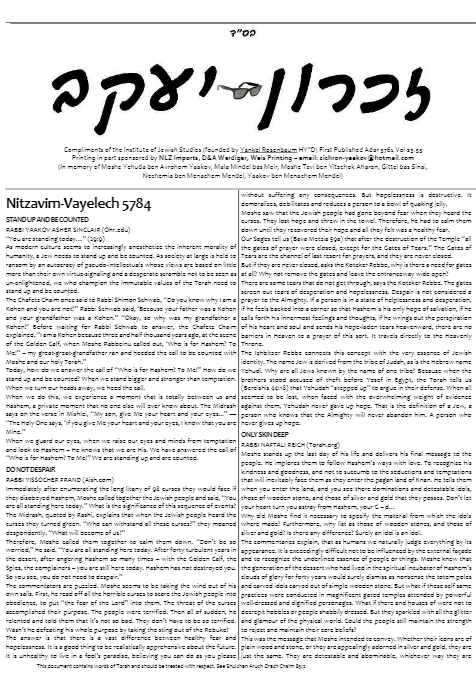
Professor Naftali Loewenthal (Chabad.org)

In this week's Torah reading, Moshe addresses the entire people standing together, whether leaders, elderly sages, or water-carriers. All were gathered to listen to what Moshe had to say.

Towards the end of his talk Moshe says: "Look, I am putting before you today life and goodness, and death and evil... You should choose life, so that you and your children should live."(30:15, 19) Moshe was saying that the path of Torah brings life and wellbeing.

There are two levels to this idea. One is that a person can see a variety of ways to live. Thinking through the possibilities and probabilities, it seems to him or her that a life guided by Torah teaching is likely to bring a more profound level of happiness, a greater degree of personal fulfillment. So he or she chooses the path of Torah, the path of life. This is one level of choice. It is guided by one's understanding, and by the feeling that Judaism brings harmony and other positive values to one's life.

The second level is when the harmony is not apparent. When there is crisis, opposition and struggle, and one's observance of authentic Jewish teaching – or simply the fact that one is a Jew – seems to lead to extra problems.

In this challenging situation, every Jew still has the power to choose the path of "life" and "goodness." However, it might well seem a choice which is higher than conventional reason and understanding. The person is choosing what they can see as true life and goodness. Other people may not understand this. Apparently well-meaning and reasonable people might advise their Jewish friend: "Why bother? Take the easy way out."

Nonetheless, Moshe tells us to choose life, authentic Judaism. His instruction is based on a wider perspective of who we are and where we are going.

Chassidic teachings explain that this choice is the expression of the essence of the soul, which is inseparably united with G‑d. It must choose the life of Torah, despite the adverse conditions of the moment. Because from the point of view of one's inner essence, no other road is possible. Why not? Because one's essence is concerned about reality. Not just what seems good at the moment, but what really is good.

Moshe’s words, telling us to "choose life," include both these levels. And this is a suitable introduction to Rosh Hashanah. For on this festival we express our dedication to G‑d as King, and He in turn "chooses" us anew, as His people.

G‑d's choice of the Jewish people is not based on our good deeds, the first level

PDF Preview



