The Significance of the Second Day of Rosh Hashanah
Ben Chamesh L'Mikra | September 11, 2023
Print This Article
View Original PDF

The Significance of the Second Day of Rosh Hashanah

Ben Chamesh L'Mikra | December 31, 2025

This relationship between the second day of Rosh Hashanah with (the first day, and with) the core theme of Rosh Hashanah is evident and expressed more prominently in this calendar year, when Rosh Hashanah falls out on Shabbos, as will be explained.

2. The Liturgy of Rosh Hashanah

In the liturgy of Rosh Hashanah, it says, “This is the day of the beginning of Your work.” The word ma’asecha, your work, is in the plural form {as if to say “all your work”}. From this usage, it is understood that “this day” does not just mark “the beginning” of the creation of the specific species of man, rather this is “the beginning” of all the work of Hashem; even of what was created during the five days of creation prior to the creation of man. This idea is elucidated in the chassidic discourses on Rosh Hashanah.

Meaning, the Divine renewal of creation that occurs on Rosh Hashanah does not apply only to humanity, but to all the worlds and to the entire spectrum of creation (seder hishtalshelus). Nevertheless, the renewal of the worlds transpires on the same day as man’s creation.

The reason: The purpose of the entire hishtalshelus, of all the worlds, tzimtzumim, mesochim and parsa’ois, etc., is in order to facilitate the creation of this lowly world, as Hashem desired to have a “home” in the lower realms.

Two Aspects of Hashem's Desire

There are two aspects of this idea:

a) What we do not understand or grasp is why Hashem desires a home in the lower worlds. For this desire, there is no reasoning; it is beyond any reasoning; and is merely because so He “desired.” This principle is explained in the series of maamarim beginning on Rosh Hashanah 5666 (1905), based on the adage of the Alter Rebbe, “Regarding a desire, there can be no question,” i.e., His intention is beyond any reason.

b) We do know {however} what it is that He “desired”—meaning, the plan and the purpose of creating all the worlds—that is, for Hashem to have a home in the lower realms.

On this basis, however, the purpose for creating all the higher, spiritual worlds is not clear. Certainly it is within Hashem’s capability to create only the creations of “the lower realms,” and they would serve as a home for Him!? The suggested explanation is as follows: His desire and intention was not only to have a home in the lower realms; he also wanted the creations of the lower realms to be the ones to make the home for Him. In other words, He wanted a home specifically through their work and toil. This objective could be accomplished only through preceding the creation of the lower realms with the entire seder hishtalshelus, with their respective arrangement of ranking, higher to lower, as explained in chassidic literature.

With this in mind, we can understand why Rosh Hashanah is “the beginning of your work” (in the plural form). Not only the creation of man is renewed on Rosh Hashanah, but also all the creations of the six days of creation, etc., since the focal point and purpose of their creation is in order for man to perform his service with them and thereby create a home for Him, in the lower realms. Therefore, their existence is renewed when man’s existence is renewed, this being the focal point and purpose of their creation.

{A problem might be raised:} Although at the onset of creation, too, the purpose of creating all the creations was only for the sake of the {subsequent} avodah of man; nevertheless, they were not created at the same time as man, but were created first. The reason is because at that time, in the beginning of their creation, their previous existence was in order to prepare and to enable the ultimate purpose of their creation (viz., man). Meaning, the intention of their existence was so that man would (afterwards) find “everything ready” for him to perform his avodah. In contrast, following the creation (and specifically, following the giving of the Torah), when the world is renewed annually, humanity is already engaged in its divine service. Man has already, effectively become, therefore, the raison d’etre of all {other} created beings, hence, their renewal is also contingent upon their focal point and purpose—man.
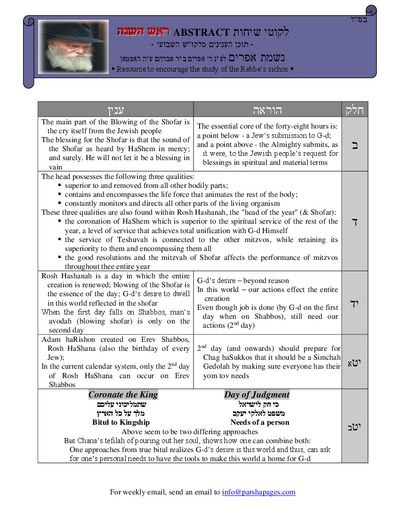
This relationship between the second day of Rosh Hashanah with (the first day, and with) the core theme of Rosh Hashanah is evident and expressed more prominently in this calendar year, when Rosh Hashanah falls out on Shabbos, as will be explained.

2. The Liturgy of Rosh Hashanah

In the liturgy of Rosh Hashanah, it says, “This is the day of the beginning of Your work.” The word ma’asecha, your work, is in the plural form {as if to say “all your work”}. From this usage, it is understood that “this day” does not just mark “the beginning” of the creation of the specific species of man, rather this is “the beginning” of all the work of Hashem; even of what was created during the five days of creation prior to the creation of man. This idea is elucidated in the chassidic discourses on Rosh Hashanah.

Meaning, the Divine renewal of creation that occurs on Rosh Hashanah does not apply only to humanity, but to all the worlds and to the entire spectrum of creation (seder hishtalshelus). Nevertheless, the renewal of the worlds transpires on the same day as man’s creation.

The reason: The purpose of the entire hishtalshelus, of all the worlds, tzimtzumim, mesochim and parsa’ois, etc., is in order to facilitate the creation of this lowly world, as Hashem desired to have a “home” in the lower realms.

Two Aspects of Hashem's Desire

There are two aspects of this idea:

a) What we do not understand or grasp is why Hashem desires a home in the lower worlds. For this desire, there is no reasoning; it is beyond any reasoning; and is merely because so He “desired.” This principle is explained in the series of maamarim beginning on Rosh Hashanah 5666 (1905), based on the adage of the Alter Rebbe, “Regarding a desire, there can be no question,” i.e., His intention is beyond any reason.

b) We do know {however} what it is that He “desired”—meaning, the plan and the purpose of creating all the worlds—that is, for Hashem to have a home in the lower realms.

On this basis, however, the purpose for creating all the higher, spiritual worlds is not clear. Certainly it is within Hashem’s capability to create only the creations of “the lower realms,” and they would serve as a home for Him!? The suggested explanation is as follows: His desire and intention was not only to have a home in the lower realms; he also wanted the creations of the lower realms to be the ones to make the home for Him. In other words, He wanted a home specifically through their work and toil. This objective could be accomplished only through preceding the creation of the lower realms with the entire seder hishtalshelus, with their respective arrangement of ranking, higher to lower, as explained in chassidic literature.

With this in mind, we can understand why Rosh Hashanah is “the beginning of your work” (in the plural form). Not only the creation of man is renewed on Rosh Hashanah, but also all the creations of the six days of creation, etc., since the focal point and purpose of their creation is in order for man to perform his service with them and thereby create a home for Him, in the lower realms. Therefore, their existence is renewed when man’s existence is renewed, this being the focal point and purpose of their creation.

{A problem might be raised:} Although at the onset of creation, too, the purpose of creating all the creations was only for the sake of the {subsequent} avodah of man; nevertheless, they were not created at the same time as man, but were created first. The reason is because at that time, in the beginning of their creation, their previous existence was in order to prepare and to enable the ultimate purpose of their creation (viz., man). Meaning, the intention of their existence was so that man would (afterwards) find “everything ready” for him to perform his avodah. In contrast, following the creation (and specifically, following the giving of the Torah), when the world is renewed annually, humanity is already engaged in its divine service. Man has already, effectively become, therefore, the raison d’etre of all {other} created beings, hence, their renewal is also contingent upon their focal point and purpose—man.

PDF Preview