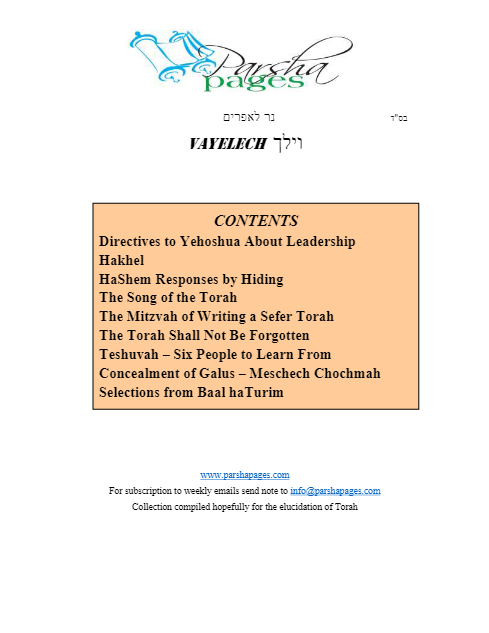
The Song of Torah
Parsha Pages | September 26, 2024
Print This Article
View Original PDF

The Song of Torah

Parsha Pages | June 27, 2025

ועתה כתבו לכם את השירה הזאת ולמדה את בני ישראל שימה בפיהם למען תהיה לי השירה הזאת לעד בבני ישראל
Now write for yourselves this “song” and teach it to the Children of Israel; place it into their mouths, so that this song will be for Me as a witness to the Children of Israel (Devarim 31,19)

What is the “song” השירה הזאת?

  • Parshas HaAzinu, which addresses the great themes of Jewish history;
  • Sefer Devarim - Discourse of Moshe addressed to all generations; or,
  • The entire Torah

Why would the Torah be referred to as a shirah “song”?
This becomes considerably more problematic in the light of another Talmudic passage (Sotah 35a) describing a certain punishment that befell King Dovid because he referred to the Torah as zemiros – songs, as in Tehillim (119:54) ‘Your statutes were like songs (zemiros) to me’.

The answer to this problem, according to the Vilna Gaon, lies in the crucial distinction between these two words that we translate identically as ‘song’ - shirah and zemirah.
A ‘zemirah’ is finite – it has a beginning and an end, at which point the song reaches its completion. Classic examples of this are the zemiros that we sing on Shabbos –all of which are of a finite length. Indeed, the word itself can also mean to ‘prune’, as in ‘six years you may prune (tizmor) your vineyard’ (Vayikra 25:3).

Shirah, on the other hand, represents something infinite. It is in order to give expression to one’s deepest and innermost feelings that leads a person to break out in a song of this nature. Thus we find that the Song by the Sea is referred to as a shirah- it was the collective articulation of the feelings of a nation that had just witnessed a miraculous salvation of the highest order. Such feelings, by definition, have neither an end nor a beginning. And so too their manifestation in the form of song, shirah, is also infinite – it is an expression of the singer’s essence.

To refer to the Torah as a zemirah implies that it has a beginning and an end – that it is in some way limited and finite. This is wrong, because the Torah is by definition infinite; it is the epitome of a shirah – the infinite expression of the essence of a Jew.

And that is why in commanding every Jew to write a Sefer Torah, the Torah itself reminds us what our attitude towards it should be. Far from being something external to us, it is our Song of Life – an infinite shirah that gives expression to the innermost desire of the soul to come close to G-d.

Sanhedrin 21b: (Mishnah): The King writes a Sefer Torah for himself.

(Beraisa): It is not enough that he inherited one.
(Rabah): Even if one inherited a Sefer Torah, it is a Mitzvah to write one himself - "Kisvu Lachem Es ha'Shirah ha'Zos."
(Abaye - Beraisa): It is not enough that he inherited one.

Rambam: It is a positive commandment for every Jewish man to write a Torah scroll for himself as the verse states “write for yourselves a Torah which contains this song.”

What is meant by “now” ועתה, which implies for the time in the desert and not for all generations?

  1. The Gemara (Gittin 60a) discusses the manner that Moshe gave the Torah to the Jews. Rabbi Yochanan states the Torah was given each section as Moshe wrote it. Whereas Resh Lakish states the Torah was given as a complete unit (Tosfos explains that even according to this opinion each Parsha was written as is occurred but was not given to the Jews until it was complete. According to either opinion the word "ועתה" indicates that the Divine command to Moshe to write it by sections only applied to the time in the Desert; however, future generations must write the entire Torah.
  2. "ועתה" now implies to Moshe’s giving of the Written Torah. Whereas the Oral Torah is not written down; rather it is given to the Jews in order to learn it as the verse states "שימה בפיהם" (to know and understand the explanations and reasons of the Torah). The Oral Torah was meant to be transmitted orally. All this is at the time (now) that Moshe provided the Written Torah to the Jews prior to entering Eretz Yisrael. However, in a future time (not now) the Oral Torah will also put into a written format (עת לעשות לה').
  3. The Torah already provided the commandment to learn Torah. How do we understand that this verse also contains ולמדה? The word "ועתה" implies that we do not fulfill the mitzvah of owning a Sefer Torah with a borrowed one. One does not fulfill one’s own learning but needs to teach others and not just once (as borrowed). Rather one needs to be שימה בפיהם (need to be always learning and teaching) which necessitates one having one’s own Sefer Torah.
  4. One does not fulfill the obligation to own a Sefer Torah with one that is received as an inheritance. One still needs to have a Sefer Torah written for oneself. The Torah needs to be fresh and not old.

The Midrash Rabbah (9:9) relates that prior to Moshe's passing he wrote thirteen Sifrei Torah — one for each tribe and one which was placed in the Ark. Since it was impossible to expect every Jew to personally write a Torah at that time, Moshe arranged that each tribe have a Torah, and through the rule of "leiv beit din matnah," when a Jew learned in it, it would be deemed as his personal Torah which Moshe wrote specifically for him.
Moshe thus set a precedent for future generations that when it is difficult to personally write a Sefer Torah, one may rely on a communal Sefer Torah for the observance of the Biblical mitzvah to write a Sefer Torah.

Rabeinu Tam: Gematria
"ולמדה את בני ישראל" same as "הן תורה בכתב"
"שימה בפיהם" same "זה התלמוד"
ועתה כתבו לכם את השירה הזאת ולמדה את בני ישראל שימה בפיהם למען תהיה לי השירה הזאת לעד בבני ישראל
Now write for yourselves this “song” and teach it to the Children of Israel; place it into their mouths, so that this song will be for Me as a witness to the Children of Israel (Devarim 31,19)

What is the “song” השירה הזאת?

  • Parshas HaAzinu, which addresses the great themes of Jewish history;
  • Sefer Devarim - Discourse of Moshe addressed to all generations; or,
  • The entire Torah

Why would the Torah be referred to as a shirah “song”?
This becomes considerably more problematic in the light of another Talmudic passage (Sotah 35a) describing a certain punishment that befell King Dovid because he referred to the Torah as zemiros – songs, as in Tehillim (119:54) ‘Your statutes were like songs (zemiros) to me’.

The answer to this problem, according to the Vilna Gaon, lies in the crucial distinction between these two words that we translate identically as ‘song’ - shirah and zemirah.
A ‘zemirah’ is finite – it has a beginning and an end, at which point the song reaches its completion. Classic examples of this are the zemiros that we sing on Shabbos –all of which are of a finite length. Indeed, the word itself can also mean to ‘prune’, as in ‘six years you may prune (tizmor) your vineyard’ (Vayikra 25:3).

Shirah, on the other hand, represents something infinite. It is in order to give expression to one’s deepest and innermost feelings that leads a person to break out in a song of this nature. Thus we find that the Song by the Sea is referred to as a shirah- it was the collective articulation of the feelings of a nation that had just witnessed a miraculous salvation of the highest order. Such feelings, by definition, have neither an end nor a beginning. And so too their manifestation in the form of song, shirah, is also infinite – it is an expression of the singer’s essence.

To refer to the Torah as a zemirah implies that it has a beginning and an end – that it is in some way limited and finite. This is wrong, because the Torah is by definition infinite; it is the epitome of a shirah – the infinite expression of the essence of a Jew.

And that is why in commanding every Jew to write a Sefer Torah, the Torah itself reminds us what our attitude towards it should be. Far from being something external to us, it is our Song of Life – an infinite shirah that gives expression to the innermost desire of the soul to come close to G-d.

Sanhedrin 21b: (Mishnah): The King writes a Sefer Torah for himself.

(Beraisa): It is not enough that he inherited one.
(Rabah): Even if one inherited a Sefer Torah, it is a Mitzvah to write one himself - "Kisvu Lachem Es ha'Shirah ha'Zos."
(Abaye - Beraisa): It is not enough that he inherited one.

Rambam: It is a positive commandment for every Jewish man to write a Torah scroll for himself as the verse states “write for yourselves a Torah which contains this song.”

What is meant by “now” ועתה, which implies for the time in the desert and not for all generations?

  1. The Gemara (Gittin 60a) discusses the manner that Moshe gave the Torah to the Jews. Rabbi Yochanan states the Torah was given each section as Moshe wrote it. Whereas Resh Lakish states the Torah was given as a complete unit (Tosfos explains that even according to this opinion each Parsha was written as is occurred but was not given to the Jews until it was complete. According to either opinion the word "ועתה" indicates that the Divine command to Moshe to write it by sections only applied to the time in the Desert; however, future generations must write the entire Torah.
  2. "ועתה" now implies to Moshe’s giving of the Written Torah. Whereas the Oral Torah is not written down; rather it is given to the Jews in order to learn it as the verse states "שימה בפיהם" (to know and understand the explanations and reasons of the Torah). The Oral Torah was meant to be transmitted orally. All this is at the time (now) that Moshe provided the Written Torah to the Jews prior to entering Eretz Yisrael. However, in a future time (not now) the Oral Torah will also put into a written format (עת לעשות לה').
  3. The Torah already provided the commandment to learn Torah. How do we understand that this verse also contains ולמדה? The word "ועתה" implies that we do not fulfill the mitzvah of owning a Sefer Torah with a borrowed one. One does not fulfill one’s own learning but needs to teach others and not just once (as borrowed). Rather one needs to be שימה בפיהם (need to be always learning and teaching) which necessitates one having one’s own Sefer Torah.
  4. One does not fulfill the obligation to own a Sefer Torah with one that is received as an inheritance. One still needs to have a Sefer Torah written for oneself. The Torah needs to be fresh and not old.

The Midrash Rabbah (9:9) relates that prior to Moshe's passing he wrote thirteen Sifrei Torah — one for each tribe and one which was placed in the Ark. Since it was impossible to expect every Jew to personally write a Torah at that time, Moshe arranged that each tribe have a Torah, and through the rule of "leiv beit din matnah," when a Jew learned in it, it would be deemed as his personal Torah which Moshe wrote specifically for him.
Moshe thus set a precedent for future generations that when it is difficult to personally write a Sefer Torah, one may rely on a communal Sefer Torah for the observance of the Biblical mitzvah to write a Sefer Torah.

Rabeinu Tam: Gematria
"ולמדה את בני ישראל" same as "הן תורה בכתב"
"שימה בפיהם" same "זה התלמוד"

PDF Preview