Now You Know
מגדל אור | October 19, 2023
Print This Article
View Original PDF

Now You Know

מגדל אור | December 31, 2025

Noach was commanded to build a ‘teiva,’ translated as an ark. It can also mean a box, such as an Aron Kodesh, which is referred to as a ‘teiva’ in the Gemara. Teiva also means word, and this week we lean about the power of words.

The Gemara (Pesachim 3a) teaches: “A person always avoid saying something uncouth, as we see the Torah went out of its way by eight letters to say, ‘of the animals which are pure, and of the animals which are not pure.’” It could have used the word ‘tamei, impure,’ but did not.

Further, we find the Torah saying Noach was righteous, wholesome in his generations. Rashi tells us that some explain this in a positive tone, while others do so in a critical one.

However, if you look in Rashi, he says, “Some of our Masters explain this for good, and there are some who explain it to denigrate him.”

Those who sought out the positive are the ones Rashi calls, “Our masters,” the people we should be learning from. The others, who were negative, are just others.

Words can provide a refuge for us, and by using them properly, we can save the entire world, along with ourselves.

We must ensure that our ‘taivos,’ are protected from the elements and dedicated to Hashem’s will, and then they will carry us to safety.
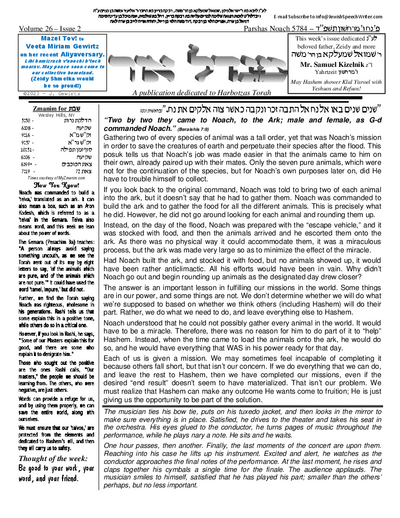

Noach was commanded to build a ‘teiva,’ translated as an ark. It can also mean a box, such as an Aron Kodesh, which is referred to as a ‘teiva’ in the Gemara. Teiva also means word, and this week we lean about the power of words.

The Gemara (Pesachim 3a) teaches: “A person always avoid saying something uncouth, as we see the Torah went out of its way by eight letters to say, ‘of the animals which are pure, and of the animals which are not pure.’” It could have used the word ‘tamei, impure,’ but did not.

Further, we find the Torah saying Noach was righteous, wholesome in his generations. Rashi tells us that some explain this in a positive tone, while others do so in a critical one.

However, if you look in Rashi, he says, “Some of our Masters explain this for good, and there are some who explain it to denigrate him.”

Those who sought out the positive are the ones Rashi calls, “Our masters,” the people we should be learning from. The others, who were negative, are just others.

Words can provide a refuge for us, and by using them properly, we can save the entire world, along with ourselves.

We must ensure that our ‘taivos,’ are protected from the elements and dedicated to Hashem’s will, and then they will carry us to safety.

PDF Preview