The Dove’s Olive Branch and the Spiritual Consequences of Dishonest Gain
Torah Papers | November 01, 2024
Print This Article
View Original PDF

The Dove’s Olive Branch and the Spiritual Consequences of Dishonest Gain

Torah Papers | June 27, 2025

After learning this, I want to explore a wonderful answer found in Shemen Rosh, who approaches the matter in a completely different, almost opposite manner. I’ll preface by saying that his idea is not black-and-white; it’s a roundabout idea meant to provoke thought, not something to be taken or applied as literally as I’m about to share it.

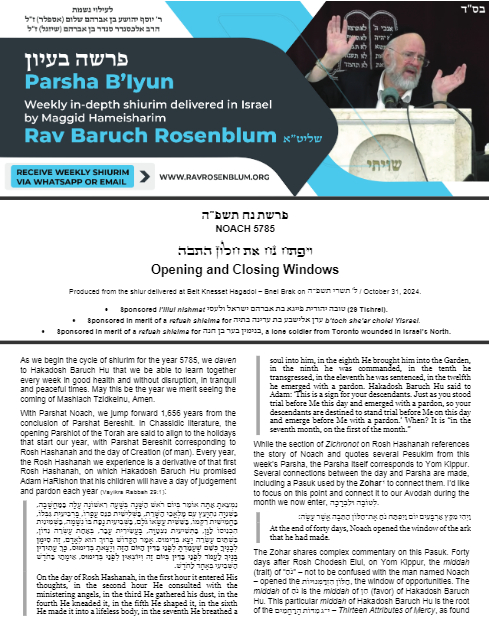
After a full year in the ark, Noach eventually sends out the raven to check if the waters had subsided. We discussed this extensively, including the question of why Noach didn’t simply ask Og Melech HaBashan, who was hanging onto the side of the ark (see Rav Rosenblum English Shiur – Noach 5783). When Noach sent the raven, the bird refused to go on the mission, accusing Noach of intending to take his mate in his absence. This led to a tense exchange between them, ultimately resulting in the raven being dismissed for good. It’s worthwhile noting that Noach spoke the language of animals, much like Shlomo HaMelech and a few others (Gitin 45a; Kohelet Rabbah 1:1). Noach then sent the dove to check on the water levels (despite it really having no bearing, given Hakadosh Baruch Hu closed the ark door for him, and he had to remain in the ark until Hakadosh Baruch Hu instructed him to exit – a topic for another shiur). The dove initially returned, unable to find dry land. The Da’at Zekainim says, the dove was sent out on the 10th of Tamuz and returned on the 17th of Tamuz, unable to find dry land on which to rest. This sequence is a foreshadow to the Churban – the destruction of the Beit Hamikdash and Am Yisrael in exile.

וְלֹא־מָצְאָה הַיּוֹנָה מָנוֹחַ לְכַף־רַגְלָהּ – the nation, oft referred to as a dove, could not find a place to rest once the city walls were breeched and the destruction began.

A week later, Noach sent the dove out again, and this time, it returned with an olive branch in its mouth. After another week, it was sent out once more and did not return. When the dove brought back the olive branch, out of all the possible sweet fruit branches available in Eretz Yisrael or Gan Eden, it chose the bitter olive branch. Why? According to the Gemara (Eruvin 18a), the dove was conveying a message:

אָמְרָה יוֹנָה לִפְנֵי הַקָּדוֹשׁ בָּרוּךְ הוּא: רִבּוֹנוֹ שֶׁל עוֹלָם, יִהְיוּ מְזוֹנוֹתַי מְרוֹרִין כְּזַיִת וּמְסוּרִין בְּיָדְךָ, וְאַל יִהְיוּ מְתוּקִין כִּדְבַשׁ וּתְלוּיִין בְּיַד בָּשָׂר וָדָם.

The dove said before Hakadosh Baruch Hu: Master of the Universe, let my food be bitter as an olive but given into Your hand, and let it not be sweet as honey but dependent upon flesh and blood.

This raises a few questions. Is this response a true expression of Hakarat HaTov – gratitude? After spending a full year in Noach’s resort with food delivered to its nest multiple times each day, was this the dove’s appropriate parting message? And why an olive to represent this feeling, and honey to represent the opposite? Of note, the honey referred to is not the date, but rather the liquid honey we know, made by bees.

Shemen Rosh poses these questions and provides an answer that will serve as the foundation for our shiur. He brings an idea from the sefer Agra D’Pirka (Remez 126) in the name of R' Menachem Mendel of Rimanov. We often see children who go to school, learn well, stay focused in their studies, daven with sincerity, exhibit good middot, and observe Shabbat beautifully at home. Then, seemingly out of nowhere, and for no discernible reason, they lose all interest and drive. Their desire to learn fades, they no longer focus or observe with the same dedication. Despite attempts to reignite their enthusiasm, the change persists, leaving us wondering: what happened? Shouldn’t one mitzvah lead to another, creating a positive cycle? How does this derailment occur?

R' Menachem Mendel of Rimanov explains that this change happens because the children were fed by their parents using stolen money, and gezel thus became a part of their heart and blood, leading to bad middot. They ate gezel – not because the parent literally robbed a grocery store, but because the money used to purchase the food was not obtained in accordance with Halacha and morality. This could happen through various forms of theft, from overtly taking what isn’t ours to justifying immoral or dishonest actions that fall short of ethical standards, such as the common day-to-day examples presented earlier.

R' Menachem Mendel of Rimanov teaches that such actions abruptly extinguish a child’s drive to learn. When they consume food acquired dishonestly – and this applies equally to eating foods that should not be eaten, or eating food on days and at times it should not be eaten – it is akin to eating stolen food, and this impacts their spiritual foundation, draining the enthusiasm that once motivated them. Hakadosh Baruch Hu wants no part of, and detests, theft. Would you like an example? Hakadosh Baruch Hu accepts Korbanot of animals who are given to eat and eat what they are given, while in contrast, a bird’s זֶפֶק (the gular pouch located on the front of a bird's neck) may not be placed upon the altar and is thrown out. Why? Rashi says, it is because the bird flies all over and picks up seeds that belong to others, storing them in that pouch. But does the bird have a prohibition against stealing? Can it really discern an ownerless seed? The...
After learning this, I want to explore a wonderful answer found in Shemen Rosh, who approaches the matter in a completely different, almost opposite manner. I’ll preface by saying that his idea is not black-and-white; it’s a roundabout idea meant to provoke thought, not something to be taken or applied as literally as I’m about to share it.

After a full year in the ark, Noach eventually sends out the raven to check if the waters had subsided. We discussed this extensively, including the question of why Noach didn’t simply ask Og Melech HaBashan, who was hanging onto the side of the ark (see Rav Rosenblum English Shiur – Noach 5783). When Noach sent the raven, the bird refused to go on the mission, accusing Noach of intending to take his mate in his absence. This led to a tense exchange between them, ultimately resulting in the raven being dismissed for good. It’s worthwhile noting that Noach spoke the language of animals, much like Shlomo HaMelech and a few others (Gitin 45a; Kohelet Rabbah 1:1). Noach then sent the dove to check on the water levels (despite it really having no bearing, given Hakadosh Baruch Hu closed the ark door for him, and he had to remain in the ark until Hakadosh Baruch Hu instructed him to exit – a topic for another shiur). The dove initially returned, unable to find dry land. The Da’at Zekainim says, the dove was sent out on the 10th of Tamuz and returned on the 17th of Tamuz, unable to find dry land on which to rest. This sequence is a foreshadow to the Churban – the destruction of the Beit Hamikdash and Am Yisrael in exile.

וְלֹא־מָצְאָה הַיּוֹנָה מָנוֹחַ לְכַף־רַגְלָהּ – the nation, oft referred to as a dove, could not find a place to rest once the city walls were breeched and the destruction began.

A week later, Noach sent the dove out again, and this time, it returned with an olive branch in its mouth. After another week, it was sent out once more and did not return. When the dove brought back the olive branch, out of all the possible sweet fruit branches available in Eretz Yisrael or Gan Eden, it chose the bitter olive branch. Why? According to the Gemara (Eruvin 18a), the dove was conveying a message:

אָמְרָה יוֹנָה לִפְנֵי הַקָּדוֹשׁ בָּרוּךְ הוּא: רִבּוֹנוֹ שֶׁל עוֹלָם, יִהְיוּ מְזוֹנוֹתַי מְרוֹרִין כְּזַיִת וּמְסוּרִין בְּיָדְךָ, וְאַל יִהְיוּ מְתוּקִין כִּדְבַשׁ וּתְלוּיִין בְּיַד בָּשָׂר וָדָם.

The dove said before Hakadosh Baruch Hu: Master of the Universe, let my food be bitter as an olive but given into Your hand, and let it not be sweet as honey but dependent upon flesh and blood.

This raises a few questions. Is this response a true expression of Hakarat HaTov – gratitude? After spending a full year in Noach’s resort with food delivered to its nest multiple times each day, was this the dove’s appropriate parting message? And why an olive to represent this feeling, and honey to represent the opposite? Of note, the honey referred to is not the date, but rather the liquid honey we know, made by bees.

Shemen Rosh poses these questions and provides an answer that will serve as the foundation for our shiur. He brings an idea from the sefer Agra D’Pirka (Remez 126) in the name of R' Menachem Mendel of Rimanov. We often see children who go to school, learn well, stay focused in their studies, daven with sincerity, exhibit good middot, and observe Shabbat beautifully at home. Then, seemingly out of nowhere, and for no discernible reason, they lose all interest and drive. Their desire to learn fades, they no longer focus or observe with the same dedication. Despite attempts to reignite their enthusiasm, the change persists, leaving us wondering: what happened? Shouldn’t one mitzvah lead to another, creating a positive cycle? How does this derailment occur?

R' Menachem Mendel of Rimanov explains that this change happens because the children were fed by their parents using stolen money, and gezel thus became a part of their heart and blood, leading to bad middot. They ate gezel – not because the parent literally robbed a grocery store, but because the money used to purchase the food was not obtained in accordance with Halacha and morality. This could happen through various forms of theft, from overtly taking what isn’t ours to justifying immoral or dishonest actions that fall short of ethical standards, such as the common day-to-day examples presented earlier.

R' Menachem Mendel of Rimanov teaches that such actions abruptly extinguish a child’s drive to learn. When they consume food acquired dishonestly – and this applies equally to eating foods that should not be eaten, or eating food on days and at times it should not be eaten – it is akin to eating stolen food, and this impacts their spiritual foundation, draining the enthusiasm that once motivated them. Hakadosh Baruch Hu wants no part of, and detests, theft. Would you like an example? Hakadosh Baruch Hu accepts Korbanot of animals who are given to eat and eat what they are given, while in contrast, a bird’s זֶפֶק (the gular pouch located on the front of a bird's neck) may not be placed upon the altar and is thrown out. Why? Rashi says, it is because the bird flies all over and picks up seeds that belong to others, storing them in that pouch. But does the bird have a prohibition against stealing? Can it really discern an ownerless seed? The...

PDF Preview

