The Passover Seder’s Most Important Idea
זכרון יעקב | April 21, 2024
Print This Article
View Original PDF

The Passover Seder’s Most Important Idea

זכרון יעקב | June 27, 2025

What is the single most important idea of the Passover Seder?

For me, it's always been captured best by the very word that gives it its name. The ritual of this night that commemorates the birth of the Jewish people on the eve of our exodus from Egypt is called Seder because it summarizes our unique understanding of history and the role played by G-d in the course of human events.

Let me explain.

The very first commandment of the 10 given on Sinai links G-d's identity with the Passover story: I am the Lord your G-d who took you out of the land of Egypt, the house of bondage. It is, on the surface, a very strange way for the Almighty to define himself. After all, it is the very first statement introducing us to the reality of an all-powerful being, of a deity worthy of being worshiped. Could not G-d have chosen something far more formidable to illustrate his greatness? Wouldn't it mean much more to us if G-d's claim to our obedience were to have been expressed with the words I am the Lord your G-d who created the heavens and the earth? The fact that G-d liberated us from slavery was a wonderful achievement but even human beings like Abraham Lincoln have been great emancipators. However only G-d himself can lay claim to the role of creator.

It is a profound question that has intrigued countless Jewish commentators. In one of the most famous philosophic works of the medieval period, the Kuzari, Rabbi Yehudah Halevi puts this very difficulty into the mouth of the pagan King of the Kahzars in the imagined dialogue between him and the Rabbi who was summoned to assist in his search for religious truth. Why would G-d, the King wonders, choose a relatively minor event to make His power known if He is in fact the creator of the entire universe?

The answer is rooted in the reality that most people in fact are not atheists. It's hard to deny the existence of a higher divine power who brought this whole world into existence. Every part of the miraculous structure and design of our bodies, every glance at the heavens and every glimpse of the wondrous workings of nature force us to agree with the psalmist that "the heavens declare the glory of G-d and the firmament shows his handiwork."

The true difficulty is not to convince people of the fallacy of atheism. Both intellectually and intuitively mankind knows there must be a G-d. The first commandment didn’t come to proclaim what was already self-evident. What is difficult to grasp however, for the millions of people on this earth who feel estranged from G-d is that the creator really cares about all those whom he created. The heresy that needs most to be addressed is Deism. Deism acknowledges that the brilliant design of the world forces us to accept a Designer, just as a watch must have had a watchmaker. But just as the watchmaker no longer has an ongoing relationship with the watch he brought into being so too is G-d surely indifferent to the lives of its inhabitants or to its ultimate destiny.

To be a deist is to believe in G-d – but in a G-d who truly doesn't matter. A deist would hardly deign to pray, for after all no one is really listening. A deist would
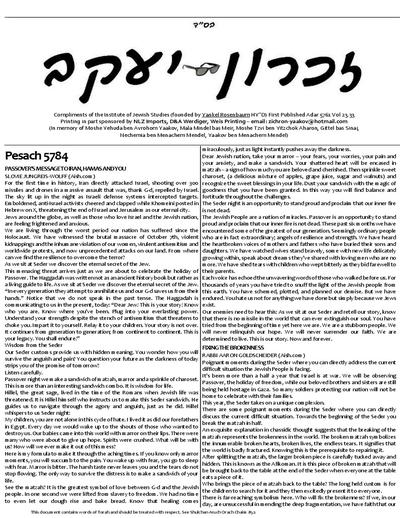

What is the single most important idea of the Passover Seder?

For me, it's always been captured best by the very word that gives it its name. The ritual of this night that commemorates the birth of the Jewish people on the eve of our exodus from Egypt is called Seder because it summarizes our unique understanding of history and the role played by G-d in the course of human events.

Let me explain.

The very first commandment of the 10 given on Sinai links G-d's identity with the Passover story: I am the Lord your G-d who took you out of the land of Egypt, the house of bondage. It is, on the surface, a very strange way for the Almighty to define himself. After all, it is the very first statement introducing us to the reality of an all-powerful being, of a deity worthy of being worshiped. Could not G-d have chosen something far more formidable to illustrate his greatness? Wouldn't it mean much more to us if G-d's claim to our obedience were to have been expressed with the words I am the Lord your G-d who created the heavens and the earth? The fact that G-d liberated us from slavery was a wonderful achievement but even human beings like Abraham Lincoln have been great emancipators. However only G-d himself can lay claim to the role of creator.

It is a profound question that has intrigued countless Jewish commentators. In one of the most famous philosophic works of the medieval period, the Kuzari, Rabbi Yehudah Halevi puts this very difficulty into the mouth of the pagan King of the Kahzars in the imagined dialogue between him and the Rabbi who was summoned to assist in his search for religious truth. Why would G-d, the King wonders, choose a relatively minor event to make His power known if He is in fact the creator of the entire universe?

The answer is rooted in the reality that most people in fact are not atheists. It's hard to deny the existence of a higher divine power who brought this whole world into existence. Every part of the miraculous structure and design of our bodies, every glance at the heavens and every glimpse of the wondrous workings of nature force us to agree with the psalmist that "the heavens declare the glory of G-d and the firmament shows his handiwork."

The true difficulty is not to convince people of the fallacy of atheism. Both intellectually and intuitively mankind knows there must be a G-d. The first commandment didn’t come to proclaim what was already self-evident. What is difficult to grasp however, for the millions of people on this earth who feel estranged from G-d is that the creator really cares about all those whom he created. The heresy that needs most to be addressed is Deism. Deism acknowledges that the brilliant design of the world forces us to accept a Designer, just as a watch must have had a watchmaker. But just as the watchmaker no longer has an ongoing relationship with the watch he brought into being so too is G-d surely indifferent to the lives of its inhabitants or to its ultimate destiny.

To be a deist is to believe in G-d – but in a G-d who truly doesn't matter. A deist would hardly deign to pray, for after all no one is really listening. A deist would

PDF Preview