Torah Sanctioned Zealotry
Parshas Pinchas
Rabbi Yissocher Frand
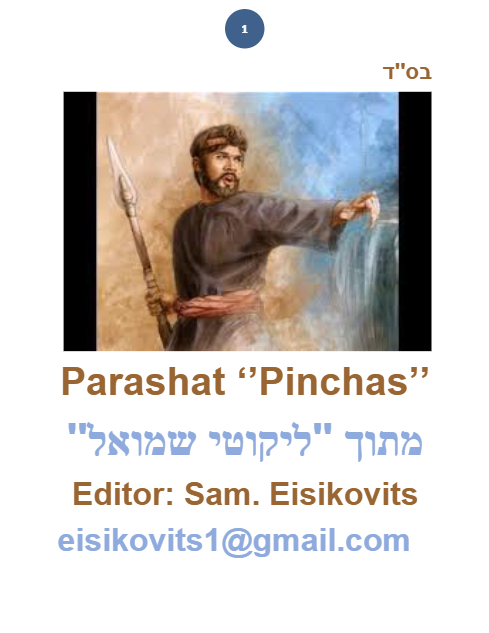
In last week’s parsha, Pinchas turned back Hashem’s anger towards the Jewish people through his act of kanaus (zealotry). The Halacha states that – subject to very strict conditions – a kanai (zealot) may kill a “boel aramis” (a person who is engaged in a specific type of public sexual immorality). As a payment to Pinchas for his act, Hashem gave Pinchas His Brisi Shalom (Covenant of Peace). Many commentators are bothered by the appropriateness of this reward. A kanai is usually understood to be someone who engages in arguments and controversy. Why is peace the appropriate reward?
There is an interesting Medrash that contains an implied criticism of Moshe Rabbeinu: “Since Moshe was passive during this incident, no one knows the location of his grave. This teaches us that a person must be as bold as a leopard, nimble as an eagle, speedy as a deer, and mighty as a lion to do the will of his Creator.” This Medrash indicates that the anonymity of Moshe’s gravesite is a punishment for the very slight infraction of Moshe not performing this act of kanaus himself. The Medrash itself points out that this is an example of Hashem acting meticulously with the righteous, measuring their actions with precision.
Properly performing an act of kanaus is not something that just anyone can take upon themselves. The person must be at the highest spiritual level. But the Medrash here faults Moshe Rabbeinu in the context of Hashem measuring the acts of the righteous “by a hair’s breadth.”
Rav Mordechai Gifter (Rosh Yeshiva, Telshe Yeshiva, Cleveland Ohio) emphasizes a very important point. The Torah describes Pinchas, or anyone who kills a person who is demonstrating this public immorality, as a “kanai”. People tend to translate the word “kanai” to mean an “extremist.” Rav Gifter writes that this is incorrect. As the Rambam writes (Hilchos Dayos 1:4), Judaism does not appreciate extremism. The middle path, the “golden mean” is the way the Torah advises people to act. “Kanaus” is not extremism.
Quoting the Sifrei, Rav Gifter defines kanaus as the act of sublimating a person’s entire self to the wants of Hashem, to the extent that the person is willing to give up his life, if necessary. That is why not all of us can assume the mantle of kanaus. Torah-sanctioned kanaus is reserved for those people who are willing to make the ultimate sacrifice for Hashem. When a personal agenda does not exist — when all that exists is Hashem’s honor — then, and only then, do we consider a person’s actions to be in the category of Torah-sanctioned kanaus. If a person’s motives are not completely pure — if there is an admixture of other motives to the act of kanaus — then it ceases to be an approved act of kanaus.
Consequently, it is highly appropriate that the reward for this act is the Brisi Shalom. Shalom does not necessarily mean peace. Shalom means perfection, as in the word “shalem” (complete). When a person performs an act of kanaus, such that his will and Hashem’s will become one, then he has achieved shleimus (completeness) with his Maker. The gift of shalom, meaning shalem is thus highly appropriate.
The chachomim (sages) say that despite the fact that Moshe Rabbeinu erred — if we can even use that word — by failing to assume the mantle of kanaus, Moshe corrects this passivity in next week’s Parsha. In Parshas Mattos, Moshe is commanded to “Seek revenge for the children of Israel against the Midianites, then be gathered into your nation” (Bamidbar 31:2). The chachomim infer from this connection between seeking revenge against Midyan and Moshe dying that Moshe had the ability to extend his lifetime. His death was dependent on his first taking revenge against Midyan. Moshe, in effect, had a blank check. He could have taken two years or five years or ten years to seek revenge against Midyan. What did Moshe do? Moshe immediately proceeded to take revenge against Midyan, knowing full well that its completion would pave the way for his own imminent demise. Here, Moshe performed the ultimate act of kanaus.
Kanaus is completely sublimating personal desires to the point that the person is prepared to even give up his life for Hashem. That is precisely what Moshe Rabbeinu demonstrates in Parshas Mattos. This is why Chazal view that incident as a kaparah (an atonement) for his passiveness during the incident at the end of last week’s parsha.