Listen Tzadok
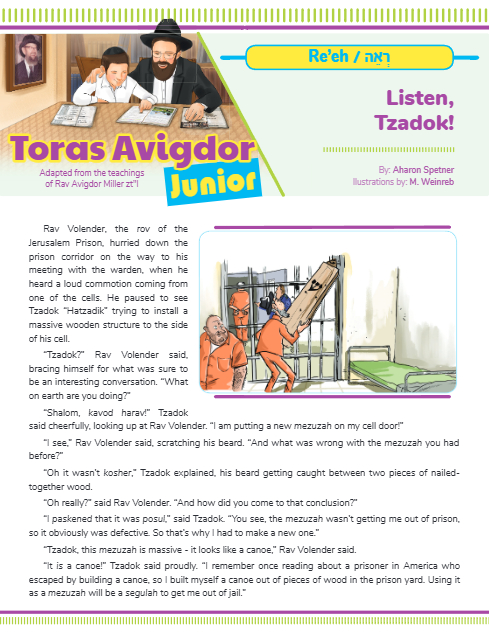
Rav Volender, the rov of the Jerusalem Prison, hurried down the prison corridor on the way to his meeting with the warden, when he heard a loud commotion coming from one of the cells. He paused to see Tzadok “Hatzadik” trying to install a massive wooden structure to the side of his cell.
“Tzadok?” Rav Volender said, bracing himself for what was sure to be an interesting conversation. “What on earth are you doing?”
“Shalom, kavod harav!” Tzadok said cheerfully, looking up at Rav Volender. “I am putting a new mezuzah on my cell door!”
“I see,” Rav Volender said, scratching his beard. “And what was wrong with the mezuzah you had before?”
“Oh it wasn’t kosher,” Tzadok explained, his beard getting caught between two pieces of nailed-together wood.
“Oh really?” said Rav Volender. “And how did you come to that conclusion?”
“I paskened that it was posul,” said Tzadok. “You see, the mezuzah wasn’t getting me out of prison, so it obviously was defective. So that’s why I had to make a new one.”
“Tzadok, this mezuzah is massive - it looks like a canoe,” Rav Volender said.
“It is a canoe!” Tzadok said proudly. “I remember once reading about a prisoner in America who escaped by building a canoe, so I built myself a canoe out of pieces of wood in the prison yard. Using it as a mezuzah will be a segulah to get me out of jail.”
“Um, Tzadok, there is no body of water anywhere near the Jerusalem Prison. I don’t think a canoe would be very helpful here.”
“But I’m not escaping in it, rebbe,” Tzadok said. “It’s a segulah - by putting a canoe here as my mezuzah, it will give Hashem the idea to get me out of here.”
“I see,” Rav Volender said. “And what did you do with your old mezuzah.”
“I put it under my pillow!” Tzadok said brightly. “That’s another segulah - it helps me have good dreams!”
“And where did you get the klaf for your new massive mezuzah?”
“The what?” asked Tzadok, puzzled.
“The klaf - the mezuzah itself! You do realize that the case is not the mezuzah, right? The actual mezuzah is a piece of parchment on which is written the first two parshios of Shema.”
“It is?” Tzadok asked.
“Yes,” said Rav Volender,” trying to remain patient. “Did you really think a mezuzah is nothing more than a piece of plastic or wood on the doorframe?”
Tzadok thought about this. “Well, I thought because there’s a shin on it... maybe it also needs some hairs from Bilaam’s donkey...”
“Tzadok, do you know what this week’s Parsha is?”
“Re’eh?” Tzadok guessed.
“Very good, Tzadok!” Rav Volender exclaimed, shocked that Tzadok knew the answer.
“Really?” asked Tzadok, equally shocked.
“Yes, Tzadok. And the Parsha talks about the brachos and klalos - the blessings and curses - that Hashem gives us. And it says that we get the brachos if we listen to Hashem.”
“I wish Hashem would listen to me,” Tzadok muttered. “I have such good ideas for him to do.”
“Tzadok,” Rav Volender continued. “Hashem doesn’t want anything more from you than just to listen to what he says. Hashem doesn’t say to put up a giant canoe mezuzah on your cell door. He says to put a piece of parchment with the words of the Torah there. If you really want to be zocheh to Hashem’s brachos, then you need to stop with these mishegasim and start listening to Him.
“You know, I’m on my way to a meeting with the warden right now. He wanted to discuss the possibility of letting you out early because of your good behavior.”
“REALLY?” Tzadok exclaimed. “So my canoe mezuzah segulah worked!”
“No, Tzadok,” Rav Volender said firmly. “That definitely will not work. And it’s just a discussion - nothing has happened yet. But if you want to be zocheh to a brochah from Hashem, then you need to focus on listening to the words that are written in a real mezuzah. You need to listen to what Hashem says and do his mitzvos. And if you do that, who knows? Hashem has many ways of giving you a yeshuah.”
Have a Wonderful Shabbos
Let’s review:
- Why is Tzadok building a mezuzah that looks like a canoe?
- What does it mean to “listen to the words of Hashem”?