Open Your Hand
BET Journal | August 21, 2025
Print This Article
View Original PDF

Open Your Hand

BET Journal | December 10, 2025

This week's parashah discusses the mitzvah of lending money to needy people. As it states (15:10), "You shall surely give him, and your heart should not be grieved when you give to him; for because of this thing Hashem, your G-d, will bless you in all your work and in all your endeavors."

Give Tzedakah Wisely

One must be wise when it comes to giving tzedakah. For example, there are halachos regarding to whom to give tzedakah. If one has a close relative or neighbor who is poor, halachah states that he is obligated to provide him with more money than he would give to strangers. Tzedakah is a matter that often needs rabbinic guidance. There was a wealthy person who discussed hilchos tzedakah with the Bach every day, so he would give tzedakah correctly. In conclusion, tzedakah should be performed wisely, as it states אשרי משכיל אל דל.

Free Loans

The Chinuch (480) explains that Hashem wants us to be kind to others and to give tzedakah and loans because then Hashem will act with us with kindness and compassion, too. He writes, "The purpose of this mitzvah is to establish the attribute of generosity in our hearts and to distance us as far as possible from stinginess. Anyone familiar with the Torah's ways and comprehends its beautiful ways knows with certainty that when he is generous with his money, he will gain more. And whoever refrains [and doesn't give money to others] will lose. This is because Hashem judges people according to their deeds. Being tight with money erects an iron wall that separates the person from Hashem's brachos. Generosity is, in itself, a blessing; therefore, those who act with kindness receive blessings."

The Chofetz Chaim (Ahavas Chesed ch.5, Hagahah) writes, "Now that we are living in a time when the midas gevurah [hardships and suffering] reigns in the world, the only solution to be saved from troubles is to do deeds of loving-kindness. These deeds of kindness will arouse Hashem's attribute of chesed. It states in Tana d'Bei Eliyahu (23) that when the Yidden lived in Mitzrayim, they gathered and made a pact to do gemilus chasadim with each other. Why? They realized there was no way to escape Pharaoh's decrees, and the labor in Mitzrayim was becoming harder each day, so the nation gathered to seek counsel. They concluded that they must do chesed with one another. That would arouse Hashem's chesed Above, and Pharaoh's decrees would be abolished. Their plan succeeded, as it states, נחית בחסדך עם זו גאלת,' With loving kindness, You led the people You redeemed,' and, as Chazal explain, נחית בחסדך refers to the gemilus chasadim of the Jewish nation."
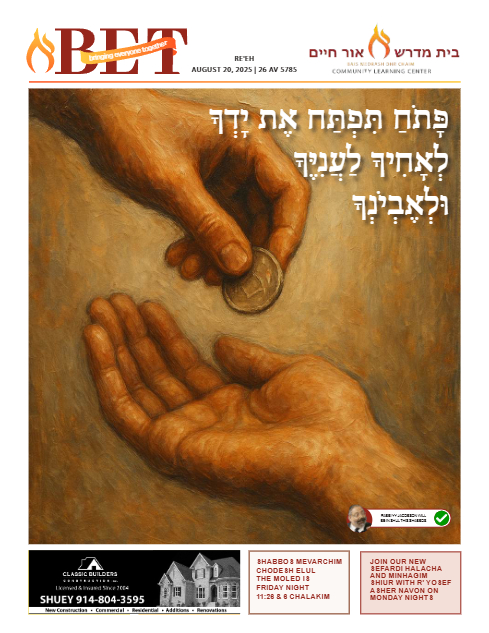

This week's parashah discusses the mitzvah of lending money to needy people. As it states (15:10), "You shall surely give him, and your heart should not be grieved when you give to him; for because of this thing Hashem, your G-d, will bless you in all your work and in all your endeavors."

Give Tzedakah Wisely

One must be wise when it comes to giving tzedakah. For example, there are halachos regarding to whom to give tzedakah. If one has a close relative or neighbor who is poor, halachah states that he is obligated to provide him with more money than he would give to strangers. Tzedakah is a matter that often needs rabbinic guidance. There was a wealthy person who discussed hilchos tzedakah with the Bach every day, so he would give tzedakah correctly. In conclusion, tzedakah should be performed wisely, as it states אשרי משכיל אל דל.

Free Loans

The Chinuch (480) explains that Hashem wants us to be kind to others and to give tzedakah and loans because then Hashem will act with us with kindness and compassion, too. He writes, "The purpose of this mitzvah is to establish the attribute of generosity in our hearts and to distance us as far as possible from stinginess. Anyone familiar with the Torah's ways and comprehends its beautiful ways knows with certainty that when he is generous with his money, he will gain more. And whoever refrains [and doesn't give money to others] will lose. This is because Hashem judges people according to their deeds. Being tight with money erects an iron wall that separates the person from Hashem's brachos. Generosity is, in itself, a blessing; therefore, those who act with kindness receive blessings."

The Chofetz Chaim (Ahavas Chesed ch.5, Hagahah) writes, "Now that we are living in a time when the midas gevurah [hardships and suffering] reigns in the world, the only solution to be saved from troubles is to do deeds of loving-kindness. These deeds of kindness will arouse Hashem's attribute of chesed. It states in Tana d'Bei Eliyahu (23) that when the Yidden lived in Mitzrayim, they gathered and made a pact to do gemilus chasadim with each other. Why? They realized there was no way to escape Pharaoh's decrees, and the labor in Mitzrayim was becoming harder each day, so the nation gathered to seek counsel. They concluded that they must do chesed with one another. That would arouse Hashem's chesed Above, and Pharaoh's decrees would be abolished. Their plan succeeded, as it states, נחית בחסדך עם זו גאלת,' With loving kindness, You led the people You redeemed,' and, as Chazal explain, נחית בחסדך refers to the gemilus chasadim of the Jewish nation."

PDF Preview