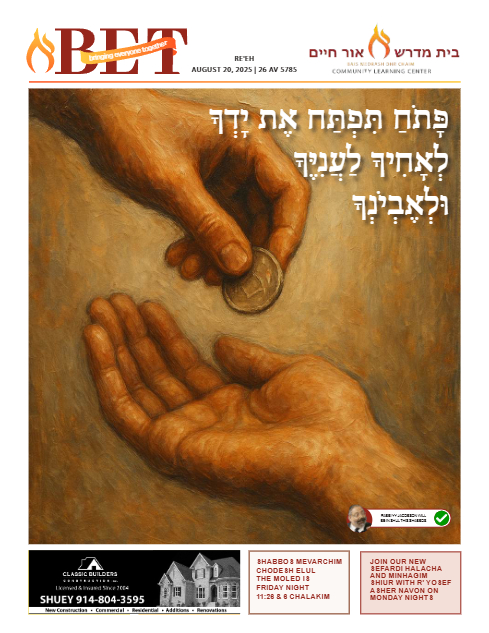
Return on Investment
The Vilna Gaon zt”l writes that giving tzedakah can be compared to a farmer who sows his field. Unlike a merchant who buys and sells instantly, a farmer invests money to plow and buy seeds. At first, the seeds must rot. They disappear into the ground and are seemingly lost. But then, they start to grow, and at the end of the year, there is profit. So too with tzedakah. When we first give, we do not see any results. On the contrary, we seemingly have “lost” our money, never to return. Only at a later time do we see results. Hashem sees our good deeds and rewards us at a later time. As we say in davening: "זורע צדקות" - If one “plants” tzedaka, charity, "מצמיח ישועות", eventually a salvation will grow out of it!
Similarly, writes the Dubno Maggid, tzedakah can be compared to a farmer who spills a bag of wheat. It starts to sprout, and he ends up with three times as much! Whatever one gives away to others is sure to bring more in return! It is as if one plants and harvests to receive so much more in return.
This is the berachah that the Torah gives us.
The Satmar Rebbe, R’ Yoel Teitelbaum zt”l, once noticed a man walking around the beis medrash collecting tzedakah. When he approached a Yid, the man refused to give a donation. Instead, he felt the need to offer up some free advice. “My friend, have bitachon, and you’ll survive!”
The Satmar Rebbe reacted and told the Yid, “The general klal (rule) is that all middos and hashkafos, whether good or bad, can be used for avodas Hashem. It is part of our obligation to follow in His ways. Even kefirah, i.e., not believing in Hashem and lacking bitachon, can also be used for the good. How is this possible? When it comes to helping others. Then, one should forget about Hashem being able to help and do their utmost to help their fellow Yid!"
RABBI SHIMON FINKELMAN TORAH TAVLIN