The absence of emunah means idolatry
טיב הקהילה English | August 20, 2025
Print This Article
View Original PDF

The absence of emunah means idolatry

טיב הקהילה English | December 10, 2025

וְהַקְּלָלָה אִם לֹא תִשְׁמְעוּ אֶל מִצְוֹת ה’ אֱלֹקֵיכֶם וְסַרְתֶּם מִן הַדֶּרֶךְ אֲשֶׁר אָנֹכִי מְצַוֶּה אֶתְכֶם הַיּוֹם לָלֶכֶת אַחֲרֵי אֱלֹהִים אֲחֵרִים אֲשֶׁר לֹא יְדַעְתֶּם: (יא, כח)

And the curse: if you do not listen to the commandments of Hashem, your G-d, and you stray from the path that I command you today, to follow the gods of others, that you did not know. (11:28)

Rashi explains: You learned from this that anyone who worships idols he has strayed from the entire path which Israel has been commanded to follow. From here they said, “Whoever believes in idolatry is like one who denies the Torah in its entirety.”

In ancient days, already in the time of the nevi’im, the Bnei Yisrael struggled greatly with the sin of idolatry, and as anyone who studies the sifrei nevi’im will see how much that trial was to the detriment of those generations, and we can well understand from this why the Torah needed to increase so many warnings about that transgression. However, in our days that trial has already been nullified, as is told in the Gemara (Yoma 69b) at length, how the Anshei Kineses Yisrael killed that difficult yetzer, and since then there is no one of Israel who at all desires such madness, to bow down to wood and stone and to say, “You are my god,” Rachmana litzlan.

However, we know that our Torah is eternal, and necessarily the Torah also spoke concerning our days, and necessarily also in our days there are stumbling blocks that one who stumbles in them is in the category of one who serves avodah zara, Rachmana litzlan. And there is room to say that even weakness in faith is in the category of idolatry, Rachmana litzlan, for one who serves idols denies thereby the King of the world, and likewise one whose faith is weak, he too denies the fundamental principle. Indeed, the very doubting of faith is not an actual sin, but in idolatry thought is considered as deed.

If so, when a person is not satisfied with the conduct of Heaven with him, behold he is exactly in the category of one who serves idolatry. For it is among the principles of faith to know that HaKadosh Baruch Hu is the source of goodness, and from the source of goodness no evil will be drawn forth. And necessarily, also that which appears to the eyes of flesh as evil is in truth good. And if a person is not content with his situation, he shows thereby that he is deficient in faith in the essence of His goodness Yisbarach and that too is in the category of denial and idolatry, Rachmana litzlan.

And this was expanded upon in the Sefer HaTanya (Iggeres HaKodesh, 11), and these are his words: “And this is the essence of faith, for which man was created, to believe that there is no place empty of Him, and in the light of the face of the King is life, and therefore strength and joy are in His place, since He is only good all the day. And therefore, the first of all is that a man should rejoice and exult at all times and hours, and truly live in his faith in Hashem, Who gives life and does good with him at every moment. And one who saddens himself and laments shows in himself that he has a little evil and suffering, and that he lacks some good, and behold this is like a denier, chas v’shalom. And therefore, Chachmei Emes greatly distanced the trait of sadness. But the believer does not worry about any suffering in the world, and in all matters of the world, yes and no are equal in his eyes in true equality. And one for whom they are not equal shows in himself that he is of the mixed multitude, who act only for themselves, and he loves himself to go out from under the hand of Hashem and to live the life of idol worshippers because of his love for himself. And therefore, he desires flesh, children, and sustenance, for that is good for him, and it would be easier for him had he not been created. For the essence of man’s creation in this world is in order to test him with these trials, and to know what is in his heart, if he will turn his heart after other gods, which are the desires of the body that extend from the Other Side, and in them he delights, or if his delight and his will is to live true life that extends from the living G-d, and he will believe that in truth he lives by them, and all his needs and all his matters truly extend in all their details not from the Other Side, for from Hashem the steps of man are established, and there is no word, etc. And if so, everything is goodness in the utmost, only it is not apprehended. And through this faith in truth, everything also becomes good in revelation, for by this faith, that he believes that the evil that is seemingly revealed in truth all its vitality is from the upper goodness, which is His wisdom Yisbarach which is not apprehended, and it is the Eden that is above the World to Come, behold through this faith the seeming evil is truly included and elevated in the upper hidden goodness.” End of quote.

Also, that which a man increases his effort in order to obtain his needs and livelihood indicates a deficiency in faith. For the believer knows that he has fulfilled his obligation with minimal effort, which is from the decree of the Creator upon us. And after he has done that which is imposed upon him, his obligation is to remove his worry and to trust in Hashem that He will provide him with all his needs. And if he does not do so, it is a sign that his trust in Hashem is not firm and strong, and this is considered as denial, as though HaKadosh Baruch Hu needs his help in order to sustain him and provide for him.

In light of the above, it is well understood the wording of the posuk before us: “To go after other gods whom you have not known.” For the words “whom you have not known” seem superfluous, for surely it is obvious that other gods are something that we have never known to have power to benefit. However, according to our words we can say that the intention of the posuk is to say that the going after other gods can sometimes be in ways that you would not at all imagine that this too is idolatry, as explained here, that the absence of faith is also like idolatry, and it is a matter to which a person does not pay attention.

And behold it is known what is brought in the Zohar HaKodesh (Part 2, page 82b), that the 613 commandments are 613 ways how to merit faith in the first utterance of the Ten Commandments, “I am Hashem your G-d.” That is to say, the purpose of all the 613 commandments is the clarity of faith in Hashem Yisbarach. And it follows that one who strengthens himself with strong faith is in the aspect of fulfilling all of the Torah, for he merits, through the power of his strengthening, to come to the purpose of the Torah.

And according to this it is well understood what is said in the Gemara (Kiddushin 40a): “Idolatry is severe, for whoever denies it is as though he acknowledges the entire Torah.” For when a person knows and feels that Hashem Yisbarach is the One Who leads the world, and He is the One Who sustains and provides for all, and all that He does is for the good, thereby he denies idolatry which is called “whom you have not known,” and through the merit of his faith he is as one who fulfills the entire Torah.

And there is room to say that this was the intention of Chazal when they said (Makkos 24a): “Chabakkuk came and established them on one, as it is said (Chabakkuk 2:4): ‘וצדיק באמונתו יחיה’ - ‘And the righteous shall live by his faith.’” That is, that the navi Chabakkuk established the entire Torah upon the commandment of faith, for as stated, through this commandment one can merit in a certain measure the fulfillment of the entire Torah, since the purpose of the entire Torah is faith.

And it is well understood according to this why this reading is read in the month of Elul. For as stated, the Torah hints to the matter of faith, that it is the purpose of the fulfillment of our holy Torah. And the person who desires to stand in judgment on the Day of Rosh Hashanah, when the merit of the fulfillment of the entire Torah is in his hand, it is imposed upon him to strengthen himself in faith and to review faith throughout the month of mercy. And then, when he comes on the Day of Judgment, the faith will be rooted in him as is fitting, and he will properly stand before the King of Judgment with the merit of the entire Torah in his hand.
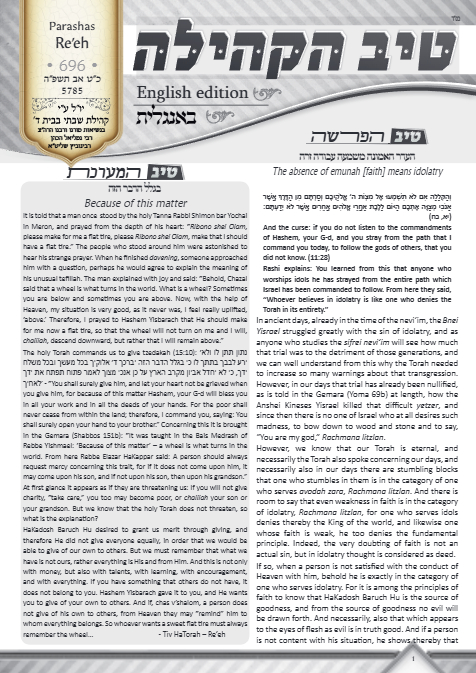

וְהַקְּלָלָה אִם לֹא תִשְׁמְעוּ אֶל מִצְוֹת ה’ אֱלֹקֵיכֶם וְסַרְתֶּם מִן הַדֶּרֶךְ אֲשֶׁר אָנֹכִי מְצַוֶּה אֶתְכֶם הַיּוֹם לָלֶכֶת אַחֲרֵי אֱלֹהִים אֲחֵרִים אֲשֶׁר לֹא יְדַעְתֶּם: (יא, כח)

And the curse: if you do not listen to the commandments of Hashem, your G-d, and you stray from the path that I command you today, to follow the gods of others, that you did not know. (11:28)

Rashi explains: You learned from this that anyone who worships idols he has strayed from the entire path which Israel has been commanded to follow. From here they said, “Whoever believes in idolatry is like one who denies the Torah in its entirety.”

In ancient days, already in the time of the nevi’im, the Bnei Yisrael struggled greatly with the sin of idolatry, and as anyone who studies the sifrei nevi’im will see how much that trial was to the detriment of those generations, and we can well understand from this why the Torah needed to increase so many warnings about that transgression. However, in our days that trial has already been nullified, as is told in the Gemara (Yoma 69b) at length, how the Anshei Kineses Yisrael killed that difficult yetzer, and since then there is no one of Israel who at all desires such madness, to bow down to wood and stone and to say, “You are my god,” Rachmana litzlan.

However, we know that our Torah is eternal, and necessarily the Torah also spoke concerning our days, and necessarily also in our days there are stumbling blocks that one who stumbles in them is in the category of one who serves avodah zara, Rachmana litzlan. And there is room to say that even weakness in faith is in the category of idolatry, Rachmana litzlan, for one who serves idols denies thereby the King of the world, and likewise one whose faith is weak, he too denies the fundamental principle. Indeed, the very doubting of faith is not an actual sin, but in idolatry thought is considered as deed.

If so, when a person is not satisfied with the conduct of Heaven with him, behold he is exactly in the category of one who serves idolatry. For it is among the principles of faith to know that HaKadosh Baruch Hu is the source of goodness, and from the source of goodness no evil will be drawn forth. And necessarily, also that which appears to the eyes of flesh as evil is in truth good. And if a person is not content with his situation, he shows thereby that he is deficient in faith in the essence of His goodness Yisbarach and that too is in the category of denial and idolatry, Rachmana litzlan.

And this was expanded upon in the Sefer HaTanya (Iggeres HaKodesh, 11), and these are his words: “And this is the essence of faith, for which man was created, to believe that there is no place empty of Him, and in the light of the face of the King is life, and therefore strength and joy are in His place, since He is only good all the day. And therefore, the first of all is that a man should rejoice and exult at all times and hours, and truly live in his faith in Hashem, Who gives life and does good with him at every moment. And one who saddens himself and laments shows in himself that he has a little evil and suffering, and that he lacks some good, and behold this is like a denier, chas v’shalom. And therefore, Chachmei Emes greatly distanced the trait of sadness. But the believer does not worry about any suffering in the world, and in all matters of the world, yes and no are equal in his eyes in true equality. And one for whom they are not equal shows in himself that he is of the mixed multitude, who act only for themselves, and he loves himself to go out from under the hand of Hashem and to live the life of idol worshippers because of his love for himself. And therefore, he desires flesh, children, and sustenance, for that is good for him, and it would be easier for him had he not been created. For the essence of man’s creation in this world is in order to test him with these trials, and to know what is in his heart, if he will turn his heart after other gods, which are the desires of the body that extend from the Other Side, and in them he delights, or if his delight and his will is to live true life that extends from the living G-d, and he will believe that in truth he lives by them, and all his needs and all his matters truly extend in all their details not from the Other Side, for from Hashem the steps of man are established, and there is no word, etc. And if so, everything is goodness in the utmost, only it is not apprehended. And through this faith in truth, everything also becomes good in revelation, for by this faith, that he believes that the evil that is seemingly revealed in truth all its vitality is from the upper goodness, which is His wisdom Yisbarach which is not apprehended, and it is the Eden that is above the World to Come, behold through this faith the seeming evil is truly included and elevated in the upper hidden goodness.” End of quote.

Also, that which a man increases his effort in order to obtain his needs and livelihood indicates a deficiency in faith. For the believer knows that he has fulfilled his obligation with minimal effort, which is from the decree of the Creator upon us. And after he has done that which is imposed upon him, his obligation is to remove his worry and to trust in Hashem that He will provide him with all his needs. And if he does not do so, it is a sign that his trust in Hashem is not firm and strong, and this is considered as denial, as though HaKadosh Baruch Hu needs his help in order to sustain him and provide for him.

In light of the above, it is well understood the wording of the posuk before us: “To go after other gods whom you have not known.” For the words “whom you have not known” seem superfluous, for surely it is obvious that other gods are something that we have never known to have power to benefit. However, according to our words we can say that the intention of the posuk is to say that the going after other gods can sometimes be in ways that you would not at all imagine that this too is idolatry, as explained here, that the absence of faith is also like idolatry, and it is a matter to which a person does not pay attention.

And behold it is known what is brought in the Zohar HaKodesh (Part 2, page 82b), that the 613 commandments are 613 ways how to merit faith in the first utterance of the Ten Commandments, “I am Hashem your G-d.” That is to say, the purpose of all the 613 commandments is the clarity of faith in Hashem Yisbarach. And it follows that one who strengthens himself with strong faith is in the aspect of fulfilling all of the Torah, for he merits, through the power of his strengthening, to come to the purpose of the Torah.

And according to this it is well understood what is said in the Gemara (Kiddushin 40a): “Idolatry is severe, for whoever denies it is as though he acknowledges the entire Torah.” For when a person knows and feels that Hashem Yisbarach is the One Who leads the world, and He is the One Who sustains and provides for all, and all that He does is for the good, thereby he denies idolatry which is called “whom you have not known,” and through the merit of his faith he is as one who fulfills the entire Torah.

And there is room to say that this was the intention of Chazal when they said (Makkos 24a): “Chabakkuk came and established them on one, as it is said (Chabakkuk 2:4): ‘וצדיק באמונתו יחיה’ - ‘And the righteous shall live by his faith.’” That is, that the navi Chabakkuk established the entire Torah upon the commandment of faith, for as stated, through this commandment one can merit in a certain measure the fulfillment of the entire Torah, since the purpose of the entire Torah is faith.

And it is well understood according to this why this reading is read in the month of Elul. For as stated, the Torah hints to the matter of faith, that it is the purpose of the fulfillment of our holy Torah. And the person who desires to stand in judgment on the Day of Rosh Hashanah, when the merit of the fulfillment of the entire Torah is in his hand, it is imposed upon him to strengthen himself in faith and to review faith throughout the month of mercy. And then, when he comes on the Day of Judgment, the faith will be rooted in him as is fitting, and he will properly stand before the King of Judgment with the merit of the entire Torah in his hand.

PDF Preview