Mosheh Heard and It Was Good in His Eyes
Sichos In English | April 25, 2025
Print This Article
View Original PDF

Mosheh Heard and It Was Good in His Eyes

Sichos In English | June 27, 2025

Adapted from a shiur given by the Tolner Rebbe shlita, Shmini 5776

לע"נ האשה החשובה מרת חוה חיה שרה ע"ה בת הרב נטע אריה ז"ל ת.נ.צ.ב.ה.

וַיִּשְׁמַע משֶׁה וַיִּיטַב בְׁעֵינָיו – And Mosheh heard and he approved

Rashi comments: And he approved – He admitted, and was not ashamed to say, “I had not heard.” Rashi’s source for this is the Gemara, but the Gemara continues, “... rather he said, ‘I had heard and forgot.’ ” Why did Rashi leave this out? In fact, the conclusion one would reach from just the words of Rashi is that Mosheh “had not heard.” Yet from the fuller version in the Gemara it is clear that he had heard, but forgot!

Q1

More fundamentally: What is Rashi telling us here, the praises of Mosheh? Should he be praised for sticking to the truth in saying that he had not heard? Could it be that he would say that he did hear, when in truth he did not?

Q2

Being Good in the Eyes
Besides, Rashi generally does not bring midrashic explanations that do not explain the simple meaning of the possuk. Clearly, the simple meaning is that Mosheh heard the words of Aharon and accepted them, so why did Rashi turn to the Midrashic interpretation?

Q3

Also, the possuk, in its literal translation says, “it was good in his eyes.” There are so many other ways of saying approved or accepted. Why did the possuk choose the words, and it was good in his eyes?

Q4

Furthermore, Mosheh was responding to Aharon saying, ...Had I eaten the sin offering this day would Hashem approve (lit. would it be good in the eyes of Hashem)? Why the mirroring of Hashem’s approval with Mosheh’s approval?

Q5

More fundamentally: We are saying that Mosheh heard, remembered that that was the correct ruling, and that is why it was good in his eyes. It almost sounds as if he was happy about his error. Wouldn’t it have been better had he not erred, and not needed to be corrected by his brother, Aharon? Why was he so happy to have erred?

Q6

I Erred in the Law, and My Brother Aaron Came and Taught Me
Even more difficult is the Midrash here that says: And Mosheh heard and he approved; he sent a herald throughout the camp to proclaim, “I erred in the law, and my brother Aharon came and taught me.” But where is this hinted at in the words of the possuk? Finally, just
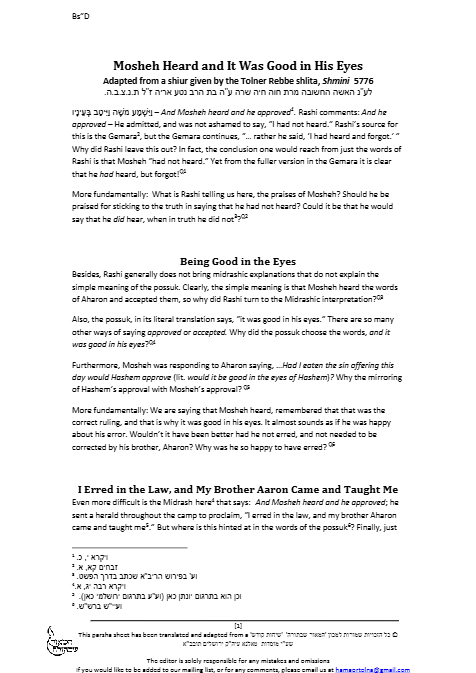

Adapted from a shiur given by the Tolner Rebbe shlita, Shmini 5776

לע"נ האשה החשובה מרת חוה חיה שרה ע"ה בת הרב נטע אריה ז"ל ת.נ.צ.ב.ה.

וַיִּשְׁמַע משֶׁה וַיִּיטַב בְׁעֵינָיו – And Mosheh heard and he approved

Rashi comments: And he approved – He admitted, and was not ashamed to say, “I had not heard.” Rashi’s source for this is the Gemara, but the Gemara continues, “... rather he said, ‘I had heard and forgot.’ ” Why did Rashi leave this out? In fact, the conclusion one would reach from just the words of Rashi is that Mosheh “had not heard.” Yet from the fuller version in the Gemara it is clear that he had heard, but forgot!

Q1

More fundamentally: What is Rashi telling us here, the praises of Mosheh? Should he be praised for sticking to the truth in saying that he had not heard? Could it be that he would say that he did hear, when in truth he did not?

Q2

Being Good in the Eyes
Besides, Rashi generally does not bring midrashic explanations that do not explain the simple meaning of the possuk. Clearly, the simple meaning is that Mosheh heard the words of Aharon and accepted them, so why did Rashi turn to the Midrashic interpretation?

Q3

Also, the possuk, in its literal translation says, “it was good in his eyes.” There are so many other ways of saying approved or accepted. Why did the possuk choose the words, and it was good in his eyes?

Q4

Furthermore, Mosheh was responding to Aharon saying, ...Had I eaten the sin offering this day would Hashem approve (lit. would it be good in the eyes of Hashem)? Why the mirroring of Hashem’s approval with Mosheh’s approval?

Q5

More fundamentally: We are saying that Mosheh heard, remembered that that was the correct ruling, and that is why it was good in his eyes. It almost sounds as if he was happy about his error. Wouldn’t it have been better had he not erred, and not needed to be corrected by his brother, Aharon? Why was he so happy to have erred?

Q6

I Erred in the Law, and My Brother Aaron Came and Taught Me
Even more difficult is the Midrash here that says: And Mosheh heard and he approved; he sent a herald throughout the camp to proclaim, “I erred in the law, and my brother Aharon came and taught me.” But where is this hinted at in the words of the possuk? Finally, just

PDF Preview