Sidra of the Week Shemini
Questions on the Sidra | April 02, 2024
Print This Article
View Original PDF

Sidra of the Week Shemini

Questions on the Sidra | June 27, 2025

1. This week’s Sidra continues the description of the Consecration of the Mishkan and the induction of Aharon and his sons as the Kohannim. Mosheh tells Aharon the things that HaShem has commanded shall be done on the eighth day of the Consecration and informs us all that on this day the Almighty Glory of HaShem will be revealed to all.

2. After the various Korbonnos had been brought, Aharon then raised his hands towards the People and, for the first time ever, blessed them with the Birkas Kohannim: “May HaShem bless you and protect you all. May HaShem shine His beneficent attention upon you and be gracious to you. May HaShem direct His favourable attention towards you and grant you all peace.”

3. Then both Mosheh our Teacher and Aharon the Kohen Ga’dol together blessed the standing crowds of people, whose contributions and skilful work had made the Mishkan: “May HaShem find satisfaction in us and in this, our work, done for His Glory and may He grant that this Mishkan be firmly established. Indeed, may HaShem grant that whatever we do for His Glory shall find satisfaction in His sight and be properly established. May it be the Will of HaShem to bestow His Presence upon this Mishkan, the work of your hands.”

4. Immediately as these words were spoken there came down a wondrous fire from Heaven and it consumed the Korbonnos that were on the Altar. At this instant reply to their prayers for the Divine Presence to manifest Itself, the people rejoiced and fell upon their faces. In pure worship of HaShem, they gave thanks to Him, Who has chosen Yisroel as His People to dwell amongst them, and they sang loud praises of HaShem.

5. It was just then that tragedy struck: Noddov and Avihu, the two eldest sons of Aharon, had also been included in the holy Service of the Consecration of the Mishkan. But in an attempt to heighten their elation on this momentous occasion, they drank some wine, for wine has the potential to loosen one’s reserve and to let one be free to express one’s happiness and ecstasy without inhibition. But under the influence of their wine, they forgot themselves. They thought that they knew better than their elders, Mosheh and Aharon, about how this great day should be celebrated. Without seeking advice from Mosheh and Aharon and without asking their permission; without even consulting with each other; indeed without consulting their wives (for they were unmarried and had they been married, their wives might well have sensibly advised them against doing what they did and thus might have saved them) Noddov and Avihu decided to celebrate the Consecration in their own individual way. Taking fire from a source not commanded by HaShem and burning incense not ordered by Him, they entered the holy Mishkan to offer their own presentation in the Presence of HaShem. The consequences were immediate. There came forth a terrible fire from HaShem and it consumed them and they died instantly.

6. The tragic death of the sons of Aharon came as a terrible shock to him and to the whole People. Mosheh comforted his brother by telling him that their punishment in fact showed their greatness: their death demonstrated to all the awesomeness of HaShem and His Mikdash. Indeed, Mosheh told Aharon, it had been foretold that the Almightiness of HaShem would be made known through His chosen ones. Although at the time no-one had known who these chosen ones were to be, nor could anyone have envisaged the fearsome Power of HaShem being demonstrated so sensationally, the fact that Noddov and Avihu had died just as they had dared to come near when they were not bidden showed that HaShem considered them fittingly great to teach that lesson.

7. Aharon’s greatness — and his complete suitability to be the Nation’s Kohen Ga’dol — was seen by everyone when he accepted these words of comfort from his younger brother Mosheh. The ever-faithful servant of HaShem, Aharon resigned himself to HaShem’s Will and, in submissive silence, he controlled his natural feelings to weep at his double personal tragedy so as not to mar the holy joy of the Consecration of the Mishkan of HaShem.

8. Straight after this demonstration of iron self-discipline by Aharon, HaShem spoke directly to him and commanded the laws forbidding intoxicating drink to Kohannim officiating in the Mishkan. Usually, HaShem spoke to Mosheh, that he should teach His instructions further. By now speaking directly to Aharon, HaShem showed that Aharon’s unquestioning loyalty found favour with Him, and indeed Aharon’s example is held up to us to show how a true servant of HaShem unreservedly accepts the Will of HaShem. In fact, all Aharon’s actions throughout that great day of Consecration were correct and in accordance with the command of HaShem, even more so than Mosheh thought and as, in fact, Mosheh himself readily admitted.

9. Even though the next part of the Sidra, the Dietary Laws, is not connected with the events of the Consecration of the Mishkan, HaShem has ordered that these laws shall be placed in His Torah, as dictated by Him to Mosheh our Teacher at Mount Sinai, immediately after those happenings. For just as the death of the sons of Aharon at the Consecration was caused by their drinking wine and their acting under the influence of what they had drunk, so, teaches the Torah, in a more fundamental way, are all human beings — but especially so the Jewish People — influenced by what they eat and drink. The Torah says, “We are what we eat,” and the Holy One, blessed is He, the Creator of the world, commands us to abstain from that food and drink that He knows will harm the unique soul of His Chosen People. These laws, commanded by HaShem, are not to be obeyed out of consideration for our physical well-being nor for health reasons (though as with all the laws of HaShem’s Torah, these benefits are assured, too). For these laws are essentially “Chukkim,” that is, laws for which no reason is stated, and which we obey for no other reason than that HaShem has commanded them. Interestingly enough, as if to stress this spiritual aspect, the Torah calls the animals that are forbidden to us, not “Ossur” (which means “forbidden”) but “Tommay,” which is the expression used for things that defile the soul.

10. The Torah forbids us to eat the meat of any animal that does not have both of two characteristics, namely, it must chew the cud and it must have hooves that are completely cloven. One without the other (as with the pig, which has cloven hooves but does not chew the cud, or the camel, which chews the cud but does not have cloven hooves) does not make that animal’s meat permitted. In the case of sea creatures and fish, too, two characteristics must exist, namely, they must have fins and they must have scales. (Shrimps, crabs, eels, etc., are therefore forbidden.) The Torah forbids us to eat any insect, winged or otherwise, and lists also those birds that are forbidden to us. [Nowadays, we eat only those birds which we know, by established Tradition, to be Kosher, and the same applies to other creatures of the air (certain kinds of locusts, etc.) too.]

11. The Sidra continues with some further laws of Tum’oh: laws concerning the carcasses of the forbidden animals; the carcasses of permitted animals that have died (as opposed to having been slaughtered correctly by Shechita, in which case they are not Tum’oh); the laws of the eight named creatures whose carcasses impart Tum’oh by mere contact. (Tum’oh can be imparted to vessels, clothing, in fact, to any manufactured articles, as well as to man, and to food and drink, too.) The laws of Tum’oh and Taharoh (the common translation “unclean” and “clean” is inadequate as it does not truly express the spiritual dimension that is intended) are complicated and intricate indeed. Yet to those who would make a serious study of all these Laws, there is revealed a system and plan which, despite the fact that they are “Chukkim,” makes clear the great and noble ideals of holiness that HaShem in His goodness intends for us, His Holy People.

12. Through observing these Laws of Kashrus and of Tum’oh and Taharoh (Taharoh is the process commanded by HaShem to dispel the state of Tum’oh, by means of the Mikveh, etc.) the Jewish People is elevated to that high spiritual level that HaShem wishes us to attain. Indeed, our deliverance from Egypt was conditional upon our fulfilling these commandments and our obedience to these Laws is reason enough for our redemption: it is through the faithful observance of these Mitzvos that we can become the holy People of HaShem. As HaShem says: “Do not make yourselves disgusting by eating any of these... Do not defile yourselves with them because it will make you spiritually ruined. For I am HaShem your Lord, and as I am holy, you also shall make yourselves holy and be sanctified. Therefore, do not defile yourselves ... I, HaShem, brought you up out of the land of Egypt to be your G-d: I am holy — and you also shall be holy...”

For the explanation of the Haftorah of Sidra שמיני please go to HAFTORAHS.
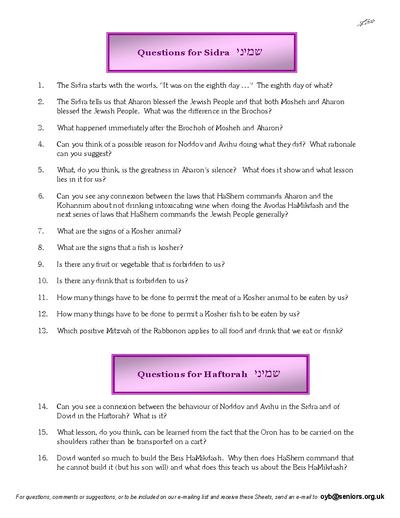
1. This week’s Sidra continues the description of the Consecration of the Mishkan and the induction of Aharon and his sons as the Kohannim. Mosheh tells Aharon the things that HaShem has commanded shall be done on the eighth day of the Consecration and informs us all that on this day the Almighty Glory of HaShem will be revealed to all.

2. After the various Korbonnos had been brought, Aharon then raised his hands towards the People and, for the first time ever, blessed them with the Birkas Kohannim: “May HaShem bless you and protect you all. May HaShem shine His beneficent attention upon you and be gracious to you. May HaShem direct His favourable attention towards you and grant you all peace.”

3. Then both Mosheh our Teacher and Aharon the Kohen Ga’dol together blessed the standing crowds of people, whose contributions and skilful work had made the Mishkan: “May HaShem find satisfaction in us and in this, our work, done for His Glory and may He grant that this Mishkan be firmly established. Indeed, may HaShem grant that whatever we do for His Glory shall find satisfaction in His sight and be properly established. May it be the Will of HaShem to bestow His Presence upon this Mishkan, the work of your hands.”

4. Immediately as these words were spoken there came down a wondrous fire from Heaven and it consumed the Korbonnos that were on the Altar. At this instant reply to their prayers for the Divine Presence to manifest Itself, the people rejoiced and fell upon their faces. In pure worship of HaShem, they gave thanks to Him, Who has chosen Yisroel as His People to dwell amongst them, and they sang loud praises of HaShem.

5. It was just then that tragedy struck: Noddov and Avihu, the two eldest sons of Aharon, had also been included in the holy Service of the Consecration of the Mishkan. But in an attempt to heighten their elation on this momentous occasion, they drank some wine, for wine has the potential to loosen one’s reserve and to let one be free to express one’s happiness and ecstasy without inhibition. But under the influence of their wine, they forgot themselves. They thought that they knew better than their elders, Mosheh and Aharon, about how this great day should be celebrated. Without seeking advice from Mosheh and Aharon and without asking their permission; without even consulting with each other; indeed without consulting their wives (for they were unmarried and had they been married, their wives might well have sensibly advised them against doing what they did and thus might have saved them) Noddov and Avihu decided to celebrate the Consecration in their own individual way. Taking fire from a source not commanded by HaShem and burning incense not ordered by Him, they entered the holy Mishkan to offer their own presentation in the Presence of HaShem. The consequences were immediate. There came forth a terrible fire from HaShem and it consumed them and they died instantly.

6. The tragic death of the sons of Aharon came as a terrible shock to him and to the whole People. Mosheh comforted his brother by telling him that their punishment in fact showed their greatness: their death demonstrated to all the awesomeness of HaShem and His Mikdash. Indeed, Mosheh told Aharon, it had been foretold that the Almightiness of HaShem would be made known through His chosen ones. Although at the time no-one had known who these chosen ones were to be, nor could anyone have envisaged the fearsome Power of HaShem being demonstrated so sensationally, the fact that Noddov and Avihu had died just as they had dared to come near when they were not bidden showed that HaShem considered them fittingly great to teach that lesson.

7. Aharon’s greatness — and his complete suitability to be the Nation’s Kohen Ga’dol — was seen by everyone when he accepted these words of comfort from his younger brother Mosheh. The ever-faithful servant of HaShem, Aharon resigned himself to HaShem’s Will and, in submissive silence, he controlled his natural feelings to weep at his double personal tragedy so as not to mar the holy joy of the Consecration of the Mishkan of HaShem.

8. Straight after this demonstration of iron self-discipline by Aharon, HaShem spoke directly to him and commanded the laws forbidding intoxicating drink to Kohannim officiating in the Mishkan. Usually, HaShem spoke to Mosheh, that he should teach His instructions further. By now speaking directly to Aharon, HaShem showed that Aharon’s unquestioning loyalty found favour with Him, and indeed Aharon’s example is held up to us to show how a true servant of HaShem unreservedly accepts the Will of HaShem. In fact, all Aharon’s actions throughout that great day of Consecration were correct and in accordance with the command of HaShem, even more so than Mosheh thought and as, in fact, Mosheh himself readily admitted.

9. Even though the next part of the Sidra, the Dietary Laws, is not connected with the events of the Consecration of the Mishkan, HaShem has ordered that these laws shall be placed in His Torah, as dictated by Him to Mosheh our Teacher at Mount Sinai, immediately after those happenings. For just as the death of the sons of Aharon at the Consecration was caused by their drinking wine and their acting under the influence of what they had drunk, so, teaches the Torah, in a more fundamental way, are all human beings — but especially so the Jewish People — influenced by what they eat and drink. The Torah says, “We are what we eat,” and the Holy One, blessed is He, the Creator of the world, commands us to abstain from that food and drink that He knows will harm the unique soul of His Chosen People. These laws, commanded by HaShem, are not to be obeyed out of consideration for our physical well-being nor for health reasons (though as with all the laws of HaShem’s Torah, these benefits are assured, too). For these laws are essentially “Chukkim,” that is, laws for which no reason is stated, and which we obey for no other reason than that HaShem has commanded them. Interestingly enough, as if to stress this spiritual aspect, the Torah calls the animals that are forbidden to us, not “Ossur” (which means “forbidden”) but “Tommay,” which is the expression used for things that defile the soul.

10. The Torah forbids us to eat the meat of any animal that does not have both of two characteristics, namely, it must chew the cud and it must have hooves that are completely cloven. One without the other (as with the pig, which has cloven hooves but does not chew the cud, or the camel, which chews the cud but does not have cloven hooves) does not make that animal’s meat permitted. In the case of sea creatures and fish, too, two characteristics must exist, namely, they must have fins and they must have scales. (Shrimps, crabs, eels, etc., are therefore forbidden.) The Torah forbids us to eat any insect, winged or otherwise, and lists also those birds that are forbidden to us. [Nowadays, we eat only those birds which we know, by established Tradition, to be Kosher, and the same applies to other creatures of the air (certain kinds of locusts, etc.) too.]

11. The Sidra continues with some further laws of Tum’oh: laws concerning the carcasses of the forbidden animals; the carcasses of permitted animals that have died (as opposed to having been slaughtered correctly by Shechita, in which case they are not Tum’oh); the laws of the eight named creatures whose carcasses impart Tum’oh by mere contact. (Tum’oh can be imparted to vessels, clothing, in fact, to any manufactured articles, as well as to man, and to food and drink, too.) The laws of Tum’oh and Taharoh (the common translation “unclean” and “clean” is inadequate as it does not truly express the spiritual dimension that is intended) are complicated and intricate indeed. Yet to those who would make a serious study of all these Laws, there is revealed a system and plan which, despite the fact that they are “Chukkim,” makes clear the great and noble ideals of holiness that HaShem in His goodness intends for us, His Holy People.

12. Through observing these Laws of Kashrus and of Tum’oh and Taharoh (Taharoh is the process commanded by HaShem to dispel the state of Tum’oh, by means of the Mikveh, etc.) the Jewish People is elevated to that high spiritual level that HaShem wishes us to attain. Indeed, our deliverance from Egypt was conditional upon our fulfilling these commandments and our obedience to these Laws is reason enough for our redemption: it is through the faithful observance of these Mitzvos that we can become the holy People of HaShem. As HaShem says: “Do not make yourselves disgusting by eating any of these... Do not defile yourselves with them because it will make you spiritually ruined. For I am HaShem your Lord, and as I am holy, you also shall make yourselves holy and be sanctified. Therefore, do not defile yourselves ... I, HaShem, brought you up out of the land of Egypt to be your G-d: I am holy — and you also shall be holy...”

For the explanation of the Haftorah of Sidra שמיני please go to HAFTORAHS.

PDF Preview