Parshat Shemot Absolute Trust
Ben Chamesh L'Mikra | January 01, 2024
Print This Article
View Original PDF

Parshat Shemot Absolute Trust

Ben Chamesh L'Mikra | December 31, 2025

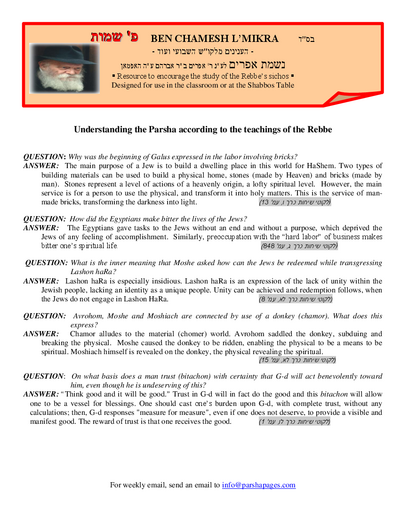
After slaying the Egyptian who had oppressed a Jewish slave, Moshe discovered that the incident had become known, and was afraid. This Sicha analyzes Moshe’s fear according to Rashi’s explanation of the verse, and reveals the tremendous power of trusting in G-d.

Moshe’s first recorded act on behalf of the Jewish people is when he saves a Jew from the oppressive hands of an Egyptian taskmaster. The Torah relates, that after growing up in the home of the Egyptian princess Basya, Moshe went out one day to observe how his brethren were faring. When he witnessed the harsh manner in which one of the Jews were treated, he decided to act and save his fellow Israelite.

Text 1

Now it came to pass in those days that Moshe grew up and went out to his brothers and looked at their burdens, and he saw an Egyptian man striking a Hebrew man of his brothers. He turned this way and that way, and he saw that there was no man; so he struck the Egyptian and hid him in the sand. He went out on the second day, and behold, two Hebrew men were quarreling, and he said to the wicked one, "Why are you going to strike your friend?" And he retorted, "Who made you a man, a prince, and a judge over us? Do you plan to slay me as you have slain the Egyptian?" Moses became frightened and said, "Indeed, the matter has become known!" Pharaoh heard of this incident, and he sought to slay Moshe; so Moshe fled from before Pharaoh...
Shemos 2:11-15

The Torah tells, that after Moshe killed the Egyptian taskmaster, two men had apparently witnessed what he had done and threatened to inform on him. Eventually, Pharaoh found about the incident and Moshe was forced to flee. The verse recounted that when the belligerent individual told Moshe, “Do you plan to slay me as you have slain the Egyptian?” Moshe became frightened. However, the Torah does not explicate what it was that frightened Moshe. Rashi clarifies the reason for this fear in two different methods:

Text 2

[To be explained] according to its simple meaning [that Moshe was afraid Pharaoh would kill him]. Medrashically, it is interpreted to mean that he was worried because he saw in Israel wicked men [i.e.,] informers. He said, “Since this is so, perhaps they [the Israelites] do not deserve to be redeemed [from slavery].”
Rashi, Shemos 2:14

Rashi presents two reasons for Moshe’s fear: 1) Moshe was afraid that Pharaoh would discover what had happened. 2) He was fearful that perhaps the Jewish people did not merit to be redeemed. The first explanation of Rashi is the simple interpretation of the verse, the second is brought from the Medrash.

The manner in which the medrash clarifies the verse however, is not the basic meaning of the text, and is not at all hinted to in the verse. The fact though that Rashi—whose objective it to explain the Torah in the straightforward manner—decided to bring the Medrashic explanation solicits the obvious question: What was lacking in the first interpretation that compelled Rashi to bring a non-literal Medrashic explanation?

The question

Generally, Rashi gives his commentary according to the simple meaning of the Torah. When he does not, and instead interprets the verse according to Medrash, it is because there is an inadequacy in the simple elucidation, which necessitates additional clarification. In the above verse describing Moshe’s fear, Rashi is evidently not satisfied with the simple understanding that the justification of Moshe’s fear was that perhaps Pharaoh would discover his exploits. Rashi therefore brings the Medrashic interpretation, that Moshe became frightened because he was no longer sure that the Jewish people merited to be redeemed. What, however, was problematic with Moshe’s fear, that Rashi was compelled to explain the verse according to the Medrash? Furthermore, Rashi’s use of the Medrash is especially difficult, as this additional explanation of Rashi necessitates that the continuation of the verse must be explained medrashicly as well. The text reads as follows: “Moshe became frightened and said, ‘Indeed, the matter has become known!’” According to the verse’s simple meaning, Moshe became frightened because the incident was publicized, and he worried that Pharaoh would find out. However, according to the Medrashic interpretation, that Moshe became frightened since “perhaps they do not deserve to be redeemed,” the words, “indeed, the matter has become known” is not understood. What had become known to Moshe that caused Moshe to fear? Rashi therefore offers explanation to the words “it had become known,” corresponding to the previous Medrashic explanation. He adds, that at this point, after seeing how his brethren were sinful, Moshe understood the reason that the Jewish people were chosen to suffer in exile more than any other nation.

Text 3

Its Medrashic interpretation, however, is [as follows]: the matter I (Moshe) was wondering about, [i.e.,] why the Israelites are considered more sinful than all the seventy nations [of the world], to be subjugated with back-breaking labor, has become known to me. Indeed, I see that they deserve it.
Rashi, Shemos 2:14

Rashi altered his customary style of explaining things in a literal manner twice in the same verse. This strengthens the question: What was it that initially compelled Rashi to explain the verse in a non-literal manner?

The simple meaning

Rashi was compelled to explain the verse according to the Medrash, being that there is an elementary problem with the simple explanation that Rashi wished to resolve.

The verse states, that after the individual told Moshe, “Who made you a man, a prince, and a judge over us? Do you plan to slay me as you have slain the Egyptian?” Moshe’s reaction was that he became frightened. Rashi was bothered that this information is of no relevance. We do not find that anything resulted because of this fright. Moshe did not flee Egypt when he became concerned; he only escaped Egypt after Pharaoh sought to kill him for his actions. If the Torah tells us this specific detail though, it must bear significance. The Torah is not merely a history book that recounts every event. If a specific incident is recorded, there must be a purpose in relating it. In explaining why it was indeed recorded, Rashi found it necessary to explain the verse Medrashicly. (While seemingly, the entire affair of the two Hebrew men who were quarreling is superfluous, this is not the case. Rashi explains their importance, being that “they informed on him.” However, the mention of Moshe’s fear does indeed seem to be unnecessary, as it did not cause any action on Moshe’s part.) This is the reason that Rashi did not settle with the basic explanation but added that Moshe was worried that “perhaps they do not deserve to be redeemed.” According to the Medrash, Moshe’s fear conveyed an important point in our understanding of the exile. It explains, that at that point, Moshe’s perspective of the Jewish people went through a dramatic shift as he now understood that perhaps they did not merit redemption.

Shemos 2:15.

Keeping it simple

While Rashi’s choice to explain the verse according to the Medrash is clearly justified, there is a principle regarding interpreting the Torah, that it must be explained on its most basic level as well.

Text 4

A verse cannot depart from its plain meaning.
Talmud, Shabbos 63a

One cannot discount the simple explanation of the verse merely because there is a difficulty in explaining it. This concept applies all the more when Rashi does bring the simple explanation as part of his commentary. Even though Rashi viewed the rudimentary meaning as problematic, which caused him to bring the Medrash, he did not leave it out entirely. Were Rashi to have not mentioned the simple meaning, it would be plausible to explain that the basic interpretation of the verse was so problematic, that even Rashi ignored it. However, given the fact that Rashi himself explains the verse “according to its simple meaning [that Moshe was afraid Pharaoh would kill him],” it is clear that Rashi does not completely discredit it. What then, can possibly be learned—on a simple level—of the Torah’s recount of Moshe’s fear, which necessitates its mention?

Being fearful

We can explain the significance to Moshe’s fear and its importance to the rest of the story through prefacing with the words of another Medrash:

Text 5

“Yaakov became very frightened and was distressed.” R. Pinchas in the name of R. Reuven said: “Two people were given an assurance from the Holy One Blessed be He, yet they were scared: the choicest of the Patriarchs and the choicest of the Prophets. The choicest of the Patriarchs was Yaakov, as the verse says, ‘For G-d chose Yaakov for Himself.’ G-d told him, ‘And behold, I am with you,’ and in the end he was fearful; as the verse says, ‘Yaakov became frightened.’ The choicest of the Prophets was Moshe, as the verse says, ‘Were it not that Moshe, His chosen one.’ G-d told him, ‘And He said, “For I will be with you,”’ and in the end he was fearful; as the verse says, ‘Do not fear him.’ One does not say, ‘do not fear,’ unless the person is already fearful.”
Bereishis Rabba, Parsha 76

The Medrash tells that Yaakov and Moshe were both told not to be afraid, yet they each were fearful. Yaakov was told that the G-d would be with him, yet he was scared of Esav. Moshe was told not to fear Og, King of Bashan, yet he too was frightened. There is a discussion amongst the commentators of the Medrash on how to view this fear: They discuss if their fear was positive and should therefore be emulated or perhaps it was misplaced.

Bereishis 32:8.

Tehillim 135:4.

Bereishis 28:15.
After slaying the Egyptian who had oppressed a Jewish slave, Moshe discovered that the incident had become known, and was afraid. This Sicha analyzes Moshe’s fear according to Rashi’s explanation of the verse, and reveals the tremendous power of trusting in G-d.

Moshe’s first recorded act on behalf of the Jewish people is when he saves a Jew from the oppressive hands of an Egyptian taskmaster. The Torah relates, that after growing up in the home of the Egyptian princess Basya, Moshe went out one day to observe how his brethren were faring. When he witnessed the harsh manner in which one of the Jews were treated, he decided to act and save his fellow Israelite.

Text 1

Now it came to pass in those days that Moshe grew up and went out to his brothers and looked at their burdens, and he saw an Egyptian man striking a Hebrew man of his brothers. He turned this way and that way, and he saw that there was no man; so he struck the Egyptian and hid him in the sand. He went out on the second day, and behold, two Hebrew men were quarreling, and he said to the wicked one, "Why are you going to strike your friend?" And he retorted, "Who made you a man, a prince, and a judge over us? Do you plan to slay me as you have slain the Egyptian?" Moses became frightened and said, "Indeed, the matter has become known!" Pharaoh heard of this incident, and he sought to slay Moshe; so Moshe fled from before Pharaoh...
Shemos 2:11-15

The Torah tells, that after Moshe killed the Egyptian taskmaster, two men had apparently witnessed what he had done and threatened to inform on him. Eventually, Pharaoh found about the incident and Moshe was forced to flee. The verse recounted that when the belligerent individual told Moshe, “Do you plan to slay me as you have slain the Egyptian?” Moshe became frightened. However, the Torah does not explicate what it was that frightened Moshe. Rashi clarifies the reason for this fear in two different methods:

Text 2

[To be explained] according to its simple meaning [that Moshe was afraid Pharaoh would kill him]. Medrashically, it is interpreted to mean that he was worried because he saw in Israel wicked men [i.e.,] informers. He said, “Since this is so, perhaps they [the Israelites] do not deserve to be redeemed [from slavery].”
Rashi, Shemos 2:14

Rashi presents two reasons for Moshe’s fear: 1) Moshe was afraid that Pharaoh would discover what had happened. 2) He was fearful that perhaps the Jewish people did not merit to be redeemed. The first explanation of Rashi is the simple interpretation of the verse, the second is brought from the Medrash.

The manner in which the medrash clarifies the verse however, is not the basic meaning of the text, and is not at all hinted to in the verse. The fact though that Rashi—whose objective it to explain the Torah in the straightforward manner—decided to bring the Medrashic explanation solicits the obvious question: What was lacking in the first interpretation that compelled Rashi to bring a non-literal Medrashic explanation?

The question

Generally, Rashi gives his commentary according to the simple meaning of the Torah. When he does not, and instead interprets the verse according to Medrash, it is because there is an inadequacy in the simple elucidation, which necessitates additional clarification. In the above verse describing Moshe’s fear, Rashi is evidently not satisfied with the simple understanding that the justification of Moshe’s fear was that perhaps Pharaoh would discover his exploits. Rashi therefore brings the Medrashic interpretation, that Moshe became frightened because he was no longer sure that the Jewish people merited to be redeemed. What, however, was problematic with Moshe’s fear, that Rashi was compelled to explain the verse according to the Medrash? Furthermore, Rashi’s use of the Medrash is especially difficult, as this additional explanation of Rashi necessitates that the continuation of the verse must be explained medrashicly as well. The text reads as follows: “Moshe became frightened and said, ‘Indeed, the matter has become known!’” According to the verse’s simple meaning, Moshe became frightened because the incident was publicized, and he worried that Pharaoh would find out. However, according to the Medrashic interpretation, that Moshe became frightened since “perhaps they do not deserve to be redeemed,” the words, “indeed, the matter has become known” is not understood. What had become known to Moshe that caused Moshe to fear? Rashi therefore offers explanation to the words “it had become known,” corresponding to the previous Medrashic explanation. He adds, that at this point, after seeing how his brethren were sinful, Moshe understood the reason that the Jewish people were chosen to suffer in exile more than any other nation.

Text 3

Its Medrashic interpretation, however, is [as follows]: the matter I (Moshe) was wondering about, [i.e.,] why the Israelites are considered more sinful than all the seventy nations [of the world], to be subjugated with back-breaking labor, has become known to me. Indeed, I see that they deserve it.
Rashi, Shemos 2:14

Rashi altered his customary style of explaining things in a literal manner twice in the same verse. This strengthens the question: What was it that initially compelled Rashi to explain the verse in a non-literal manner?

The simple meaning

Rashi was compelled to explain the verse according to the Medrash, being that there is an elementary problem with the simple explanation that Rashi wished to resolve.

The verse states, that after the individual told Moshe, “Who made you a man, a prince, and a judge over us? Do you plan to slay me as you have slain the Egyptian?” Moshe’s reaction was that he became frightened. Rashi was bothered that this information is of no relevance. We do not find that anything resulted because of this fright. Moshe did not flee Egypt when he became concerned; he only escaped Egypt after Pharaoh sought to kill him for his actions. If the Torah tells us this specific detail though, it must bear significance. The Torah is not merely a history book that recounts every event. If a specific incident is recorded, there must be a purpose in relating it. In explaining why it was indeed recorded, Rashi found it necessary to explain the verse Medrashicly. (While seemingly, the entire affair of the two Hebrew men who were quarreling is superfluous, this is not the case. Rashi explains their importance, being that “they informed on him.” However, the mention of Moshe’s fear does indeed seem to be unnecessary, as it did not cause any action on Moshe’s part.) This is the reason that Rashi did not settle with the basic explanation but added that Moshe was worried that “perhaps they do not deserve to be redeemed.” According to the Medrash, Moshe’s fear conveyed an important point in our understanding of the exile. It explains, that at that point, Moshe’s perspective of the Jewish people went through a dramatic shift as he now understood that perhaps they did not merit redemption.

Shemos 2:15.

Keeping it simple

While Rashi’s choice to explain the verse according to the Medrash is clearly justified, there is a principle regarding interpreting the Torah, that it must be explained on its most basic level as well.

Text 4

A verse cannot depart from its plain meaning.
Talmud, Shabbos 63a

One cannot discount the simple explanation of the verse merely because there is a difficulty in explaining it. This concept applies all the more when Rashi does bring the simple explanation as part of his commentary. Even though Rashi viewed the rudimentary meaning as problematic, which caused him to bring the Medrash, he did not leave it out entirely. Were Rashi to have not mentioned the simple meaning, it would be plausible to explain that the basic interpretation of the verse was so problematic, that even Rashi ignored it. However, given the fact that Rashi himself explains the verse “according to its simple meaning [that Moshe was afraid Pharaoh would kill him],” it is clear that Rashi does not completely discredit it. What then, can possibly be learned—on a simple level—of the Torah’s recount of Moshe’s fear, which necessitates its mention?

Being fearful

We can explain the significance to Moshe’s fear and its importance to the rest of the story through prefacing with the words of another Medrash:

Text 5

“Yaakov became very frightened and was distressed.” R. Pinchas in the name of R. Reuven said: “Two people were given an assurance from the Holy One Blessed be He, yet they were scared: the choicest of the Patriarchs and the choicest of the Prophets. The choicest of the Patriarchs was Yaakov, as the verse says, ‘For G-d chose Yaakov for Himself.’ G-d told him, ‘And behold, I am with you,’ and in the end he was fearful; as the verse says, ‘Yaakov became frightened.’ The choicest of the Prophets was Moshe, as the verse says, ‘Were it not that Moshe, His chosen one.’ G-d told him, ‘And He said, “For I will be with you,”’ and in the end he was fearful; as the verse says, ‘Do not fear him.’ One does not say, ‘do not fear,’ unless the person is already fearful.”
Bereishis Rabba, Parsha 76

The Medrash tells that Yaakov and Moshe were both told not to be afraid, yet they each were fearful. Yaakov was told that the G-d would be with him, yet he was scared of Esav. Moshe was told not to fear Og, King of Bashan, yet he too was frightened. There is a discussion amongst the commentators of the Medrash on how to view this fear: They discuss if their fear was positive and should therefore be emulated or perhaps it was misplaced.

Bereishis 32:8.

Tehillim 135:4.

Bereishis 28:15.

PDF Preview