Sidra of the Week Shemos
This week’s Sidra takes its name from its opening words and, as with the other Chumoshim, also gives its name to this whole Book, the second, of the Five Books of the Torah of which this is the first Sidra.
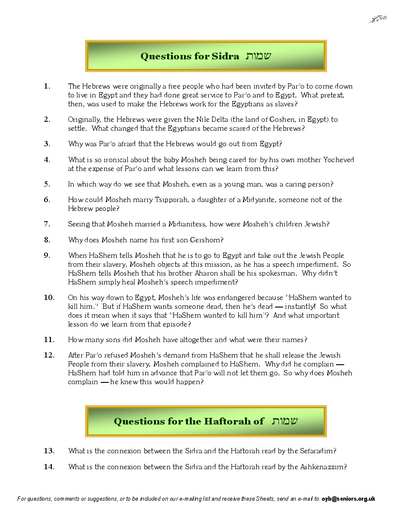
The Sidra begins by listing the names of the heads of the family of Yaakov who came down to Egypt. Originally, they were invited by Par’o, the king of Egypt, to come down from the Land of Kenaan and join Yosef, Yaakov’s son, whom Par’o had appointed as the Viceroy of Egypt. When they first came down, they were therefore the honoured guests of the Egyptian people, for the Egyptians were grateful to the family and people of Yosef. After all, it was because of Yosef’s foresight and efforts that, firstly, the land and its people were spared from the desolation of the seven years of famine and, secondly, through his plan, Egypt had become exceedingly wealthy and powerful. With time, the family of Yaakov increased greatly and their presence became strong, first in the region of Goshen, which had been set aside for them, and then throughout the land of Egypt.
But time passes. Yosef and his brothers died. And there rose up in Egypt a king who chose not to recognize the great service that Yosef had done for the country. He then claimed that the Hebrews posed some sort of a threat to the safety of his people. Using this as a pretext, he and his advisers planned to subjugate the Hebrew People and to enslave them. Not suspecting anything so sinister, the Hebrews answered the king’s ostensible appeals to their feelings of patriotism towards their adopted country and readily volunteered their services in the programme of extensive building works of storage-cities that had been drawn up. Very quickly, the Hebrews found themselves entrapped. First, the pay was stopped, ostensibly, for economic reasons. Then it was ordered that the labourers shall not go home each night but, in view of the emergency and need for speedy implementation of the quotas, the labourers were to sleep in the barracks on the building sites. The quota of work to be done was steadily increased day by day, with Egyptian guards ensuring that the orders of Par’o were carried out. The demands made upon the Hebrews were harshly enforced, with Hebrew foremen made to force and to coax their fellow Hebrews to work ever harder to complete the quotas of labour demanded by the Egyptian overseers. All pretence of their work being voluntary faded quickly with nobody able to escape from their oppressors, either. The Hebrew people had been duped into becoming slaves in Egypt.
Over the months and years, their situation worsened. The years stretched into decades and as time passed, the Hebrews became resigned to this state of affairs and that they could not help themselves out of their plight. They had hardly a moment to think of anything else but the heavy workload and physical burdens placed upon them by the Egyptian taskmasters, enforced with cruel beatings and torture.
Whatever particular emergency had been the pretext for enslaving the Hebrews originally, whether it was a threatened invasion, or some other military alarm, or a drought and famine, with the Egyptian state now dependent upon a slave economy, Par’o the king of Egypt was now afraid that his Hebrew slaves might rise up and fight for their freedom, bringing economic ruin to his country. Par’o was indeed informed by his astrologers that they foresaw that a future leader of the Hebrews was about to be born and Par’o was fearful that eventually this person might rise up and lead them to freedom. Acting on the advice of his astrologers and Court officials, Par’o then decreed that until this perceived threat had passed, all Hebrew boys were to be killed at birth. At first he tried to get the midwives to do this surreptitiously but when he saw that they disobeyed his command, he decreed that they should be killed by being thrown into the River Nile. Then, as the stars foretold that this birth was imminent, Par’o and his advisers became more frantic and the decree was more rigorously implemented. As the time of his birth came closer still, the stars seemed to indicate ambiguously that this leader was to be both, a Hebrew and an Egyptian. In response, and until this perceived threat to Egypt had passed, the decree was therefore temporarily broadened to include all male children, even those of the Egyptian people themselves.
When Mosheh was born, his mother Yochevved managed to conceal him for some time. But the danger was very great and so, in a bid to save him and yet at the same time comply literally with the king’s edict (for failure to do so was punished with death) she hid him amongst the bulrushes in the river. His older sister Miryam settled down to keep watch at a distance. If he should need feeding, she hoped, she would bring him to his mother just as soon as the scene would be clear. After all, she thought, it would be only a short time before this terrible decree came to an end and then they could pretend that he was born later. But then Princess Bityoh, the daughter of Par’o himself, comes down to bathe in the river, and just there where Mosheh is hidden! She discovers the basket of reeds and realizes that the baby boy must be one of the Hebrews. Acting completely out of character and indeed pushing aside all the cruel indoctrination of the palace of her father, she has pity on the child and she determinedly takes him as her foster-child. But the baby, although obviously hungry, will not feed from an Egyptian wet-nurse and Miryam steps forward to offer to bring a nursing mother from the Hebrews. Thus it comes about that his mother Yochevved is paid from the royal coffers to nurse her own child, whom Bityoh later named “Mosheh,” and so it comes about, too, that Mosheh is brought up in the very palace of Par’o, learning at the knee of Par’o himself all that he will need to know about being the leader of his people, for so does HaShem often arrange things: trying to run away from the Will of HaShem is invariably utilized by Him in bringing it about that His Will is done.
As he grows up, the young Prince Mosheh interests himself in the sufferings of his brother-Hebrews. The very first time that he ventured out to one of the work sites where they are building a storage-city, he saves a Hebrew from a mercilessly cruel beating by an Egyptian slave-driver. Making sure that no-one was there, he kills the Egyptian tormentor and hides the body in the sand. But the next day, when Mosheh tries to stop a quarrel between two Hebrews, one of them rebukes Mosheh for interfering and asks in a loud voice if he would perhaps kill him as he had killed the Egyptian the day before — and so Mosheh’s deed becomes known to the Egyptians and he has to escape from Egypt to save his life. He flees to Midyon (it is the western side of today’s Saudi Arabia) and is given shelter there by Yisro, the lord of that region.
And so the one man in the whole of the land of Egypt who had shown any care for the Hebrew slaves and who might have alleviated their plight, is now a fugitive in a distant country — ironically because of a Hebrew slave that he was trying to help — and he is powerless to help them. Mosheh stays in Midyon with Yisro as the shepherd of his sheep. He later marries Tzipporah, Yisro’s daughter and there is born to them a son, whom he named Gershom, meaning, “a stranger there.” (Mosheh’s heart was with his brothers. As long as he is away from his people, he wanted to keep in mind that “I am a stranger in a strange land.”)
Meanwhile, back in Egypt the slavery of the Hebrews becomes relentlessly more harsh and additional horrendous cruelties are inflicted upon the suffering Hebrew slaves so that they cannot even think of redemption. But HaShem has not forgotten His People and He knows how He will fulfil His promise to redeem them.
Far away in the land of Midyon, Mosheh is tending the sheep of Yisro his father-in-law. HaShem sees his kindness and care for these helpless creatures and He is determined that Mosheh shall now become the shepherd of His sheep, the Hebrew People. When Mosheh takes the sheep to graze a fair distance from the usual pasture, an angel of HaShem appears to Mosheh in the Burning Bush and HaShem commands Mosheh that he is to return to Egypt to deliver the Hebrews from their misery. Mosheh pleads with HaShem that he is not fit for such a task: he has a speech impediment, he is no orator, the people will not listen to him. Par’o will not listen to him and he is anxious that his disobedience of HaShem’s explicit command to him will be a desecration of HaShem’s Name and Mosheh does not want to have any part in such a Chillul HaShem. He is concerned that if he should fail, it will result in the suffering of the Hebrew People being intensified — for seven days Mosheh pleaded with HaShem that he did not want to go. But eventually he is ready to do HaShem’s bidding, with the assurance that HaShem will be with him. In response to Mosheh’s self-doubt and his worry about his speech impediment (which he had from an early age) HaShem tells him that Aharon, Mosheh’s older brother, will act as spokesman for him before the mighty king of Egypt.
However, on the way down to Egypt together with his wife and son, Mosheh’s life is threatened because he had delayed the Bris Mi’lah of his newborn son Eliezer. But Tzipporah quickly performs the Bris Mi’lah and thus saves Mosheh’s life. (From this episode we learn that even a person on a mission of supreme importance may not disregard HaShem’s commandments.)
Meanwhile, HaShem commands Aharon in Egypt to come out to meet Mosheh. Together they then assemble the elders of the Hebrews and tell them that HaShem has sent them to deliver them from their slavery. The people place their trust in them and in HaShem Who has sent them, and they offer up thanks to HaShem.
But when Mosheh and Aharon come before Par’o, he refuses to acknowledge HaShem and to obey His command to him to let the Hebrew People go. In open rebellion against HaShem, he orders their workload to be increased and their cruel treatment to be intensified.
Seeing the slavery made worse, Mosheh returns to HaShem and complains about the worsened situation for the Hebrews. This was exactly what he was afraid of, and Mosheh questions why HaShem chose him of all people for this mission if the result of his failure is only more hardship for his brothers. But HaShem tells him that now he will witness what HaShem will do to Par’o. The Hebrew People will indeed be released from Egypt, with great wonders and miracles, but in such a way that not only Egypt but the whole world will come to know of HaShem and His almighty power — for all time.
For the explanation of the Haftorah of Sidra Shemos please go to HAFTORAHS.