Two Exiles Two Redemptions
Parsha B'Iyun | January 09, 2026
Print This Article
View Original PDF

Two Exiles Two Redemptions

Parsha B'Iyun | January 09, 2026

The Parsha we read B'ezrat Hashem this Shabbat is Parshat Shemot. We begin Sefer Shemot, which the Ramban calls the Sefer HaGeula – the Book of Redemption. By contrast, the Behag calls this book Sefer HaSheini – the Second Book, even though he gives each of the other sefarim their own distinct name – Sefer Bereishit, Sefer Kohanim, Chumash HaPekudim, and Mishneh Torah. Only for Shemot does he not give a name, calling it instead the Second Book. In his introduction to Sefer Shemot, the Netziv explains why. The Netziv writes that he comes to teach us that this book is second to the book of the beginning of creation, for it is the second part of that book and in it, the order of creation is completed. As Chazal say in Bereishit Rabbah, the word ב ּ ְ רֵ א שׁ ִ י ת signifies for the sake of Bnei Yisrael, called רֵ א שׁ ִ י ת.

The purpose of the world in general is that there be one nation that is Hakadosh Baruch Hu’s portion with Him. This was not completed until Bnei Yisrael left Egypt and arrived at their purpose – to be worthy of being a light to the nations, and to establish them in knowledge of the G-d of the world. This is the purpose of Creation, which was created for Hakadosh Baruch Hu’s honor. Thus, Yetziat Mitzrayim was the completion of Creation, or Matan Torah. This is further explained in the Gemara (Avoda Zara 3a), which teaches that Hakadosh Baruch Hu made a condition with the work of Creation: “If Bnei Yisrael accept the Torah, good; if not, I will return you to tohu va’vohu – chaos and void. Thus, Matan Torah is the completion of Creation, and although the world and its fullness did not reach this perfection until long after the creation of heaven and earth, and even today many people have not reached this level, nevertheless the matter is understood even by the nations of the world – that only this is the true purpose of human existence.

I would like to connect these matters to the words of the Kli Yakar, and from there to connect, Besiyata Dishmaya, to the Parsha. The Kli Yakar notes there that the word Yosef is mentioned many times at the beginning of the Parsha:

יַעֲקֹב שִׁ בְעִים נָפֶשׁ וַיְהִי כָּל נֶפֶשׁ יֹצְאֵי יֶרֶ ךוְ יוֹסֵ ף הָ יָ ה בְ מִ צְ רָ יִ ם: ... וַ יָמָ ת יוֹסֵ ף וְ כָל אֶ חָ יו וְ כֹל הַ דּ וֹר הַ הוּא: ... וַיָקָם מֶלֶך חָדָשׁ עַל מִצְרָ יִם אֲשׁ ֶר לֹא יָדַע אֶת יוֹסֵ ף:

All the souls that came out from Yaakov were seventy souls, and Yosef was in Egypt... And Yosef died and all his brothers and all that generation... And a new king arose over Egypt who did not know Yosef.

Given this, if Pharaoh had looked a bit at Yosef's "resume" and exercised his intellect a bit, says the Kli Yakar, he would not have decreed these decrees upon Bnei Yisrael.

The Kli Yakar writes, when it says "who did not know Yosef," it means he did not know what happened to Yosef. Namely, he was unaware that his brothers were striving with all their might to destroy him and nullify his dreams, and all their schemes that they schemed did not help them, for the will of Hakadosh Baruch Hu was with Yosef to redeem and raise him. So, Pharaoh devised schemes against them, but these plans did not succeed, just as they did not succeed in the hand of Yosef's brothers.

A person sometimes makes all sorts of efforts that do not truly help him, and this is what the Ramban tells us in Parshat Vayeshev – a person must know that what is decreed upon him will surely come to him. He will not be able to escape from it. And therefore, wise men who tried to escape from all sorts of decrees that were decreed upon them, not only did they not succeed in escaping, but on the contrary, Hakadosh Baruch Hu used their actions to bring the decree into effect!

It is told about Benaiah ben Yehoyada, one of King Shlomo’s chief officers, that at a moment of the king’s confidence and good spirits, he asked Shlomo to teach him the language of the animals. And despite the king's insistence that this was not good for him, he persisted and wanted to learn this language anyway, and the king taught him. Behold, one day when he came home, he heard the cat saying to the other cat: "I heard that the house is due to burn tonight." And of course, Benayahu got up and prepared everything necessary so that this calamity would not come upon him, and he was saved. The next day he heard the duck saying to the other duck: "I heard that thieves are due to come tonight to steal everything in the house," and again he prepared for it beforehand and was saved. The next day he heard the dog saying to the other dog: "I heard that the angel of death is coming to take one of the members of the household to the heavenly court." Benayahu ben Yehoyada went before the king and asked him what to do. Shlomo HaMelech said to him: "Did I not tell you that this is not good for you?! And indeed, it is decreed upon one of the household members that he shall die, but Hakadosh Baruch Hu, in His great mercy, said to exchange the judgment for poverty, as a poor person is considered ‘dead’. In the first instance (of the house burning), you did not allow it, and in the second instance (of the thieves), you did not give, but now you will fulfill the decree as it is; and this clearly proves a person should not seek what is not fitting for him.”

The meaning of the matter is: a person cannot escape from what is decreed upon him!

The holy brothers come and want to destroy Yosef from the world – "You will rule over us?! This shall not arise and shall not be!" At first, they wanted to kill him, and afterward they wanted to sell him to Egypt, as there’s no chance he’d emerge as king! But the Ramban tells us: כִּי הַגְּזֵרָה אֱמֶת וְהַחֲרִיצוּת שֶׁקֶר – For the decree is true and diligence is false. Everything the brothers did only accelerated Yosef's kingship!

Pharaoh comes and decrees that every male child shall be cast into the Nile. But why? Rashi explains, on the day Moshe was born, Pharaoh's astrologers said to him, "Today a savior has been born, but we do not know whether he is from Egypt or from Israel. We see that in the end he will be struck by water. Therefore, Pharaoh decreed this decree even against the Egyptians – אִם־בֵּן הוּא וַהֲמִתֶּן אֹתוֹ, not distinguishing who gave birth to the child! They did not know that Moshe’s end would be to be struck at the waters of Meriva and not the Nile!

But what came from that decree? Batya, daughter of Pharaoh, contracted leprosy. She goes to bathe in the Nile and sees the basket with little Moshe Rabbeinu inside. The moment she touches the basket, she is healed of her leprosy. She takes Moshe and raises him in her home – which is also Pharaoh's home! If so, what did Pharaoh gain from this decree?! Nothing! On the contrary, he himself raises Moshe Rabbeinu, sits him on his knees, feeds him baby food, buys him shoes, and rocks his cradle!

This is why it says: וַיָקָם מֶלֶך חָדָשׁ עַל מִצְרָ יִם אֲשׁ ֶר לֹא יָדַע אֶת יוֹסֵף – A new king arose over Egypt who did not know Yosef. For if he had known Yosef HaTzaddik and understood who he was, he would never have decreed all these decrees!

In this context, the Gemara (Shabbat 119a) brings the story of יוֹסֵ ף מוֹקַ ר שׁ ַ בֵּי – Yosef Mokir Shabbat (Yosef who treasures Shabbat). There was a certain non-Jew in the neighborhood of Yosef Mokir Shabbat who possessed great wealth. The astrologers said to him: “All your property will be consumed by Yosef Mokir Shabbat” – that is, all your wealth will pass to him. The non-Jew, wanting to prevent their words from coming true, went and sold all his possessions. He bought a precious pearl with the proceeds and set it in a hat he made for himself. In this way he thought he could preserve his wealth. As he was crossing a river by ferry, the wind blew off his hat. It fell into the water, and a fish swallowed the pearl. The fishermen caught this fish and brought it to the city late on Erev Shabbat, when everyone had already purchased their Shabbat provisions. The disappointed fishermen said: “Who will buy this? Who would purchase a fish at such a late hour?” They were told: “Go and bring it to Yosef Mokir Shabbat, for he’s accustomed to buying all sorts of delicacies in honor of Shabbat.” They brought it to him, and he bought it. When he cut open the fish to prepare it for Shabbat, he found the pearl inside. He later sold the pearl for thirteen vessels filled with golden dinars – an enormous fortune. An elderly man met him and said: “מַאן דְּ יָזֵיף שׁ ַבְּתָא פַּרְ עֵיהּ שׁ ַבְּתָא – One who lends to Shabbat, Shabbat repays him!”

The question arises: Why did the Gemara need to tell this entire story about a non-Jew neighbor who sold all his possessions and bought a pearl, and so forth?

The Etz Yosef says it teaches you שׁ ֶהַגְזֵרָ ה אֱמֶת וְהֶחָרִ יצוּת שׁ ֶקֶר – that the decree is true and cunning is false! What did that non-Jew not do to prevent his money from reaching Yosef Mokir Shabbat? Yet whatever Hakadosh Baruch Hu wants to bring forth – He brings forth!

If so, we can understand why the Parsha opens with the connecting vav – וְאֵלֶה שְׁמוֹת בְּנֵי יִשְׂרָאֵל. The vav connects it to the earlier Parshiot at the end of Bereshit, so that we see what happened with Yosef and thereby understand that all of Pharaoh's decrees were unnecessary and futile.

With this, I would like to focus today on one small point in the Parsha – the birth of Moshe Rabbeinu. It is known that his entire birth occurs in complete concealment, as it says in in the Parsha: וַיֵּלֶךְ אִישׁ מִבֵּית לֵוִי וַיִּקַּח אֶת בַּת לֵוִי – A man from the house of Levi went and took a daughter of Levi as his wife. We must wait until next week for the Torah to tell us that these two individuals were Amram and Yocheved. Moshe is born, and his sister stands at a distance. We know this refers to Miriam, but the Torah does not reveal her name here, only saying: וַתֵּתַצַּב אֲחֹתוֹ מֵרָחֹק לְדֵעָה מַה יֵּעָשֶׂה לוֹ – His sister stood at a distance to know what would be done to him. Furthermore, Batya, the daughter of Pharaoh, goes down to the Nile to bathe and to cleanse herself from the idolatries of her father's house. But the Torah does not reveal her name either – it only says: וַתֵּרֶד בַּת פַּרְעֹה לִרְחֹץ עַל הַיְאֹר – The daughter of Pharaoh went down to bathe at the Nile.

At first glance, this entire story appears like a charitable organization operating anonymously, with full concealment of names. It's like people who give checks to charity without signing them; you ask why they didn’t sign the check, and they answer, "It's anonymous!" The question arises: Why is the entire story of the birth of Bnei Yisrael’s savior hidden and concealed?

Moshe Rabbeinu grew up in Pharaoh's house and went out to see the welfare of his brothers. How old was he at that time? There is a dispute among Chazal; some say eighteen, some say twenty, and some say forty. On the first day, the Torah tells us: וַיַּרְא אִישׁ מִצְרִי מַכֶּה אִישׁ עִבְרִי מֵאֶחָיו – He saw an Egyptian man striking a Hebrew man, one of his brothers. Rashi says this ‘Egyptian man’ was a taskmaster, appointed over the officers of Bnei Yisrael, and he would wake them at dawn for their work. Rashi adds that he was beating and oppressing the Jewish man, who was the husband of Shlomit bat Divri, as this taskmaster had set his eyes on her. At night he woke the husband and took him out of his house, then returned and entered the house and lay with his wife, who thought he was her husband. When the husband later returned to his house and realized what had happened, the Egyptian taskmaster knew it, and he therefore beat and oppressed him all day long.

Moshe Rabbeinu proceeded to kill him, as it says: וַיִּפֶן כֹּה וָכֹה וַיַּרְא כִּי אֵין אִישׁ וַיַּךְ אֶת הַמִּצְרִי וַיִּטְמְנֵהוּ בַּחוֹל: He turned this way and that and saw that there was no one there, so he struck down the Egyptian and hid him in the sand.

The Torah continues and says Moshe went out again on the second day. וַיֵּצֵא בַּיּוֹם הַשֵּׁנִי וְהִנֵּה שְׁנֵי־אֲנָשִׁים עִבְרִים נִצִּים וַיֹּאמֶר לָרָשָׁע לָמָּה תַכֶּה רֵעֶךָ׃ When he went out the next day, he found two Hebrews fighting; he said to the offender, “Why do you strike your fellow?”

Why does it matter to us whether he went out on the second day or the third day? Why is there emphasis on the second day? The commentators say it is because the way of a killer is to hide for an extended period until the story calms down. Moshe instead heads out immediately and confronts the two men, who decree a death sentence upon him, and he flees to Midian where he takes Tzipporah, daughter of Yitro, as his wife. The Torah says: וּמֹשֶׁה הָיָה רֹעֶה אֶת צֹאן יִתְרוֹ חֹתְנוֹ כֹּהֵן מִדְיָן וַיִּנְהַג אֶת הַצֹּאן אַחַר הַמִּדְבָּר וַיָּבֹא אֶל הַר הָאֱ-לֹהִים חֹרֵבָה: And Moshe was shepherding the flock of Yitro his father-in-law, the priest of Midian, and he led the flock beyond the wilderness and came to the mountain of G-d, to Horev.

Rashi says, he went ‘beyond the wilderness’ to distance himself from theft, in order for the flock not to graze in others' fields.

וַיֵּרָא מַלְאַךְ ה' אֵלָיו בְּלַבַּת אֵשׁ מִתּוֹךְ הַסְּנֶה וַיַּרְא וְהִנֵּה הַסְּנֶה בֹּעֵר בָּאֵשׁ וְהַסְּנֶה אֵינֶנּוּ אֻכָּל: וַיֹּאמֶר מֹשֶׁה אָסֻרָה־נָּא וְאֶרְאֶה אֶת־הַמַּרְאֶה הַגָּדֹל הַזֶּה מַדּוּעַ לֹא־יִבְעַר הַסְּנֶה׃ וַיַּרְא ה' כִּי סָר לִרְאוֹת וַיִּקְרָא אֵלָיו אֱ-לֹהִים מִתּוֹךְ הַסְּנֶה וַיֹּאמֶר מֹשֶׁה מֹשֶׁה וַיֹּאמֶר הִנֵּנִי׃ An angel of Hashem appeared to him in a flame of fire from within the bush, and he saw that the bush was burning with fire but the bush was not consumed. And Moshe said, 'Let me turn aside now and see this great sight, why the bush is not consumed.' And Hashem saw that he turned aside to see, and G-d called to him from within the bush and said, 'Moshe, Moshe,' and he said, 'Here I am.'

After Hakadosh Baruch Hu tells Moshe how much Bnei Yisrael are suffering in Egypt, the Torah says: וְעַתָּה לְכָה וְאֶשְׁלָחֲךָ אֶל פַּרְעֹה וְהוֹצֵא אֶת עַמִּי בְּנֵי יִשְׂרָאֵל מִמִּצְרָיִם: And now, come, and I will send you to Pharaoh, and bring out My people, Bnei Yisrael, from Egypt. And Moshe said to G-d, 'Who am I that I should go to Pharaoh, and that I should bring out Bnei Yisrael from Egypt?'

Rashi says, Moshe asked, “What importance do I have to speak with kings? And even if I am important, what merit do Bnei Yisrael have that You should perform a miracle for them and bring them out of Egypt?”

On this point, the Beis HaLevi doesn't understand – why does Moshe Rabbeinu suddenly care that Hakadosh Baruch Hu is taking Bnei Yisrael out of Egypt?! Why isn't he happy for them?! We're talking about Moshe Rabbeinu, who said: "Let Moshe die and a hundred like him, rather than harm the fingernail of one of them" (Devarim Rabbah, 7:10). Why does he challenge the idea of Bnei Yisrael leaving Egypt now?!

Moshe Rabbeinu doesn't want to go and redeem Bnei Yisrael; and if you say he didn't want to because 400 years of exile hadn't yet passed – we've seen many times that pardons were given to prisoners sentenced to decades in jail and they were released early. Did any of them ask, “why early?” That's what was decided and that's the deal!

וַיֹּאמֶר כִּי אֶהְיֶה עִמָּךְ וְזֶה לְּךָ הָאוֹת כִּי אָנֹכִי שְׁלַחְתִּיךָ בְּהוֹצִיאֲךָ אֶת הָעָם מִמִּצְרַיִם תַּעַבְדוּן אֶת הָאֱ-לֹהִים עַל הָהָר הַזֶּה: And He said, “For I will be with you, and this shall be the sign for you that I have sent you: when you bring the people out of Egypt, you shall serve G-d upon this mountain.”

Rashi says: He answered the first question with the first answer and the last question with the last answer. Hakadosh Baruch Hu said to him, “You said, ‘Who am I that I should go to Pharaoh?’ But this is not your concern – it is Mine. And this sign that you saw in the bush is proof to you that I have sent you. Just as you saw the bush performing its mission and it was not consumed, so too will you go on My mission, and you will not be harmed. And regarding your question about what merit Bnei Yisrael have to leave Egypt – I have a great interest concerning this exodus: they are destined to receive the Torah on this mountain three months after they leave Egypt!”

The Rashbam explains that it is not that Moshe Rabbeinu was unwilling to take Bnei Yisrael out of Egypt, but something else at play. Moshe said: "And how will I take Bnei Yisrael out of Egypt?" In other words, “Even if I am worthy to stand before Pharaoh, I am foolish about other matters. What argument can I present to Pharaoh? Is Pharaoh so foolish as to listen to me and send out a great people who have been his loyal slaves for the last 85 years? What argument can I present to him through which I will take them out of Egypt with his permission?! Do I just walk up to him and say, ‘Pardon me, my lord, I request that you immediately release Bnei Yisrael!’ Why would he possibly agree?!”

The Rashbam explains that Moshe’s question, “How will I take Bnei Yisrael out of Egypt?” meant: What persuasive argument could possibly move Pharaoh to release them? Hakadosh Baruch Hu therefore instructed Moshe to request permission for only a three-day journey to offer sacrifices, a demand Pharaoh could understand and grant. This approach was a divinely guided strategy, not full emancipation, and Moshe consistently used it with Pharaoh. The Rashbam notes a parallel with Shmuel, who was similarly given a wise pretext – going to offer a sacrifice – when anointing David, showing that Hakadosh Baruch Hu sometimes advances His will through measured, prudent means. These are the words of the Rashbam, as an addition to the words of Rashi.

From this question, let us move on to the next question that Moshe Rabbeinu asked:

וַיַּעַן מֹשֶׁה וַיֹּאמֶר וְהֵן לֹא־יַאֲמִינוּ לִי וְלֹא יִשְׁמְעוּ בְּקֹלִי כִּי יֹאמְרוּ לֹא־נִרְאָה אֵלֶיךָ ה': וַיֹּאמֶר אֵלָיו ה' מַה־זֶּה בְיָדֶךָ וַיֹּאמֶר מַטֶּה: וַיֹּאמֶר הַשְׁלִיכֵהוּ אַרְצָה וַיַּשְׁלִכֵהוּ אַרְצָה וַיְהִי לְנָחָשׁ וַיָּנָס מֹשֶׁה מִפָּנָיו: וַיֹּאמֶר ה' אֶל מֹשֶׁה שְׁלַח יָדְךָ וֶאֱחֹז בִּזְנָבוֹ וַיִּשְׁלַח יָדוֹ וַיַּחֲזֶק בּוֹ וַיְהִי לְמַטֶּה בְּכַפּוֹ:

And Moshe answered and said: But they will not believe me and will not listen to my voice, for they will say: 'Hashem has not appeared to you.' And Hashem said to him: 'What is that in your hand?' And he said: 'A staff.' And He said: 'Cast it to the ground,' and he cast it to the ground, and it became a serpent, and Moshe fled from before it. And Hashem said to Moshe: 'Stretch out your hand and grasp it by its tail,' and he stretched out his hand and seized it, and it became a staff in his palm.

The question arises – where exactly did this staff come to Moshe from? Chazal say (Midrash HaChefetz Shemot 4:2) the staff was created at twilight on the sixth day of Creation and was given to Adam HaRishon in Gan Eden. Adam gave it to Noach, Noach to Shem, Shem to Avraham, Avraham to Yitzchak, Yitzchak to Yaakov, and Yaakov brought it down to Egypt and gave it to Yosef. When Yosef died, his house was plundered into Pharaoh's house, and Yitro was one of Pharaoh's advisors (alongside Iyov and Bilaam). When Moshe entered Yitro's house, he saw the staff and read the letters on it and took it. When Yitro saw that Moshe took the staff, he said: “Here is the one who is destined to redeem Bnei Yisrael,” and he gave him his daughter in marriage. Moshe shepherded the flock with this staff, and no wild animal harmed them, and they multiplied greatly.

וַיֹּאמֶר ה' לוֹ עוֹד הָבֵא נָא יָדְךָ בְּחֵיקֶךָ וַיָּבֵא יָדוֹ בְּחֵיקוֹ וַיּוֹצִאָהּ וְהִנֵּה יָדוֹ מְצֹרַעַת כַּשָּׁלֶג: וַיֹּאמֶר הָשֵׁב יָדְךָ אֶל חֵיקֶךָ וַיָּשֶׁב יָדוֹ אֶל חֵיקוֹ וַיּוֹצִאָהּ מֵחֵיקוֹ וְהִנֵּה שָׁבָה כִּבְשָׂרוֹ:

And Hashem said to him further: 'Put your hand into your bosom,' and he put his hand into his bosom, and he took it out, and behold, his hand was leprous like snow. And He said: 'Return your hand to your bosom,' and he returned his hand to his bosom, and he took it out from his bosom, and behold, it had returned like his flesh.

Rashi says, Hakadosh Baruch Hu is telling Moshe, as soon he says to them, “On your account have I been smitten — because I uttered slander about you,” they will believe him, for they are already experienced in this; namely, that those who combine to harm them are smitten by plagues, such as Pharaoh and Avimelech on account of Sarah.

A question arises: It seems unclear; why was Moshe confident that they would not believe him that he was the redeemer?

The Chatam Sofer offers a remarkable insight. Moshe Rabbeinu grew up in Pharaoh's house. He knew what was happening in Egypt – he knew that all of Egypt worshipped idolatry, except for the tribe of Levi. Therefore, he feared they would not believe him, arguing: "If they all worship idolatry, I will come to them and say, 'Peace, I am the messenger of Hakadosh Baruch Hu' – why should they believe me if they are idol worshippers?” If they were observers of Torah and Mitzvot, and knew that a redeemer was supposed to come, he would have no fear. But they all worship idolatry, and if that's the case, why on earth would they believe him?!

The Chatam Sofer writes: Moshe Rabbeinu raised three objections. The first was "they will not believe me," which stemmed from their poor faith in G-d, for he saw that they had been seduced greatly after the idols of Egypt. To this, Hakadosh Baruch Hu answered him: "What is that in your hand? Cast it to the ground and it became a serpent." The meaning here is that we cannot blame Bnei Yisrael for this, because according to the degree of holiness, so too do evil forces increase that strike at the removal of supreme protection from them. Holy things become disqualified even through mere inattention; even though it is the staff of a righteous person and stands in a holy place, nevertheless if you cast it to the ground and remove your protection from it for even a moment, it becomes a serpent. For such is the way
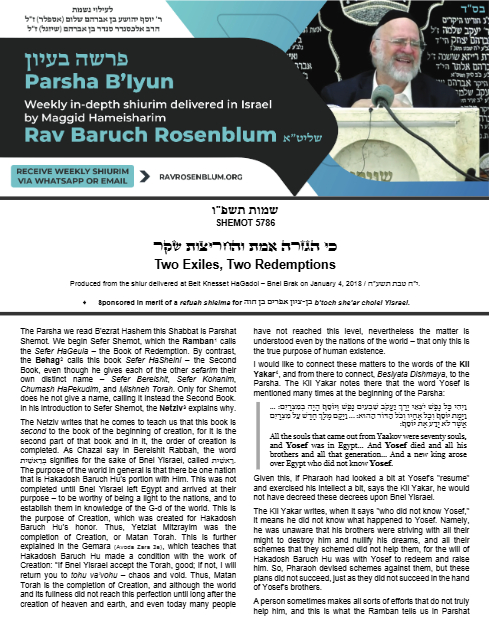
The Parsha we read B'ezrat Hashem this Shabbat is Parshat Shemot. We begin Sefer Shemot, which the Ramban calls the Sefer HaGeula – the Book of Redemption. By contrast, the Behag calls this book Sefer HaSheini – the Second Book, even though he gives each of the other sefarim their own distinct name – Sefer Bereishit, Sefer Kohanim, Chumash HaPekudim, and Mishneh Torah. Only for Shemot does he not give a name, calling it instead the Second Book. In his introduction to Sefer Shemot, the Netziv explains why. The Netziv writes that he comes to teach us that this book is second to the book of the beginning of creation, for it is the second part of that book and in it, the order of creation is completed. As Chazal say in Bereishit Rabbah, the word ב ּ ְ רֵ א שׁ ִ י ת signifies for the sake of Bnei Yisrael, called רֵ א שׁ ִ י ת.

The purpose of the world in general is that there be one nation that is Hakadosh Baruch Hu’s portion with Him. This was not completed until Bnei Yisrael left Egypt and arrived at their purpose – to be worthy of being a light to the nations, and to establish them in knowledge of the G-d of the world. This is the purpose of Creation, which was created for Hakadosh Baruch Hu’s honor. Thus, Yetziat Mitzrayim was the completion of Creation, or Matan Torah. This is further explained in the Gemara (Avoda Zara 3a), which teaches that Hakadosh Baruch Hu made a condition with the work of Creation: “If Bnei Yisrael accept the Torah, good; if not, I will return you to tohu va’vohu – chaos and void. Thus, Matan Torah is the completion of Creation, and although the world and its fullness did not reach this perfection until long after the creation of heaven and earth, and even today many people have not reached this level, nevertheless the matter is understood even by the nations of the world – that only this is the true purpose of human existence.

I would like to connect these matters to the words of the Kli Yakar, and from there to connect, Besiyata Dishmaya, to the Parsha. The Kli Yakar notes there that the word Yosef is mentioned many times at the beginning of the Parsha:

יַעֲקֹב שִׁ בְעִים נָפֶשׁ וַיְהִי כָּל נֶפֶשׁ יֹצְאֵי יֶרֶ ךוְ יוֹסֵ ף הָ יָ ה בְ מִ צְ רָ יִ ם: ... וַ יָמָ ת יוֹסֵ ף וְ כָל אֶ חָ יו וְ כֹל הַ דּ וֹר הַ הוּא: ... וַיָקָם מֶלֶך חָדָשׁ עַל מִצְרָ יִם אֲשׁ ֶר לֹא יָדַע אֶת יוֹסֵ ף:

All the souls that came out from Yaakov were seventy souls, and Yosef was in Egypt... And Yosef died and all his brothers and all that generation... And a new king arose over Egypt who did not know Yosef.

Given this, if Pharaoh had looked a bit at Yosef's "resume" and exercised his intellect a bit, says the Kli Yakar, he would not have decreed these decrees upon Bnei Yisrael.

The Kli Yakar writes, when it says "who did not know Yosef," it means he did not know what happened to Yosef. Namely, he was unaware that his brothers were striving with all their might to destroy him and nullify his dreams, and all their schemes that they schemed did not help them, for the will of Hakadosh Baruch Hu was with Yosef to redeem and raise him. So, Pharaoh devised schemes against them, but these plans did not succeed, just as they did not succeed in the hand of Yosef's brothers.

A person sometimes makes all sorts of efforts that do not truly help him, and this is what the Ramban tells us in Parshat Vayeshev – a person must know that what is decreed upon him will surely come to him. He will not be able to escape from it. And therefore, wise men who tried to escape from all sorts of decrees that were decreed upon them, not only did they not succeed in escaping, but on the contrary, Hakadosh Baruch Hu used their actions to bring the decree into effect!

It is told about Benaiah ben Yehoyada, one of King Shlomo’s chief officers, that at a moment of the king’s confidence and good spirits, he asked Shlomo to teach him the language of the animals. And despite the king's insistence that this was not good for him, he persisted and wanted to learn this language anyway, and the king taught him. Behold, one day when he came home, he heard the cat saying to the other cat: "I heard that the house is due to burn tonight." And of course, Benayahu got up and prepared everything necessary so that this calamity would not come upon him, and he was saved. The next day he heard the duck saying to the other duck: "I heard that thieves are due to come tonight to steal everything in the house," and again he prepared for it beforehand and was saved. The next day he heard the dog saying to the other dog: "I heard that the angel of death is coming to take one of the members of the household to the heavenly court." Benayahu ben Yehoyada went before the king and asked him what to do. Shlomo HaMelech said to him: "Did I not tell you that this is not good for you?! And indeed, it is decreed upon one of the household members that he shall die, but Hakadosh Baruch Hu, in His great mercy, said to exchange the judgment for poverty, as a poor person is considered ‘dead’. In the first instance (of the house burning), you did not allow it, and in the second instance (of the thieves), you did not give, but now you will fulfill the decree as it is; and this clearly proves a person should not seek what is not fitting for him.”

The meaning of the matter is: a person cannot escape from what is decreed upon him!

The holy brothers come and want to destroy Yosef from the world – "You will rule over us?! This shall not arise and shall not be!" At first, they wanted to kill him, and afterward they wanted to sell him to Egypt, as there’s no chance he’d emerge as king! But the Ramban tells us: כִּי הַגְּזֵרָה אֱמֶת וְהַחֲרִיצוּת שֶׁקֶר – For the decree is true and diligence is false. Everything the brothers did only accelerated Yosef's kingship!

Pharaoh comes and decrees that every male child shall be cast into the Nile. But why? Rashi explains, on the day Moshe was born, Pharaoh's astrologers said to him, "Today a savior has been born, but we do not know whether he is from Egypt or from Israel. We see that in the end he will be struck by water. Therefore, Pharaoh decreed this decree even against the Egyptians – אִם־בֵּן הוּא וַהֲמִתֶּן אֹתוֹ, not distinguishing who gave birth to the child! They did not know that Moshe’s end would be to be struck at the waters of Meriva and not the Nile!

But what came from that decree? Batya, daughter of Pharaoh, contracted leprosy. She goes to bathe in the Nile and sees the basket with little Moshe Rabbeinu inside. The moment she touches the basket, she is healed of her leprosy. She takes Moshe and raises him in her home – which is also Pharaoh's home! If so, what did Pharaoh gain from this decree?! Nothing! On the contrary, he himself raises Moshe Rabbeinu, sits him on his knees, feeds him baby food, buys him shoes, and rocks his cradle!

This is why it says: וַיָקָם מֶלֶך חָדָשׁ עַל מִצְרָ יִם אֲשׁ ֶר לֹא יָדַע אֶת יוֹסֵף – A new king arose over Egypt who did not know Yosef. For if he had known Yosef HaTzaddik and understood who he was, he would never have decreed all these decrees!

In this context, the Gemara (Shabbat 119a) brings the story of יוֹסֵ ף מוֹקַ ר שׁ ַ בֵּי – Yosef Mokir Shabbat (Yosef who treasures Shabbat). There was a certain non-Jew in the neighborhood of Yosef Mokir Shabbat who possessed great wealth. The astrologers said to him: “All your property will be consumed by Yosef Mokir Shabbat” – that is, all your wealth will pass to him. The non-Jew, wanting to prevent their words from coming true, went and sold all his possessions. He bought a precious pearl with the proceeds and set it in a hat he made for himself. In this way he thought he could preserve his wealth. As he was crossing a river by ferry, the wind blew off his hat. It fell into the water, and a fish swallowed the pearl. The fishermen caught this fish and brought it to the city late on Erev Shabbat, when everyone had already purchased their Shabbat provisions. The disappointed fishermen said: “Who will buy this? Who would purchase a fish at such a late hour?” They were told: “Go and bring it to Yosef Mokir Shabbat, for he’s accustomed to buying all sorts of delicacies in honor of Shabbat.” They brought it to him, and he bought it. When he cut open the fish to prepare it for Shabbat, he found the pearl inside. He later sold the pearl for thirteen vessels filled with golden dinars – an enormous fortune. An elderly man met him and said: “מַאן דְּ יָזֵיף שׁ ַבְּתָא פַּרְ עֵיהּ שׁ ַבְּתָא – One who lends to Shabbat, Shabbat repays him!”

The question arises: Why did the Gemara need to tell this entire story about a non-Jew neighbor who sold all his possessions and bought a pearl, and so forth?

The Etz Yosef says it teaches you שׁ ֶהַגְזֵרָ ה אֱמֶת וְהֶחָרִ יצוּת שׁ ֶקֶר – that the decree is true and cunning is false! What did that non-Jew not do to prevent his money from reaching Yosef Mokir Shabbat? Yet whatever Hakadosh Baruch Hu wants to bring forth – He brings forth!

If so, we can understand why the Parsha opens with the connecting vav – וְאֵלֶה שְׁמוֹת בְּנֵי יִשְׂרָאֵל. The vav connects it to the earlier Parshiot at the end of Bereshit, so that we see what happened with Yosef and thereby understand that all of Pharaoh's decrees were unnecessary and futile.

With this, I would like to focus today on one small point in the Parsha – the birth of Moshe Rabbeinu. It is known that his entire birth occurs in complete concealment, as it says in in the Parsha: וַיֵּלֶךְ אִישׁ מִבֵּית לֵוִי וַיִּקַּח אֶת בַּת לֵוִי – A man from the house of Levi went and took a daughter of Levi as his wife. We must wait until next week for the Torah to tell us that these two individuals were Amram and Yocheved. Moshe is born, and his sister stands at a distance. We know this refers to Miriam, but the Torah does not reveal her name here, only saying: וַתֵּתַצַּב אֲחֹתוֹ מֵרָחֹק לְדֵעָה מַה יֵּעָשֶׂה לוֹ – His sister stood at a distance to know what would be done to him. Furthermore, Batya, the daughter of Pharaoh, goes down to the Nile to bathe and to cleanse herself from the idolatries of her father's house. But the Torah does not reveal her name either – it only says: וַתֵּרֶד בַּת פַּרְעֹה לִרְחֹץ עַל הַיְאֹר – The daughter of Pharaoh went down to bathe at the Nile.

At first glance, this entire story appears like a charitable organization operating anonymously, with full concealment of names. It's like people who give checks to charity without signing them; you ask why they didn’t sign the check, and they answer, "It's anonymous!" The question arises: Why is the entire story of the birth of Bnei Yisrael’s savior hidden and concealed?

Moshe Rabbeinu grew up in Pharaoh's house and went out to see the welfare of his brothers. How old was he at that time? There is a dispute among Chazal; some say eighteen, some say twenty, and some say forty. On the first day, the Torah tells us: וַיַּרְא אִישׁ מִצְרִי מַכֶּה אִישׁ עִבְרִי מֵאֶחָיו – He saw an Egyptian man striking a Hebrew man, one of his brothers. Rashi says this ‘Egyptian man’ was a taskmaster, appointed over the officers of Bnei Yisrael, and he would wake them at dawn for their work. Rashi adds that he was beating and oppressing the Jewish man, who was the husband of Shlomit bat Divri, as this taskmaster had set his eyes on her. At night he woke the husband and took him out of his house, then returned and entered the house and lay with his wife, who thought he was her husband. When the husband later returned to his house and realized what had happened, the Egyptian taskmaster knew it, and he therefore beat and oppressed him all day long.

Moshe Rabbeinu proceeded to kill him, as it says: וַיִּפֶן כֹּה וָכֹה וַיַּרְא כִּי אֵין אִישׁ וַיַּךְ אֶת הַמִּצְרִי וַיִּטְמְנֵהוּ בַּחוֹל: He turned this way and that and saw that there was no one there, so he struck down the Egyptian and hid him in the sand.

The Torah continues and says Moshe went out again on the second day. וַיֵּצֵא בַּיּוֹם הַשֵּׁנִי וְהִנֵּה שְׁנֵי־אֲנָשִׁים עִבְרִים נִצִּים וַיֹּאמֶר לָרָשָׁע לָמָּה תַכֶּה רֵעֶךָ׃ When he went out the next day, he found two Hebrews fighting; he said to the offender, “Why do you strike your fellow?”

Why does it matter to us whether he went out on the second day or the third day? Why is there emphasis on the second day? The commentators say it is because the way of a killer is to hide for an extended period until the story calms down. Moshe instead heads out immediately and confronts the two men, who decree a death sentence upon him, and he flees to Midian where he takes Tzipporah, daughter of Yitro, as his wife. The Torah says: וּמֹשֶׁה הָיָה רֹעֶה אֶת צֹאן יִתְרוֹ חֹתְנוֹ כֹּהֵן מִדְיָן וַיִּנְהַג אֶת הַצֹּאן אַחַר הַמִּדְבָּר וַיָּבֹא אֶל הַר הָאֱ-לֹהִים חֹרֵבָה: And Moshe was shepherding the flock of Yitro his father-in-law, the priest of Midian, and he led the flock beyond the wilderness and came to the mountain of G-d, to Horev.

Rashi says, he went ‘beyond the wilderness’ to distance himself from theft, in order for the flock not to graze in others' fields.

וַיֵּרָא מַלְאַךְ ה' אֵלָיו בְּלַבַּת אֵשׁ מִתּוֹךְ הַסְּנֶה וַיַּרְא וְהִנֵּה הַסְּנֶה בֹּעֵר בָּאֵשׁ וְהַסְּנֶה אֵינֶנּוּ אֻכָּל: וַיֹּאמֶר מֹשֶׁה אָסֻרָה־נָּא וְאֶרְאֶה אֶת־הַמַּרְאֶה הַגָּדֹל הַזֶּה מַדּוּעַ לֹא־יִבְעַר הַסְּנֶה׃ וַיַּרְא ה' כִּי סָר לִרְאוֹת וַיִּקְרָא אֵלָיו אֱ-לֹהִים מִתּוֹךְ הַסְּנֶה וַיֹּאמֶר מֹשֶׁה מֹשֶׁה וַיֹּאמֶר הִנֵּנִי׃ An angel of Hashem appeared to him in a flame of fire from within the bush, and he saw that the bush was burning with fire but the bush was not consumed. And Moshe said, 'Let me turn aside now and see this great sight, why the bush is not consumed.' And Hashem saw that he turned aside to see, and G-d called to him from within the bush and said, 'Moshe, Moshe,' and he said, 'Here I am.'

After Hakadosh Baruch Hu tells Moshe how much Bnei Yisrael are suffering in Egypt, the Torah says: וְעַתָּה לְכָה וְאֶשְׁלָחֲךָ אֶל פַּרְעֹה וְהוֹצֵא אֶת עַמִּי בְּנֵי יִשְׂרָאֵל מִמִּצְרָיִם: And now, come, and I will send you to Pharaoh, and bring out My people, Bnei Yisrael, from Egypt. And Moshe said to G-d, 'Who am I that I should go to Pharaoh, and that I should bring out Bnei Yisrael from Egypt?'

Rashi says, Moshe asked, “What importance do I have to speak with kings? And even if I am important, what merit do Bnei Yisrael have that You should perform a miracle for them and bring them out of Egypt?”

On this point, the Beis HaLevi doesn't understand – why does Moshe Rabbeinu suddenly care that Hakadosh Baruch Hu is taking Bnei Yisrael out of Egypt?! Why isn't he happy for them?! We're talking about Moshe Rabbeinu, who said: "Let Moshe die and a hundred like him, rather than harm the fingernail of one of them" (Devarim Rabbah, 7:10). Why does he challenge the idea of Bnei Yisrael leaving Egypt now?!

Moshe Rabbeinu doesn't want to go and redeem Bnei Yisrael; and if you say he didn't want to because 400 years of exile hadn't yet passed – we've seen many times that pardons were given to prisoners sentenced to decades in jail and they were released early. Did any of them ask, “why early?” That's what was decided and that's the deal!

וַיֹּאמֶר כִּי אֶהְיֶה עִמָּךְ וְזֶה לְּךָ הָאוֹת כִּי אָנֹכִי שְׁלַחְתִּיךָ בְּהוֹצִיאֲךָ אֶת הָעָם מִמִּצְרַיִם תַּעַבְדוּן אֶת הָאֱ-לֹהִים עַל הָהָר הַזֶּה: And He said, “For I will be with you, and this shall be the sign for you that I have sent you: when you bring the people out of Egypt, you shall serve G-d upon this mountain.”

Rashi says: He answered the first question with the first answer and the last question with the last answer. Hakadosh Baruch Hu said to him, “You said, ‘Who am I that I should go to Pharaoh?’ But this is not your concern – it is Mine. And this sign that you saw in the bush is proof to you that I have sent you. Just as you saw the bush performing its mission and it was not consumed, so too will you go on My mission, and you will not be harmed. And regarding your question about what merit Bnei Yisrael have to leave Egypt – I have a great interest concerning this exodus: they are destined to receive the Torah on this mountain three months after they leave Egypt!”

The Rashbam explains that it is not that Moshe Rabbeinu was unwilling to take Bnei Yisrael out of Egypt, but something else at play. Moshe said: "And how will I take Bnei Yisrael out of Egypt?" In other words, “Even if I am worthy to stand before Pharaoh, I am foolish about other matters. What argument can I present to Pharaoh? Is Pharaoh so foolish as to listen to me and send out a great people who have been his loyal slaves for the last 85 years? What argument can I present to him through which I will take them out of Egypt with his permission?! Do I just walk up to him and say, ‘Pardon me, my lord, I request that you immediately release Bnei Yisrael!’ Why would he possibly agree?!”

The Rashbam explains that Moshe’s question, “How will I take Bnei Yisrael out of Egypt?” meant: What persuasive argument could possibly move Pharaoh to release them? Hakadosh Baruch Hu therefore instructed Moshe to request permission for only a three-day journey to offer sacrifices, a demand Pharaoh could understand and grant. This approach was a divinely guided strategy, not full emancipation, and Moshe consistently used it with Pharaoh. The Rashbam notes a parallel with Shmuel, who was similarly given a wise pretext – going to offer a sacrifice – when anointing David, showing that Hakadosh Baruch Hu sometimes advances His will through measured, prudent means. These are the words of the Rashbam, as an addition to the words of Rashi.

From this question, let us move on to the next question that Moshe Rabbeinu asked:

וַיַּעַן מֹשֶׁה וַיֹּאמֶר וְהֵן לֹא־יַאֲמִינוּ לִי וְלֹא יִשְׁמְעוּ בְּקֹלִי כִּי יֹאמְרוּ לֹא־נִרְאָה אֵלֶיךָ ה': וַיֹּאמֶר אֵלָיו ה' מַה־זֶּה בְיָדֶךָ וַיֹּאמֶר מַטֶּה: וַיֹּאמֶר הַשְׁלִיכֵהוּ אַרְצָה וַיַּשְׁלִכֵהוּ אַרְצָה וַיְהִי לְנָחָשׁ וַיָּנָס מֹשֶׁה מִפָּנָיו: וַיֹּאמֶר ה' אֶל מֹשֶׁה שְׁלַח יָדְךָ וֶאֱחֹז בִּזְנָבוֹ וַיִּשְׁלַח יָדוֹ וַיַּחֲזֶק בּוֹ וַיְהִי לְמַטֶּה בְּכַפּוֹ:

And Moshe answered and said: But they will not believe me and will not listen to my voice, for they will say: 'Hashem has not appeared to you.' And Hashem said to him: 'What is that in your hand?' And he said: 'A staff.' And He said: 'Cast it to the ground,' and he cast it to the ground, and it became a serpent, and Moshe fled from before it. And Hashem said to Moshe: 'Stretch out your hand and grasp it by its tail,' and he stretched out his hand and seized it, and it became a staff in his palm.

The question arises – where exactly did this staff come to Moshe from? Chazal say (Midrash HaChefetz Shemot 4:2) the staff was created at twilight on the sixth day of Creation and was given to Adam HaRishon in Gan Eden. Adam gave it to Noach, Noach to Shem, Shem to Avraham, Avraham to Yitzchak, Yitzchak to Yaakov, and Yaakov brought it down to Egypt and gave it to Yosef. When Yosef died, his house was plundered into Pharaoh's house, and Yitro was one of Pharaoh's advisors (alongside Iyov and Bilaam). When Moshe entered Yitro's house, he saw the staff and read the letters on it and took it. When Yitro saw that Moshe took the staff, he said: “Here is the one who is destined to redeem Bnei Yisrael,” and he gave him his daughter in marriage. Moshe shepherded the flock with this staff, and no wild animal harmed them, and they multiplied greatly.

וַיֹּאמֶר ה' לוֹ עוֹד הָבֵא נָא יָדְךָ בְּחֵיקֶךָ וַיָּבֵא יָדוֹ בְּחֵיקוֹ וַיּוֹצִאָהּ וְהִנֵּה יָדוֹ מְצֹרַעַת כַּשָּׁלֶג: וַיֹּאמֶר הָשֵׁב יָדְךָ אֶל חֵיקֶךָ וַיָּשֶׁב יָדוֹ אֶל חֵיקוֹ וַיּוֹצִאָהּ מֵחֵיקוֹ וְהִנֵּה שָׁבָה כִּבְשָׂרוֹ:

And Hashem said to him further: 'Put your hand into your bosom,' and he put his hand into his bosom, and he took it out, and behold, his hand was leprous like snow. And He said: 'Return your hand to your bosom,' and he returned his hand to his bosom, and he took it out from his bosom, and behold, it had returned like his flesh.

Rashi says, Hakadosh Baruch Hu is telling Moshe, as soon he says to them, “On your account have I been smitten — because I uttered slander about you,” they will believe him, for they are already experienced in this; namely, that those who combine to harm them are smitten by plagues, such as Pharaoh and Avimelech on account of Sarah.

A question arises: It seems unclear; why was Moshe confident that they would not believe him that he was the redeemer?

The Chatam Sofer offers a remarkable insight. Moshe Rabbeinu grew up in Pharaoh's house. He knew what was happening in Egypt – he knew that all of Egypt worshipped idolatry, except for the tribe of Levi. Therefore, he feared they would not believe him, arguing: "If they all worship idolatry, I will come to them and say, 'Peace, I am the messenger of Hakadosh Baruch Hu' – why should they believe me if they are idol worshippers?” If they were observers of Torah and Mitzvot, and knew that a redeemer was supposed to come, he would have no fear. But they all worship idolatry, and if that's the case, why on earth would they believe him?!

The Chatam Sofer writes: Moshe Rabbeinu raised three objections. The first was "they will not believe me," which stemmed from their poor faith in G-d, for he saw that they had been seduced greatly after the idols of Egypt. To this, Hakadosh Baruch Hu answered him: "What is that in your hand? Cast it to the ground and it became a serpent." The meaning here is that we cannot blame Bnei Yisrael for this, because according to the degree of holiness, so too do evil forces increase that strike at the removal of supreme protection from them. Holy things become disqualified even through mere inattention; even though it is the staff of a righteous person and stands in a holy place, nevertheless if you cast it to the ground and remove your protection from it for even a moment, it becomes a serpent. For such is the way

PDF Preview