Disturbing Remarks from the Avodas Yisrael and the Zera Kodesh
Shvilei Pinchas | August 29, 2025
Print This Article
View Original PDF

Disturbing Remarks from the Avodas Yisrael and the Zera Kodesh

Shvilei Pinchas | December 10, 2025

On the auspiciously approaching Shabbas kodesh, we will read parshas Shoftim. It will be the first Shabbas in the month of Elul, the month designated for teshuvah. It is fitting to begin this essay with the sacred remarks of the holy Maggid of Kozhnitz, zy”a, in Avodas Yisrael. He explains the wonderful connection between parshas Shoftim and the month of Elul. Here are the opening pesukim of the parsha (Devarim 16, 18):

"שופטים ושוטרים תתן לך בכל שעריך אשר ה' אלקיך נותן לך לשבטיך ושפטו את העם משפט צדק. לא תטה משפט לא תכיר פנים ולא תקח שוחד, כי השוחד יעור עיני חכמים ויסלף דברי צדיקים".

Judges and officers (enforcers) shall you place at all of your entryways which Hashem, your G-d, gives you for your tribes; and they shall judge the people with righteous judgment. You shall not pervert judgment, you shall not display favoritism; and you shall not take a bribe, because bribery will blind the eyes of the wise and distort the words of the righteous. The Avodas Yisrael teaches us that these pesukim contain a crucial lesson related to the teshuvah we are obligated to perform during the month of Elul. Here is a concise translation of his remarks:

This parsha is always read during the month of Elul, which is the designated time for every Jew to return to his Creator. His sins of the past year will be forgiven on account of remorse, contemplations of teshuvah, tears, and lamenting his past transgressions. He should be so embittered until it is evident to the One Who knows our deepest thoughts that he will not commit that sin ever again. This is the implication of the Torah’s admonition: “Judges and officers . . .” Every Jew must position personal judges to monitor himself—namely, his eyes, ears, nostrils, and mouth. These seven orifices in the skull are referred to as the gates to his soul. This is the meaning of “at all your entryways.” They should monitor all of his actions.

The Yetzer HaRa Occasionally Helps a Jew Perform a Mitzvah

Continuing with this concept, the Avodas Yisrael adds an insight that should concern us all. He explains how the words “you shall not take a bribe” relate to the month of Elul. He writes that a strategy of the yetzer hara is to cause a person to sin, fall into its trap, and then to be consoled by performing a mitzvah or learning Torah—thinking to himself that this makes up for the transgression. Ultimately, he will desire to commit the wrongdoing again (because he did not really do teshuvah). Hence, the Torah warns against this pitfall; it is tantamount to a bribe blinding the wise from the truth. For, in reality, the reward for a mitzvah and the punishment for an aveirah are separate. An aveirah can only be atoned for by means of true, sincere teshuvah; it will prevent a person from repeating the prior offense.

The great Rabbi of Ropshitz, zy”a, teaches us this same concept in Zera Kodesh (Shoftim). He explains that occasionally the neshamah plans to do a good deed and cannot be thwarted completely. This causes the yetzer hara to panic being fearful that this Jew will start learning Torah regularly or performing important mitzvos that foil the yetzer hara. This prompts the yetzer hara to make a minor mitzvah available to this Jew to curb his enthusiasm and prevent him from doing something better and more significant. For, he will think that he can suffice and make do with this minor mitzvah.

In this vein, he interprets the phrase “bribery will blind the eyes of the wise”: For, when you approach a particular chacham, and he ignores the wrongdoing you did, and treats you with respect in the merit of the mitzvah you performed, and neglects to reveal or acknowledge your transgression, the honor and respect he pays you will harm you. “And distort the words of the righteous”—even if they inform you that it is necessary to do teshuvah, the yetzer hara will convince you otherwise, since you are performing such a significant mitzvah.

Thus, we learn from their sacred remarks an important principle regarding the service of Hashem. It is not sufficient to merely check if you have performed mitzvos, because sometimes those mitzvos are part of the duplicitous tactics of the yetzer hara. It makes those mitzvos available to you to quiet the fervent desire of your neshamah to serve Hashem with all your vigor in the study of Torah and the fulfillment of mitzvos. Hence, it is the strategy of the yetzer hara to distract you by assisting you to perform several minor mitzvos. This will make you feel good about yourself and what you have accomplished and dissuade you from serving Hashem to the full extent you are capable of—such as studying Torah regularly and praying diligently to Hashem with pure intent and focus, and ridding yourself of material concerns.
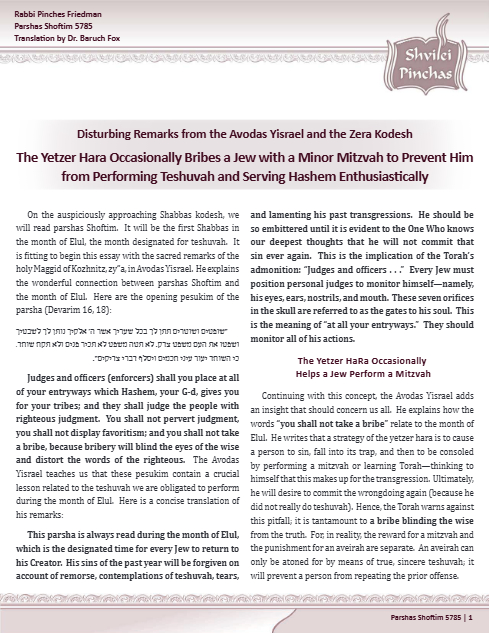

On the auspiciously approaching Shabbas kodesh, we will read parshas Shoftim. It will be the first Shabbas in the month of Elul, the month designated for teshuvah. It is fitting to begin this essay with the sacred remarks of the holy Maggid of Kozhnitz, zy”a, in Avodas Yisrael. He explains the wonderful connection between parshas Shoftim and the month of Elul. Here are the opening pesukim of the parsha (Devarim 16, 18):

"שופטים ושוטרים תתן לך בכל שעריך אשר ה' אלקיך נותן לך לשבטיך ושפטו את העם משפט צדק. לא תטה משפט לא תכיר פנים ולא תקח שוחד, כי השוחד יעור עיני חכמים ויסלף דברי צדיקים".

Judges and officers (enforcers) shall you place at all of your entryways which Hashem, your G-d, gives you for your tribes; and they shall judge the people with righteous judgment. You shall not pervert judgment, you shall not display favoritism; and you shall not take a bribe, because bribery will blind the eyes of the wise and distort the words of the righteous. The Avodas Yisrael teaches us that these pesukim contain a crucial lesson related to the teshuvah we are obligated to perform during the month of Elul. Here is a concise translation of his remarks:

This parsha is always read during the month of Elul, which is the designated time for every Jew to return to his Creator. His sins of the past year will be forgiven on account of remorse, contemplations of teshuvah, tears, and lamenting his past transgressions. He should be so embittered until it is evident to the One Who knows our deepest thoughts that he will not commit that sin ever again. This is the implication of the Torah’s admonition: “Judges and officers . . .” Every Jew must position personal judges to monitor himself—namely, his eyes, ears, nostrils, and mouth. These seven orifices in the skull are referred to as the gates to his soul. This is the meaning of “at all your entryways.” They should monitor all of his actions.

The Yetzer HaRa Occasionally Helps a Jew Perform a Mitzvah

Continuing with this concept, the Avodas Yisrael adds an insight that should concern us all. He explains how the words “you shall not take a bribe” relate to the month of Elul. He writes that a strategy of the yetzer hara is to cause a person to sin, fall into its trap, and then to be consoled by performing a mitzvah or learning Torah—thinking to himself that this makes up for the transgression. Ultimately, he will desire to commit the wrongdoing again (because he did not really do teshuvah). Hence, the Torah warns against this pitfall; it is tantamount to a bribe blinding the wise from the truth. For, in reality, the reward for a mitzvah and the punishment for an aveirah are separate. An aveirah can only be atoned for by means of true, sincere teshuvah; it will prevent a person from repeating the prior offense.

The great Rabbi of Ropshitz, zy”a, teaches us this same concept in Zera Kodesh (Shoftim). He explains that occasionally the neshamah plans to do a good deed and cannot be thwarted completely. This causes the yetzer hara to panic being fearful that this Jew will start learning Torah regularly or performing important mitzvos that foil the yetzer hara. This prompts the yetzer hara to make a minor mitzvah available to this Jew to curb his enthusiasm and prevent him from doing something better and more significant. For, he will think that he can suffice and make do with this minor mitzvah.

In this vein, he interprets the phrase “bribery will blind the eyes of the wise”: For, when you approach a particular chacham, and he ignores the wrongdoing you did, and treats you with respect in the merit of the mitzvah you performed, and neglects to reveal or acknowledge your transgression, the honor and respect he pays you will harm you. “And distort the words of the righteous”—even if they inform you that it is necessary to do teshuvah, the yetzer hara will convince you otherwise, since you are performing such a significant mitzvah.

Thus, we learn from their sacred remarks an important principle regarding the service of Hashem. It is not sufficient to merely check if you have performed mitzvos, because sometimes those mitzvos are part of the duplicitous tactics of the yetzer hara. It makes those mitzvos available to you to quiet the fervent desire of your neshamah to serve Hashem with all your vigor in the study of Torah and the fulfillment of mitzvos. Hence, it is the strategy of the yetzer hara to distract you by assisting you to perform several minor mitzvos. This will make you feel good about yourself and what you have accomplished and dissuade you from serving Hashem to the full extent you are capable of—such as studying Torah regularly and praying diligently to Hashem with pure intent and focus, and ridding yourself of material concerns.

PDF Preview