Murder in Horki
The Village of Horki, 5593 — 1832
For years, the evil poritz had abused everyone in the town and taken all of their money. But this morning, the news spread that the poritz had passed away. A huge funeral was held for the poritz, and even the king himself had arrived in their little town to pay his respects. Even though everyone hated the poritz, the entire village came to the funeral. Nobody knew who the new poritz would be and they wanted to demonstrate that they showed respect to the people in charge of their town.
After the funeral, the Rebbe approached the king.
“Your majesty,” he said. “We are so honored by your presence in our small town. We are your loyal subjects and would like to offer you this gift as a thank you for your kind leadership.”
The Rebbe’s gabbai handed the king a wooden goblet that Anshel the carpenter had carved. It wasn’t that fancy, but it was the most the poor town could afford.
The king examined the goblet and looked at the Rebbe and his chassidim, who were all dressed in shabby clothes.
“Hmmm,” he said.
Everyone watched nervously. Was the king upset at the gift?
“Rabbi,” the king said. “The craftsmanship on this goblet is quite impressive, even if it is made of cheap wood. With craftsmen like this, it seems odd that you are all so poor.”
The chassidim stood there uncomfortably. Nobody wanted to badmouth the poritz in front of the king, even if the poritz was no longer alive.
“Rabbi,” the king said. “I have been having trouble finding a new poritz for your village. You look like you are respected by the townsfolk and there is a certain quality about you that I just can’t put my finger on. How would you like to be in charge of the village of Horki?”
The chassidim gasped. Could this really be happening?
The Rebbe smiled. “It would be my pleasure,” he said.
“Amazing,” said the king, handing the Rebbe a large document. “Here is the deed to the poritz’s house. It’s yours now, as is the village of Horki. I trust I am leaving it in good hands.”
The king climbed into his chariot and rode off, leaving the chassidim shocked. Everyone broke out singing and dancing, thanking Hashem for the yeshuah.
In the following days, everything changed for the village of Horki. The Rebbe’s gabbai discovered vast amounts of gold stored in the poritz’s mansion, along with records of all of the money he had taken from each person. The Rebbe immediately ordered that the money be returned to everyone, and the village soon became very prosperous. Aharon the fish man bought new nets and was now able to catch bigger and tastier fish. Berel the innkeeper upgraded his inn to be the fanciest hotel in the region. Anshel the carpenter began producing the finest oak and mahogany furniture. Everyone was able to properly be mechabed Shabbos with beautiful and delicious seudos. Every morning the Horki Chassidim thanked Hashem anew for their miraculous good fortune.
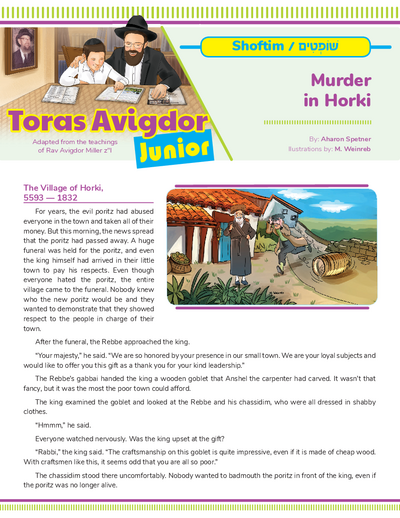
One day, Berel the innkeeper was rolling a barrel of fine whiskey towards his inn, when he noticed the Rebbe walking by. Ah! A chance to be mechabed his Rebbe! Berel quickly abandoned his barrel in the middle of the street and ran over.
“Sholom Aleichem Rebbe,” he said, bowing humbly.
To his surprise, the Rebbe looked at him angrily.
“I never thought you were the type of person to be a rotzeiach,” the Rebbe said sternly.
“A murderer???” Berel stammered. “But Rebbe, I never killed anyone! I’m a kind and gentle person!”
“Berel,” the Rebbe said. “Do you know how dangerous it is to leave a barrel in the middle of the road like that? It can roll down and someone can get seriously hurt!”
“Oy, I’m sorry, Rebbe,” Berel said. “It was an accident. But I’m not a rotzeiach — I promise!”
“Berel, in this week’s Parsha we talk about someone who kills someone beshogeg — by accident, and his punishment is that he is sent to an Ir Miklat — he essentially becomes a prisoner for not being careful.”
“But Rebbe, nobody died. Look, I’ll move the barrel right now!”
Berel quickly rolled the barrel to the grass on the side of the road and ran back to the Rebbe.
“Berel,” the Rebbe continued. “The Rambam has a whole section where he discusses protecting oneself and others from danger. And do you know what section that is? It’s ‘Hilchos Rotzeiach U’Shmiras Hanefesh’. He puts the halachos of someone who kills on purpose, someone who kills accidentally, and someone who puts others in danger, all under the same section: ‘Rotzeiach U’Shmiras Hanefesh’.
“Do you understand? Putting someone else in danger is like murdering someone. Even if nobody gets hurt or killed, it is the same action. Being careful not to leave something where someone could get injured is just as serious as not going out and killing people.”
“Oy, I never realized that,” lamented Berel. “Thank you so much, Rebbe, for teaching this to me. I will bli neder never do something like this ever again.”
Takeaway:
Safety is a very serious responsibility. We can’t say “it was only a mistake”, or “what’s the big deal?” The Torah treats safety as the biggest deal.
Related Articles



