Temimus
BET Journal | August 29, 2025
Print This Article
View Original PDF

Temimus

BET Journal | December 10, 2025

תמים תהיה עם השם אלוקיך

The shofar has begun to blow. School buses rumble, uniforms reappear, and Elul arrives with its quiet urgency. Amid global noise, we’re reminded of the long-neglected, dusty “me.” It’s time to confront, reflect, repent, and return. If not now, when?

Parshas Shoftim warns against the abominations of other nations—sorcery, necromancy, kishuf, tumah. Immediately afterward, the Torah says: תמים תהיה עם ה׳ אלקיך—be wholehearted with Hashem. Rashi explains: Walk with Him in temimus, hope in Him, and accept whatever comes without probing the future. When we distance ourselves from impurity, we become vessels for connection with Hashem.

The Ramban, however, flips the lens. Temimus isn’t the result of distancing—it’s the path itself. To withstand the pull of tumah and avodah zarah, we must cultivate תהיה תמים—a constant awareness of Hashem’s presence. This mindfulness is our armor. Even if we don’t face sorcery today, we’re surrounded by our own nisyonos. בכל דור ודור עומדים עלינו לכלותנו—every generation has its trials. We need siyata d’Shmaya to endure.

The Ramban, echoed by the Rambam in Sefer HaMitzvos, teaches that תהיה תמים means נייחד לבנו אליו יתברך—to dedicate our hearts to Hashem, all day, every day. This avodah demands blood, sweat, and tears. It’s not easy. But it’s an investment that yields eternity.

Rav Shraga Kallus shares a mashal: A little girl buys fake pink pearls with her spending money and treasures them. Her father, night after night, asks her to give them up. “Do you love me more than the pearls?” She says yes, but can’t part with them. Until one night, with tears in her eyes, she hands them over. Her father then gives her a velvet box—with real, lustrous pearls. “If I ask you for something,” he says, “it’s because I love you. When you give it up, you won’t lose—you’ll gain.”

We, Klal Yisrael, are Hashem’s kallah. We know what brings Him nachas and what doesn’t. We know the difference between fake pearls and real ones. Elul invites us to give up the false, the impure, the easy. Even when the nisyonos feel relentless, even when we wonder how much more we can bear, the Ramban reminds us: the strength lies in the quiet moments. In temimus. In trusting Avinu Malkeinu.

When we do that—when we hand over the fake pearls with trembling hands and hopeful hearts—we don’t lose. We gain. We’re gifted with real joy, real connection, and the promise of true eternity.
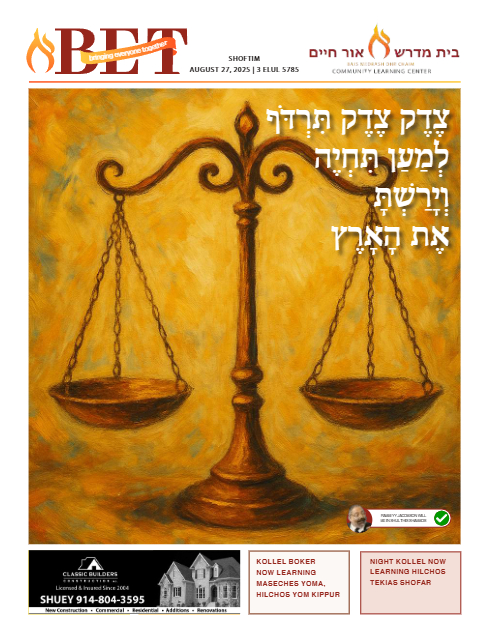
תמים תהיה עם השם אלוקיך

The shofar has begun to blow. School buses rumble, uniforms reappear, and Elul arrives with its quiet urgency. Amid global noise, we’re reminded of the long-neglected, dusty “me.” It’s time to confront, reflect, repent, and return. If not now, when?

Parshas Shoftim warns against the abominations of other nations—sorcery, necromancy, kishuf, tumah. Immediately afterward, the Torah says: תמים תהיה עם ה׳ אלקיך—be wholehearted with Hashem. Rashi explains: Walk with Him in temimus, hope in Him, and accept whatever comes without probing the future. When we distance ourselves from impurity, we become vessels for connection with Hashem.

The Ramban, however, flips the lens. Temimus isn’t the result of distancing—it’s the path itself. To withstand the pull of tumah and avodah zarah, we must cultivate תהיה תמים—a constant awareness of Hashem’s presence. This mindfulness is our armor. Even if we don’t face sorcery today, we’re surrounded by our own nisyonos. בכל דור ודור עומדים עלינו לכלותנו—every generation has its trials. We need siyata d’Shmaya to endure.

The Ramban, echoed by the Rambam in Sefer HaMitzvos, teaches that תהיה תמים means נייחד לבנו אליו יתברך—to dedicate our hearts to Hashem, all day, every day. This avodah demands blood, sweat, and tears. It’s not easy. But it’s an investment that yields eternity.

Rav Shraga Kallus shares a mashal: A little girl buys fake pink pearls with her spending money and treasures them. Her father, night after night, asks her to give them up. “Do you love me more than the pearls?” She says yes, but can’t part with them. Until one night, with tears in her eyes, she hands them over. Her father then gives her a velvet box—with real, lustrous pearls. “If I ask you for something,” he says, “it’s because I love you. When you give it up, you won’t lose—you’ll gain.”

We, Klal Yisrael, are Hashem’s kallah. We know what brings Him nachas and what doesn’t. We know the difference between fake pearls and real ones. Elul invites us to give up the false, the impure, the easy. Even when the nisyonos feel relentless, even when we wonder how much more we can bear, the Ramban reminds us: the strength lies in the quiet moments. In temimus. In trusting Avinu Malkeinu.

When we do that—when we hand over the fake pearls with trembling hands and hopeful hearts—we don’t lose. We gain. We’re gifted with real joy, real connection, and the promise of true eternity.

PDF Preview