The Dynamics of Isarussa Dil’Tatoh and Isarussa Dil’Eilah
Print This Article
View Original PDF

The Dynamics of Isarussa Dil’Tatoh and Isarussa Dil’Eilah

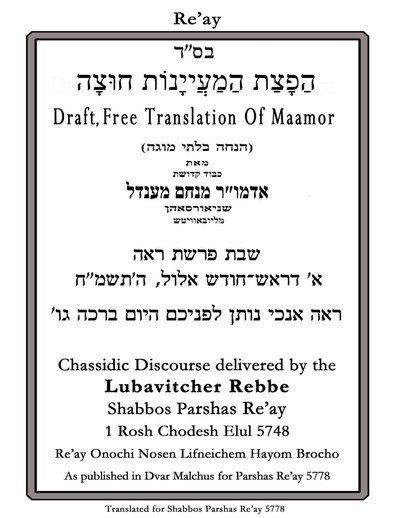
הפצת המיינות חוצה | December 31, 2025

On the one hand our sages of blessed memory have stated; “HaShem does not demand more than one’s ability” and elsewhere it is explained that any Avodah that a person performs down here in this world below (Isarussa Dil’Tatoh) needs to be pre-empted by an impetus from above (Isarussa Dil’Eilah). So how can we [possibly] say that the system of Avodah in Chodesh Elul relies on a person making the first move? As the chosen Possuk illustrates that the Avodah of אֲנִי לְדוֹדִי ‘I am to my beloved’ (Issarusa Dil’Tatoh) is due first, and only afterwards comes the Avodah of וְדוֹדִי לִי ‘my beloved is to me’ (Issarusa Dil’Eilah)? (And not the opposite as it is in a different Possuk, first דוֹדִי לִי and only thereafter וְאֲנִי לוֹ)

Yet according to what we have established above we can say that when we say in Chodesh Elul that the Avodah relies on a person’s input first with an Issarusa Dil’Tatoh and only afterwards is one reciprocated with an Issarusa Dil’Eilah, that is [only] when one is referring to the system as it is within the confinement and parameters of the ‘Seder Hishtalshelus’. (It is because of these limitations that the B’nei Yisroel are only extended a state of ‘vision’ as mentioned above). However, when operating from the perspective of ‘beyond the confines and parameters’ of the ‘Seder Hishtalshelus’, then, on the contrary, the impetus for the Avodah of אֲנִי לְדוֹדִי comes from the lofty Divine level of אָנֹכִי מִי שֶׁאָנֹכִי which transcends the state of דוֹדִי. And this ‘Koach’ is given [specifically] in the month of Elul and given generously.

Isarussa Dil’Tatoh and Isarussa Dil’Eilah Explained

Isarussa Dil’Tatoh: An inspiration from below. A self-motivated inspiration where a person inspires himself to become closer to Hashem and motivates himself to do more for his Yiddishkeit and his connection with Hashem. As a result of one’s effort in his ‘Isarussa Dil’Tatoh’ he will be rewarded with an ‘Isarussa Dil’Eilah.

Isarussa Dil’Eilah: An arousal from above. A Divine inspiration from above. Where Hashem so to speak shines his countenance down upon the person drawing him in closer to Hashem. The general system is that when a person puts in the effort Hashem reciprocates by helping him along as the Talmud says (Yoma 38b): “If one comes to purify, they assist him”.

The process is as follows: first comes a slight nudge from HaShem, encouraging and giving us the power to achieve greatness; this is an Issarusa Dil’Eilah-an arousal from HaShem. Then comes our hard work and service as a response to HaShem’s awakening from above, this is when we harness the power given to us for free without any hard work and put it into action with our Issarusa Dil’Tatoh. Finally, as a result of our hard work, showing HaShem we take his encouragement seriously by putting our gifted power into practice, and so long as everything else is in order with our spiritual quest there comes a reward from HaShem as a recognition of our hard work and a precursor for the next set of hard work; this final spiritual encounter is also an Issarusa Dil’Eilah, but a far superior Divine connection that cannot be elicited.

There is another Possuk in Shir Hashirim that reads דוֹדִי לִי וְּאֲנִי לוֹ “My beloved is to me, and then I am to him”, hinting to an opposite chain of events, first HaShem’s move, then ours. The question is: If our hard work is only as a result of a preceding arousal from above, then why is the Avodah in Elul like the acronym, “I am to my Beloved and my Beloved is to meִ”, implying we have to act first, if in truth we could turn the tables and say “My beloved is to me and only them am I to Him”, referring to the seeming natural order of things: First HaShem, and then me.
On the one hand our sages of blessed memory have stated; “HaShem does not demand more than one’s ability” and elsewhere it is explained that any Avodah that a person performs down here in this world below (Isarussa Dil’Tatoh) needs to be pre-empted by an impetus from above (Isarussa Dil’Eilah). So how can we [possibly] say that the system of Avodah in Chodesh Elul relies on a person making the first move? As the chosen Possuk illustrates that the Avodah of אֲנִי לְדוֹדִי ‘I am to my beloved’ (Issarusa Dil’Tatoh) is due first, and only afterwards comes the Avodah of וְדוֹדִי לִי ‘my beloved is to me’ (Issarusa Dil’Eilah)? (And not the opposite as it is in a different Possuk, first דוֹדִי לִי and only thereafter וְאֲנִי לוֹ)

Yet according to what we have established above we can say that when we say in Chodesh Elul that the Avodah relies on a person’s input first with an Issarusa Dil’Tatoh and only afterwards is one reciprocated with an Issarusa Dil’Eilah, that is [only] when one is referring to the system as it is within the confinement and parameters of the ‘Seder Hishtalshelus’. (It is because of these limitations that the B’nei Yisroel are only extended a state of ‘vision’ as mentioned above). However, when operating from the perspective of ‘beyond the confines and parameters’ of the ‘Seder Hishtalshelus’, then, on the contrary, the impetus for the Avodah of אֲנִי לְדוֹדִי comes from the lofty Divine level of אָנֹכִי מִי שֶׁאָנֹכִי which transcends the state of דוֹדִי. And this ‘Koach’ is given [specifically] in the month of Elul and given generously.

Isarussa Dil’Tatoh and Isarussa Dil’Eilah Explained

Isarussa Dil’Tatoh: An inspiration from below. A self-motivated inspiration where a person inspires himself to become closer to Hashem and motivates himself to do more for his Yiddishkeit and his connection with Hashem. As a result of one’s effort in his ‘Isarussa Dil’Tatoh’ he will be rewarded with an ‘Isarussa Dil’Eilah.

Isarussa Dil’Eilah: An arousal from above. A Divine inspiration from above. Where Hashem so to speak shines his countenance down upon the person drawing him in closer to Hashem. The general system is that when a person puts in the effort Hashem reciprocates by helping him along as the Talmud says (Yoma 38b): “If one comes to purify, they assist him”.

The process is as follows: first comes a slight nudge from HaShem, encouraging and giving us the power to achieve greatness; this is an Issarusa Dil’Eilah-an arousal from HaShem. Then comes our hard work and service as a response to HaShem’s awakening from above, this is when we harness the power given to us for free without any hard work and put it into action with our Issarusa Dil’Tatoh. Finally, as a result of our hard work, showing HaShem we take his encouragement seriously by putting our gifted power into practice, and so long as everything else is in order with our spiritual quest there comes a reward from HaShem as a recognition of our hard work and a precursor for the next set of hard work; this final spiritual encounter is also an Issarusa Dil’Eilah, but a far superior Divine connection that cannot be elicited.

There is another Possuk in Shir Hashirim that reads דוֹדִי לִי וְּאֲנִי לוֹ “My beloved is to me, and then I am to him”, hinting to an opposite chain of events, first HaShem’s move, then ours. The question is: If our hard work is only as a result of a preceding arousal from above, then why is the Avodah in Elul like the acronym, “I am to my Beloved and my Beloved is to meִ”, implying we have to act first, if in truth we could turn the tables and say “My beloved is to me and only them am I to Him”, referring to the seeming natural order of things: First HaShem, and then me.

PDF Preview