Cleaning Season
Torah Papers | April 12, 2024
Print This Article
View Original PDF

Cleaning Season

Torah Papers | June 27, 2025

On this first Shabbat of Nisan, we’ll read the first of two Parshiot which are generally read together each year after Pesach. Due to the leap year, they are read separately and before Pesach this time around. The Bnei Yissaschar points out that the name נִיסָ ן has a numerical value of 170, equal to two times the word פּ ֶ ה – mouth (85). Our primary Avodah during the month of Nisan is through our mouths, as alluded to in the play on words פּ ֶ ה סָ ח – mouth that speaks. There are two pipes that sit just behind our mouths: the קָ נֶה and ו ֶ שׁ ֶ ט – the windpipe for breathing and speaking, and the gullet which serves as our pipe for the intake of food. The entire holiday of Pesach surrounds these two pipes. Firstly, the consumption of Matza, the Korban Pesach, Marror, and four cups of wine. Secondly, וְ הִ גַ דְ תּ ָ לְ בִ נְ ך – the telling over of the story of Yetziat Mitzrayim. On a regular year that is not a leap year, the two Parshiot that immediately follow Pesach are Shmini and Tazria-Metzora, because after the focus and usage of these two pipes over Pesach, the Torah comes to instruct us what is permissible to eat (Shmini), and how one must be mindful of their speech (Tazria-Metzora). This year, however, all of these directions are provided before Pesach and can serve as a valuable preparation for the holiday.

In such, I’d like to focus on a learning from the Tur together with its explanation from the Shelah HaKadosh. The Tur lays out the sequence of Parshiot that should be read during the year, with the Shabbat prior to Pesach being either Parshat Tzav on a regular year or Parshat Metzora on a leap year. He presents it in poetic language reflecting a primary action taken in each Parsha:

פִּקְדוּ וּפִסְחוֹ וְלִמְעֻבֶּרֶ ת סִגְרוּ וּפִסְחוּ – Command (Tzav) and then Pesach, and in a leap year, confine (Metzora) and then Pesach.

As it plays out in our contemporary calendar, during a regular year we always read Parshat Tzav before Pesach without exception. However, in a leap year, we do not always confine the leper – i.e. read Parshat Metzora – just prior to Pesach. There are some leap years in which Acharei Mot is what’s read just prior (often in years where Pesach falls on Motzei Shabbat). According to the Tur, however, the above never occurs and Metzora is always read prior to Pesach on a leap year, without exception. This schedule also leads into his directive on what needs to be read on the Shabbat preceding Shavuot – namely, Parshat Bamidar (whereas in our current schedule that would be Parshat Naso when Acharei Mot is read just prior to Pesach). Based on the Tur’s schedule, how is this accomplished and what is done with the extra week prior to Pesach? I found an answer in the Minchat Chinuch, which references a custom of splitting Parshat Mishpatim into two sections during those years, with the latter section beginning at אִ ם כֶּסֶ ף תּ ַ לְ וֶ ה אֶ ת עַ מִּ י. Sure, lending and collecting money is a parsha (a big deal) in its own right, and in those years, it would also be a standalone Parsha of the Torah read on Shabbat. As a result, all the Parshiot would be pushed forward one week and Metzora would be read just prior to Pesach and Bamidbar just prior to Shavuot. As an interesting anecdote, I once met someone in a shul in Ashkelon, and while giving a shiur on this approach of the Tur, he told me his Bar Mitzvah Parsha in France was Parshat “Im Kesef Talveh Et Ami”! Lost in the excitement, I forgot to ask him which Haftarah he read. I later looked into this and realized it was not an issue, as the previous Shabbatot included Rosh Chodesh and Parshat Shekalim, and there were spare words of the Nevi’im to go around.

The question to ask here is, why? Why does the Tur insist that the Parsha read just prior to Pesach be that of Tzav or Metzora? The Shelah HaKadosh helps provide the answer. In every Parsha that falls just prior to a holiday, the sod of the chag – its secret, or esoteric and mystical meaning – can be found in the Parsha preceding it. In our case, the sod of Pesach can be found in Tzav and Metzora, and thus the Tur insists these be what is read prior to Pesach. Let’s dive in and learn what this secret meaning is. Besiyata Dishmaya, we’ll reveal a tremendous principle in our Avodat Hashem.

The Korban Todah and Pesach

One of the key chapters in Parshat Tzav is that of the Korban Todah – the Thanksgiving Offering:

If he offer it for a thanksgiving, then he shall offer with the sacrifice of thanksgiving unleavened cakes mingled with oil, and unleavened wafers anointed with oil, and cakes mingled with oil, of fine flour, well soaked. Together with loaves of leavened bread shall he make his offering, these to be added to his peace offering of thanksgiving.

The Korban Todah consists of a Shelamim – a standard peace offering, but with one difference. This offering is not eaten over the course of two days and one night, but rather, only over the course of the day it is brought and that night, and only until chatzot (midnight). Furthermore, it consists of forty types of bread – three sets of ten matzahs plus ten loaves. When this Korban Todah is brought, the Kohen takes one of each bread type – four in total – and returns thirty-six to the owner, which must be eaten by midnight. The Abarbanel asks how it is possible to eat that quantity – approximately 30 kgs. according to the Chazon Ish – by midnight, not to mention the meat of the Korban itself. It is impossible, and that is the intent. To ensure no leftovers by midnight (and a requirement to burn them), the owner will hire a bus and bring a group in from Eilat for the occasion, and in the process, he’ll present to them the miracle performed for him as he safely crossed the sea under a barrage of missiles from the nearby Houthis. In doing so, and in sharing photos and videos, he’ll fulfill the underlying goals of this Korban, namely: חַ סְ דּ וֹ וְ נִפְ לְאוֹתָ יו לִ בְ נֵי אָ דָ ם 'יוֹדוּ לַה – Let them give praise for G-d’s steadfast love and wondrous deeds for mankind, and וִירוֹמְ מוּהוּ בִּקְ הַל־עָם וּבְמוֹשׁ ַב זְקֵנִים יְהַלְלוּהוּ – Let them exalt in the congregation of the people, acclaim in the assembly of the elders. One is directed to offer a Korban Todah not to broadcast how strong and great a fighter they are, but to publicly acknowledge the powers and mercy of Hashem.

Who Brings a Korban Todah?

What are the conditions for which such a Korban Todah is brought? What stories of wonder and marvel are to be told to the masses? The Gemara (Berachot 54b) lists four cases:

אַרְ בָּעָה צְרִ יכִין לְהוֹדוֹת: יוֹרְ דֵי הַיָם, הוֹלְכֵי מִדְ בָּרוֹת, וּמִי שׁ ֶהָיָה חוֹלֶה וְנִתְרַ פֵּא, וּמִי שׁ ֶהָיָה חָבוּשׁ בְּבֵית הָאֲסוּרִ ים וְיָצָא.

Four must offer thanks to G-d with a Thanksgiving offering and a special blessing. They are: Seafarers, those who walk in the desert, one who was ill and recovered, and one who was incarcerated in prison and went out.

The four cases brought by the Gemara are all in the verses of Tehillim 107. Today, when we cannot bring a Korban Todah, the practice is replaced by reciting Birkat HaGomel. If you flew across the ocean, you step up and recite Birkat HaGomel. But if you recovered from a serious and lengthy illness, you do not only do that, but also sponsor a shiur, host a festive meal, and maybe even more. Nobody needed to know you were abroad, so a quiet bracha does the trick. But a miraculous recovery – that everyone needs to be aware of, to give proper recognition and praise to Hakadosh Baruch Hu.

The Four Cups of Wine

The four cups of wine we will drink at our Pesach Seder are traditionally attributed to the four languages of geula found in the story of Yetziat Mitzrayim: וְ הוֹצֵאתִ י, וְ הִ צַלְתִּ י, וְ גָאַ לְתִּ י, וְ לָקַ חְ תִּ י. The Maharsha, however, says the four cups correspond to these four individuals who must give thanks: 1) one who has crossed the sea, 2) one who traversed the desert, 3) one who was sick and became healed, and 4) one who was incarcerated and became free. In the process of presenting this approach, the Maharsha adds something magnificent. All four persona can be found in Yetziat Mitzrayim! We left the prison and hard labor of Egypt on the 15th of Nisan; we crossed the waters of Yam Suf on the 21st of Nisan; we traversed the desert for forty years once on the other side; and at Ma’amad Har Sinai, all the sick of Bnei Yisrael were healed. Thus, we drink four cups of wine at the Seder.

There is another answer to explore, from Torat Chaim, based on the summary of Bnei Yisrael’s stay in Egypt:

וּמוֹשׁ ַב בְּנֵי יִשְׂרָאֵל אֲשׁ ֶר יָשְׁבוּ בְּמִצְרָ יִם שְׁלֹשִׁים שׁ ָנָה וְאַרְ בַּע מֵאוֹת שׁ ָ נ ָ ה ׃

The length of time that Bnei Yisrael lived in Egypt was four hundred and thirty years.

As we know, when the elders translated the Torah to Greek, they did not write this exactly as it appears above. Instead, they wrote “lived in Egypt and other locations”. What was supposed to be four hundred years, was in reality two-hundred and ten years, and they were challenged on the number four hundred and thirty in Egypt proper. Thus, they expanded the definition and boundaries slightly, to match up with the larger number of years. Torat Chaim says, in essence, we were supposed to be in Egypt for the full four-hundred and thirty years, just as the pasuk states. How is that reconciled with the promise made to Avraham Avinu that his children would be slaves in a foreign land for only four hundred years? He explains, via some math. Eighty-six of the years in Egypt were spent enduring עֲ בוֹ דַ ת פּ ָ רֶ ך – oppressive labor (beginning from when Miriam was born, thus the name מִ רְ י ָ ם, taken from ו ַ י ְ מָ רְ ר וּ אֶ ת חַ יֵיהֶ ם בַּ עֲבֹדָ ה קָ שׁ ָ ה). The word כּ וֹס has the numerical value of eighty-six, and five cups results in a total of four hundred and thirty. According to Torat Chaim, however, we do not drink a cup of wine for the years of harsh labor and severe troubles, leaving us with four cups that we do drink in commemoration of the redemption and the years we were spared severe suffering.

The Three Matzahs and the Seder

I’d like to now return to the parallel drawn by the Maharsha between the four types of people required to give thanks and the four cups of wine at our Seder. From here, we can draw a powerful yesod. Within the laws of Pesach (Orach Chaim 475), the Tur lists the following custom:

ו ְ נ ָ ה ֲ ג ו ּ ל ַ ע ֲ ש ׂ ו ֹ ת שׁ ָ ל ֹ שׁ וֹת שׁ ֶל סֵדֶ ר מֵעִשָּׂרוֹן זֵכֶר לְלַחְמִי תּוֹדָה מַצ.

And the custom is to make the three Seder matzahs out of an issaron of flour, as a commemoration of the Todah loaves.

The three matzahs placed on the Seder table have the weight of an issaron – 2.5 kgs total and approximately 830 grams for each matzah. That is similar in size to a pizza, excluding the cheese and toppings. And not just any pizza. The “Extra Large” option. Today, there are no such matzahs. The standard round handmade matzahs come twenty in a one-kilogram box, with each weighing approximately fifty grams. It would take eighteen such matzahs to reach the target weight of an issaron. All this would be done to parallel the breads of the Korban Todah. The Maharsha’s opinion that four cups of wine correspond to the four individuals who must offer thanks, makes sense. Four k’neged four. But if there are four who need to give thanks, how do we line up only three giant matzahs, or eighteen regular ones? The point being made by this custom is that the night of the Pesach Seder is a night of giving thanks for all the kindness and wonders provided to us by Hakadosh Baruch Hu.

The Abrabanel adds, this allows us to better understand the child’s question within the Ma Nishtanah. The question asked is why on all other nights do we eat חָ מֵ ץ וּמַ צָה – both chametz and matzah, whereas at the Seder we eat only matzah. On what other nights do we eat both? As soon as Pesach ends, the box of matzah is placed on the highest possible shelf and declared to be for emergencies only. What night is the child’s question referring to? The Abarbanel explains, if we are placing three matzahs on the table in commemoration of the Lachmei Todah – as the Tur instructs – those breads consisted of three-parts matzah and one-part chametz. The child is essentially asking, “If these matzahs correspond to the breads of the Korban Todah, where is the fourth set? Where is the chametz?” We answer the child, “Don’t worry about chametz on this one night. When the holiday of Shavuot arrives, then we’ll see the chametz.” What chametz is seen on Shavuot? This refers to the שׁ ְ תּ ֵ י ה ַ לֶ חֶ ם – the two loaves brought on Shavuot (which is one of only two offerings that consists of chametz, along with the Korban Todah itself). If so, the child could rightfully ask why we wait seven weeks to see the chametz component manifest itself – why not bring it out early in the morning on the day after Pesach ends? The answer is simple yet beautiful.

What is the meaning of splitting the Lachmei Todah into three sets of matzah and one set of chametz? Over the course of the year, we all eat significantly more leavened bread (chametz) than unleavened bread (matzah). Should the ratio not be reversed as a result? The reason for it is that among the four individuals who need to express gratitude, three experienced no deterioration of their bodies. Crossing the sea, traversing the desert, and sitting in prison do not directly depreciate the body. Here in Israel, I have even met people who sat comfortably in prison and finished shas not once but twice! They cannot leave, but nothing happens to their body inside the prison walls. The ship may have bounced around on the waves and even been damaged slightly, but the passenger’s body remained intact. The same for one who traverses through the desert and meets a lion or tiger. Clearly, they escaped, and nothing happened to them, otherwise we’d not be here talking about their subsequent obligations! Oznaim Latorah says, this is exactly like matzah, which does not experience degradation. It may not remain fresh or in its perfect state of crispiness, but it can last forever! The only case of the four where the body worsens is the one who is sick and then healed. This is like the chametz bread, which contains more than just flour and water, and which will deteriorate over time.

With that explanation, we can understand why only the three matzahs appear on our Seder table and not the fourth loaf of bread. At the seder, we are not giving thanks for our bodies being healed, for our vision and hearing being restored, for our limbs being returned to full function, and so forth. That event did not take place on Pesach, but rather seven weeks later at the time of Matan Torah. At the Seder, we give thanks for the other three current cases, represented by the three matzahs; and when Shavuot comes around, we’ll give thanks for the final case, via the שׁ ְ תּ ֵ י ה ַ לֶ חֶ ם.

Tazria and Metzora: Lessons Before Pesach

Shifting to the two Parshiot we’ll read before Pesach in this leap year – Tazria and Metzora – it is important to recognize that the two are connected and not distinct chapters. In our day, we no longer have נְ גָעִ ים – plagues, such as leprosy, but we do have what are referred to as דּ וֹמֶ ה לַנְּ גָעִ ים – what appear to be plagues. There are illnesses that we see people suffering from, Rachmana litzlan, in which the symptoms are quite similar to those detailed in the Torah, reminding us of the topic of lashon hara. Someone who reads all the repercussions of speaking lashon hara, as detailed in the Torah, will undoubtedly stay clear of speaking lashon hara throughout their lifetime. But these effects are not available to us right now.

Tzara’at is divided into three categories it affects: the body, the clothing, and the house. We’ll read about the first two this week, and the final category next week. The order in which they are told to us is exactly as above – body, clothing, house – but the order in which they manifest themselves is the opposite. The Midrash says: פּ וֹ גֵ עַ בִּ נְ פָ שׁ וֹ ת תְּ חִ לאֵין בַּעַל הָרַ חֲמִים – the Master of Mercy will not strike the body first. Hakadosh Baruch Hu will not begin the delivery of punishment by afflicting a person directly, but rather their money and possessions will be targeted first – a warning sign to examine one’s ways and perform Teshuva. The order in which Tzara’at manifests itself is house, clothing, body, and with a couple of stages in each. At first, if the message is received correctly and in a timely manner, all that’s required is some minor renovations before moving back in. If the message is not received, the house will be brought down completely. Moving on to the clothing, it is once again in stages – quick receipt of the message results in the simple laundering of the clothing, whereas a failure to grasp results in the clothing being burned and destroyed. Finally, the body is the same. After warning signs, the failure to internalize the message and respond accordingly results in banishment from the community until it properly sinks in. Hakadosh Baruch Hu has many options at His disposal when it comes to punishment, such as Tzara’at. As another example, if one does not give the proper amount of tzedakah, either the money can be taken from them, or they can be taken from the money.

The Tzara’at that existed at the time of the Beit Hamikdash was not considered to be contagious. It was not like the Tzara’at that existed many years later, where according to stories about the special hospital for lepers in Yerushalayim, the tefillin of those afflicted needed to be burned because the plague would spread onto them. It sounds a bit like what was done at the start of the Covid pandemic, where anything touched needed to be destroyed, and those who touched it isolated. The Tzara’at was originally not like that and was purely a warning sign. It was a gift from Hakadosh Baruch Hu, giving us a path to Teshuva. Therefore, there was no Tzara’at on the holidays. If someone approached the Kohen to examine a suspect blemish on their skin, they’d be told to go home and return following the conclusion of the chag. The same was true for a chatan during the days of sheva brachot.

I recall a story from just after my son was married, roughly twenty years ago. The wedding was in Yerushalayim and the sheva brachot were in Bnei Brak. I invited Rav Shteinman ztz’l to the wedding, but it was difficult for him to travel, so he instead joined us at the local sheva brachot. It was the week of Parshat Metzora – what is there to say that week to a newlywed couple?! It’s the worst luck of the draw to be speaking to a chatan and kalah that week! There was a discussion around the table regarding the halacha of not examining the negai’im of a chatan, and someone asked how a chatan can possibly receive Tzara’at if all their sins are forgiven, as per the Gemara. Some suggested that he must have spoken negatively about his mother-in-law immediately after the wedding! But one instance of lashon hara doesn’t bring Tzara’at right away. Rav Shteinman arrived, and they asked him the question – how can a chatan receive Tzara’at? He responded, “It’s simple. What atones more, Yom Kippur or the wedding day? Naturally, it’s Yom Kippur. But even that day doesn’t automatically atone for sins bein adam l’chaveiro, so for sure the wedding doesn’t either! We don’t check the nega’im of a chatan because we want him to remain with his wife that week and lead him to Teshuva. But there’s no risk of it spreading to his wife in the interim, so he can wait.”

What is the significance of reading these two Parshiot before Pesach? In addressing this question. the Ibn Ezra
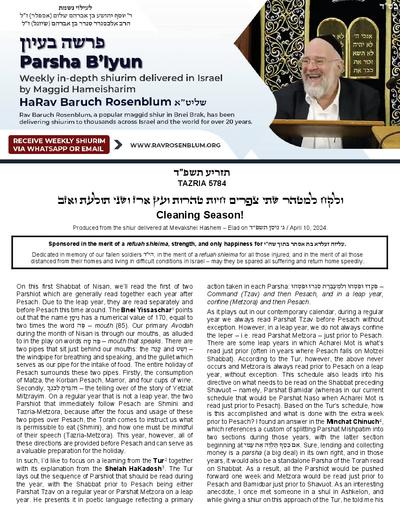
On this first Shabbat of Nisan, we’ll read the first of two Parshiot which are generally read together each year after Pesach. Due to the leap year, they are read separately and before Pesach this time around. The Bnei Yissaschar points out that the name נִיסָ ן has a numerical value of 170, equal to two times the word פּ ֶ ה – mouth (85). Our primary Avodah during the month of Nisan is through our mouths, as alluded to in the play on words פּ ֶ ה סָ ח – mouth that speaks. There are two pipes that sit just behind our mouths: the קָ נֶה and ו ֶ שׁ ֶ ט – the windpipe for breathing and speaking, and the gullet which serves as our pipe for the intake of food. The entire holiday of Pesach surrounds these two pipes. Firstly, the consumption of Matza, the Korban Pesach, Marror, and four cups of wine. Secondly, וְ הִ גַ דְ תּ ָ לְ בִ נְ ך – the telling over of the story of Yetziat Mitzrayim. On a regular year that is not a leap year, the two Parshiot that immediately follow Pesach are Shmini and Tazria-Metzora, because after the focus and usage of these two pipes over Pesach, the Torah comes to instruct us what is permissible to eat (Shmini), and how one must be mindful of their speech (Tazria-Metzora). This year, however, all of these directions are provided before Pesach and can serve as a valuable preparation for the holiday.

In such, I’d like to focus on a learning from the Tur together with its explanation from the Shelah HaKadosh. The Tur lays out the sequence of Parshiot that should be read during the year, with the Shabbat prior to Pesach being either Parshat Tzav on a regular year or Parshat Metzora on a leap year. He presents it in poetic language reflecting a primary action taken in each Parsha:

פִּקְדוּ וּפִסְחוֹ וְלִמְעֻבֶּרֶ ת סִגְרוּ וּפִסְחוּ – Command (Tzav) and then Pesach, and in a leap year, confine (Metzora) and then Pesach.

As it plays out in our contemporary calendar, during a regular year we always read Parshat Tzav before Pesach without exception. However, in a leap year, we do not always confine the leper – i.e. read Parshat Metzora – just prior to Pesach. There are some leap years in which Acharei Mot is what’s read just prior (often in years where Pesach falls on Motzei Shabbat). According to the Tur, however, the above never occurs and Metzora is always read prior to Pesach on a leap year, without exception. This schedule also leads into his directive on what needs to be read on the Shabbat preceding Shavuot – namely, Parshat Bamidar (whereas in our current schedule that would be Parshat Naso when Acharei Mot is read just prior to Pesach). Based on the Tur’s schedule, how is this accomplished and what is done with the extra week prior to Pesach? I found an answer in the Minchat Chinuch, which references a custom of splitting Parshat Mishpatim into two sections during those years, with the latter section beginning at אִ ם כֶּסֶ ף תּ ַ לְ וֶ ה אֶ ת עַ מִּ י. Sure, lending and collecting money is a parsha (a big deal) in its own right, and in those years, it would also be a standalone Parsha of the Torah read on Shabbat. As a result, all the Parshiot would be pushed forward one week and Metzora would be read just prior to Pesach and Bamidbar just prior to Shavuot. As an interesting anecdote, I once met someone in a shul in Ashkelon, and while giving a shiur on this approach of the Tur, he told me his Bar Mitzvah Parsha in France was Parshat “Im Kesef Talveh Et Ami”! Lost in the excitement, I forgot to ask him which Haftarah he read. I later looked into this and realized it was not an issue, as the previous Shabbatot included Rosh Chodesh and Parshat Shekalim, and there were spare words of the Nevi’im to go around.

The question to ask here is, why? Why does the Tur insist that the Parsha read just prior to Pesach be that of Tzav or Metzora? The Shelah HaKadosh helps provide the answer. In every Parsha that falls just prior to a holiday, the sod of the chag – its secret, or esoteric and mystical meaning – can be found in the Parsha preceding it. In our case, the sod of Pesach can be found in Tzav and Metzora, and thus the Tur insists these be what is read prior to Pesach. Let’s dive in and learn what this secret meaning is. Besiyata Dishmaya, we’ll reveal a tremendous principle in our Avodat Hashem.

The Korban Todah and Pesach

One of the key chapters in Parshat Tzav is that of the Korban Todah – the Thanksgiving Offering:

If he offer it for a thanksgiving, then he shall offer with the sacrifice of thanksgiving unleavened cakes mingled with oil, and unleavened wafers anointed with oil, and cakes mingled with oil, of fine flour, well soaked. Together with loaves of leavened bread shall he make his offering, these to be added to his peace offering of thanksgiving.

The Korban Todah consists of a Shelamim – a standard peace offering, but with one difference. This offering is not eaten over the course of two days and one night, but rather, only over the course of the day it is brought and that night, and only until chatzot (midnight). Furthermore, it consists of forty types of bread – three sets of ten matzahs plus ten loaves. When this Korban Todah is brought, the Kohen takes one of each bread type – four in total – and returns thirty-six to the owner, which must be eaten by midnight. The Abarbanel asks how it is possible to eat that quantity – approximately 30 kgs. according to the Chazon Ish – by midnight, not to mention the meat of the Korban itself. It is impossible, and that is the intent. To ensure no leftovers by midnight (and a requirement to burn them), the owner will hire a bus and bring a group in from Eilat for the occasion, and in the process, he’ll present to them the miracle performed for him as he safely crossed the sea under a barrage of missiles from the nearby Houthis. In doing so, and in sharing photos and videos, he’ll fulfill the underlying goals of this Korban, namely: חַ סְ דּ וֹ וְ נִפְ לְאוֹתָ יו לִ בְ נֵי אָ דָ ם 'יוֹדוּ לַה – Let them give praise for G-d’s steadfast love and wondrous deeds for mankind, and וִירוֹמְ מוּהוּ בִּקְ הַל־עָם וּבְמוֹשׁ ַב זְקֵנִים יְהַלְלוּהוּ – Let them exalt in the congregation of the people, acclaim in the assembly of the elders. One is directed to offer a Korban Todah not to broadcast how strong and great a fighter they are, but to publicly acknowledge the powers and mercy of Hashem.

Who Brings a Korban Todah?

What are the conditions for which such a Korban Todah is brought? What stories of wonder and marvel are to be told to the masses? The Gemara (Berachot 54b) lists four cases:

אַרְ בָּעָה צְרִ יכִין לְהוֹדוֹת: יוֹרְ דֵי הַיָם, הוֹלְכֵי מִדְ בָּרוֹת, וּמִי שׁ ֶהָיָה חוֹלֶה וְנִתְרַ פֵּא, וּמִי שׁ ֶהָיָה חָבוּשׁ בְּבֵית הָאֲסוּרִ ים וְיָצָא.

Four must offer thanks to G-d with a Thanksgiving offering and a special blessing. They are: Seafarers, those who walk in the desert, one who was ill and recovered, and one who was incarcerated in prison and went out.

The four cases brought by the Gemara are all in the verses of Tehillim 107. Today, when we cannot bring a Korban Todah, the practice is replaced by reciting Birkat HaGomel. If you flew across the ocean, you step up and recite Birkat HaGomel. But if you recovered from a serious and lengthy illness, you do not only do that, but also sponsor a shiur, host a festive meal, and maybe even more. Nobody needed to know you were abroad, so a quiet bracha does the trick. But a miraculous recovery – that everyone needs to be aware of, to give proper recognition and praise to Hakadosh Baruch Hu.

The Four Cups of Wine

The four cups of wine we will drink at our Pesach Seder are traditionally attributed to the four languages of geula found in the story of Yetziat Mitzrayim: וְ הוֹצֵאתִ י, וְ הִ צַלְתִּ י, וְ גָאַ לְתִּ י, וְ לָקַ חְ תִּ י. The Maharsha, however, says the four cups correspond to these four individuals who must give thanks: 1) one who has crossed the sea, 2) one who traversed the desert, 3) one who was sick and became healed, and 4) one who was incarcerated and became free. In the process of presenting this approach, the Maharsha adds something magnificent. All four persona can be found in Yetziat Mitzrayim! We left the prison and hard labor of Egypt on the 15th of Nisan; we crossed the waters of Yam Suf on the 21st of Nisan; we traversed the desert for forty years once on the other side; and at Ma’amad Har Sinai, all the sick of Bnei Yisrael were healed. Thus, we drink four cups of wine at the Seder.

There is another answer to explore, from Torat Chaim, based on the summary of Bnei Yisrael’s stay in Egypt:

וּמוֹשׁ ַב בְּנֵי יִשְׂרָאֵל אֲשׁ ֶר יָשְׁבוּ בְּמִצְרָ יִם שְׁלֹשִׁים שׁ ָנָה וְאַרְ בַּע מֵאוֹת שׁ ָ נ ָ ה ׃

The length of time that Bnei Yisrael lived in Egypt was four hundred and thirty years.

As we know, when the elders translated the Torah to Greek, they did not write this exactly as it appears above. Instead, they wrote “lived in Egypt and other locations”. What was supposed to be four hundred years, was in reality two-hundred and ten years, and they were challenged on the number four hundred and thirty in Egypt proper. Thus, they expanded the definition and boundaries slightly, to match up with the larger number of years. Torat Chaim says, in essence, we were supposed to be in Egypt for the full four-hundred and thirty years, just as the pasuk states. How is that reconciled with the promise made to Avraham Avinu that his children would be slaves in a foreign land for only four hundred years? He explains, via some math. Eighty-six of the years in Egypt were spent enduring עֲ בוֹ דַ ת פּ ָ רֶ ך – oppressive labor (beginning from when Miriam was born, thus the name מִ רְ י ָ ם, taken from ו ַ י ְ מָ רְ ר וּ אֶ ת חַ יֵיהֶ ם בַּ עֲבֹדָ ה קָ שׁ ָ ה). The word כּ וֹס has the numerical value of eighty-six, and five cups results in a total of four hundred and thirty. According to Torat Chaim, however, we do not drink a cup of wine for the years of harsh labor and severe troubles, leaving us with four cups that we do drink in commemoration of the redemption and the years we were spared severe suffering.

The Three Matzahs and the Seder

I’d like to now return to the parallel drawn by the Maharsha between the four types of people required to give thanks and the four cups of wine at our Seder. From here, we can draw a powerful yesod. Within the laws of Pesach (Orach Chaim 475), the Tur lists the following custom:

ו ְ נ ָ ה ֲ ג ו ּ ל ַ ע ֲ ש ׂ ו ֹ ת שׁ ָ ל ֹ שׁ וֹת שׁ ֶל סֵדֶ ר מֵעִשָּׂרוֹן זֵכֶר לְלַחְמִי תּוֹדָה מַצ.

And the custom is to make the three Seder matzahs out of an issaron of flour, as a commemoration of the Todah loaves.

The three matzahs placed on the Seder table have the weight of an issaron – 2.5 kgs total and approximately 830 grams for each matzah. That is similar in size to a pizza, excluding the cheese and toppings. And not just any pizza. The “Extra Large” option. Today, there are no such matzahs. The standard round handmade matzahs come twenty in a one-kilogram box, with each weighing approximately fifty grams. It would take eighteen such matzahs to reach the target weight of an issaron. All this would be done to parallel the breads of the Korban Todah. The Maharsha’s opinion that four cups of wine correspond to the four individuals who must offer thanks, makes sense. Four k’neged four. But if there are four who need to give thanks, how do we line up only three giant matzahs, or eighteen regular ones? The point being made by this custom is that the night of the Pesach Seder is a night of giving thanks for all the kindness and wonders provided to us by Hakadosh Baruch Hu.

The Abrabanel adds, this allows us to better understand the child’s question within the Ma Nishtanah. The question asked is why on all other nights do we eat חָ מֵ ץ וּמַ צָה – both chametz and matzah, whereas at the Seder we eat only matzah. On what other nights do we eat both? As soon as Pesach ends, the box of matzah is placed on the highest possible shelf and declared to be for emergencies only. What night is the child’s question referring to? The Abarbanel explains, if we are placing three matzahs on the table in commemoration of the Lachmei Todah – as the Tur instructs – those breads consisted of three-parts matzah and one-part chametz. The child is essentially asking, “If these matzahs correspond to the breads of the Korban Todah, where is the fourth set? Where is the chametz?” We answer the child, “Don’t worry about chametz on this one night. When the holiday of Shavuot arrives, then we’ll see the chametz.” What chametz is seen on Shavuot? This refers to the שׁ ְ תּ ֵ י ה ַ לֶ חֶ ם – the two loaves brought on Shavuot (which is one of only two offerings that consists of chametz, along with the Korban Todah itself). If so, the child could rightfully ask why we wait seven weeks to see the chametz component manifest itself – why not bring it out early in the morning on the day after Pesach ends? The answer is simple yet beautiful.

What is the meaning of splitting the Lachmei Todah into three sets of matzah and one set of chametz? Over the course of the year, we all eat significantly more leavened bread (chametz) than unleavened bread (matzah). Should the ratio not be reversed as a result? The reason for it is that among the four individuals who need to express gratitude, three experienced no deterioration of their bodies. Crossing the sea, traversing the desert, and sitting in prison do not directly depreciate the body. Here in Israel, I have even met people who sat comfortably in prison and finished shas not once but twice! They cannot leave, but nothing happens to their body inside the prison walls. The ship may have bounced around on the waves and even been damaged slightly, but the passenger’s body remained intact. The same for one who traverses through the desert and meets a lion or tiger. Clearly, they escaped, and nothing happened to them, otherwise we’d not be here talking about their subsequent obligations! Oznaim Latorah says, this is exactly like matzah, which does not experience degradation. It may not remain fresh or in its perfect state of crispiness, but it can last forever! The only case of the four where the body worsens is the one who is sick and then healed. This is like the chametz bread, which contains more than just flour and water, and which will deteriorate over time.

With that explanation, we can understand why only the three matzahs appear on our Seder table and not the fourth loaf of bread. At the seder, we are not giving thanks for our bodies being healed, for our vision and hearing being restored, for our limbs being returned to full function, and so forth. That event did not take place on Pesach, but rather seven weeks later at the time of Matan Torah. At the Seder, we give thanks for the other three current cases, represented by the three matzahs; and when Shavuot comes around, we’ll give thanks for the final case, via the שׁ ְ תּ ֵ י ה ַ לֶ חֶ ם.

Tazria and Metzora: Lessons Before Pesach

Shifting to the two Parshiot we’ll read before Pesach in this leap year – Tazria and Metzora – it is important to recognize that the two are connected and not distinct chapters. In our day, we no longer have נְ גָעִ ים – plagues, such as leprosy, but we do have what are referred to as דּ וֹמֶ ה לַנְּ גָעִ ים – what appear to be plagues. There are illnesses that we see people suffering from, Rachmana litzlan, in which the symptoms are quite similar to those detailed in the Torah, reminding us of the topic of lashon hara. Someone who reads all the repercussions of speaking lashon hara, as detailed in the Torah, will undoubtedly stay clear of speaking lashon hara throughout their lifetime. But these effects are not available to us right now.

Tzara’at is divided into three categories it affects: the body, the clothing, and the house. We’ll read about the first two this week, and the final category next week. The order in which they are told to us is exactly as above – body, clothing, house – but the order in which they manifest themselves is the opposite. The Midrash says: פּ וֹ גֵ עַ בִּ נְ פָ שׁ וֹ ת תְּ חִ לאֵין בַּעַל הָרַ חֲמִים – the Master of Mercy will not strike the body first. Hakadosh Baruch Hu will not begin the delivery of punishment by afflicting a person directly, but rather their money and possessions will be targeted first – a warning sign to examine one’s ways and perform Teshuva. The order in which Tzara’at manifests itself is house, clothing, body, and with a couple of stages in each. At first, if the message is received correctly and in a timely manner, all that’s required is some minor renovations before moving back in. If the message is not received, the house will be brought down completely. Moving on to the clothing, it is once again in stages – quick receipt of the message results in the simple laundering of the clothing, whereas a failure to grasp results in the clothing being burned and destroyed. Finally, the body is the same. After warning signs, the failure to internalize the message and respond accordingly results in banishment from the community until it properly sinks in. Hakadosh Baruch Hu has many options at His disposal when it comes to punishment, such as Tzara’at. As another example, if one does not give the proper amount of tzedakah, either the money can be taken from them, or they can be taken from the money.

The Tzara’at that existed at the time of the Beit Hamikdash was not considered to be contagious. It was not like the Tzara’at that existed many years later, where according to stories about the special hospital for lepers in Yerushalayim, the tefillin of those afflicted needed to be burned because the plague would spread onto them. It sounds a bit like what was done at the start of the Covid pandemic, where anything touched needed to be destroyed, and those who touched it isolated. The Tzara’at was originally not like that and was purely a warning sign. It was a gift from Hakadosh Baruch Hu, giving us a path to Teshuva. Therefore, there was no Tzara’at on the holidays. If someone approached the Kohen to examine a suspect blemish on their skin, they’d be told to go home and return following the conclusion of the chag. The same was true for a chatan during the days of sheva brachot.

I recall a story from just after my son was married, roughly twenty years ago. The wedding was in Yerushalayim and the sheva brachot were in Bnei Brak. I invited Rav Shteinman ztz’l to the wedding, but it was difficult for him to travel, so he instead joined us at the local sheva brachot. It was the week of Parshat Metzora – what is there to say that week to a newlywed couple?! It’s the worst luck of the draw to be speaking to a chatan and kalah that week! There was a discussion around the table regarding the halacha of not examining the negai’im of a chatan, and someone asked how a chatan can possibly receive Tzara’at if all their sins are forgiven, as per the Gemara. Some suggested that he must have spoken negatively about his mother-in-law immediately after the wedding! But one instance of lashon hara doesn’t bring Tzara’at right away. Rav Shteinman arrived, and they asked him the question – how can a chatan receive Tzara’at? He responded, “It’s simple. What atones more, Yom Kippur or the wedding day? Naturally, it’s Yom Kippur. But even that day doesn’t automatically atone for sins bein adam l’chaveiro, so for sure the wedding doesn’t either! We don’t check the nega’im of a chatan because we want him to remain with his wife that week and lead him to Teshuva. But there’s no risk of it spreading to his wife in the interim, so he can wait.”

What is the significance of reading these two Parshiot before Pesach? In addressing this question. the Ibn Ezra

PDF Preview