Chasidic Insights: Tzaraat Covering All Flesh and Messianic Redemption
Project Likkutei Sichos | April 26, 2025
Print This Article
View Original PDF

Chasidic Insights: Tzaraat Covering All Flesh and Messianic Redemption

Project Likkutei Sichos | June 27, 2025

One of the signs given by the sages that the Messiah’s arrival is imminent is that “the entire government has become heretical, with none to rebuke them.” This notion, they say, is alluded to in the law that if tzara’at covers the entire body, the person is undefiled.

There are two ways of understanding this sign given by the sages:

  • Negatively, i.e., that heresy will infect all the world’s governments. None of them will acknowledge God as Master of the world and its lawgiver, promoting instead licentiousness and barbaric behavior. In this entrenched, depraved condition, the Messiah is the world’s only hope; it is therefore a sign of his imminent arrival. But since the world will not be worthy of redemption, God will redeem it “by force”—for His own sake, as it were, fulfilling the verse, “For My own sake, for My own sake I will do this, for how can I let My Name be profaned?”
  • Positively, i.e., that the truth of the Torah will become so self-evident that it will be universally acknowledged that any government that does not submit to the Torah’s rules is “heretical,” i.e., based on the delusion that it is possible to create a just and moral society any other way. Accordingly, the Jewish people will be esteemed as the preservers of the Torah’s message of true monotheism. In this enlightened condition, the Messiah’s imminent arrival will be a natural outgrowth of the world’s desire for moral perfection. God will not have to “impose” the redemption on the world.

Inasmuch as the sages cite the law given in this verse as support for their sign, it follows that the two ways of understanding their sign parallel the two ways of understanding this law, namely:

  • Negatively: The spread of tzara’at over the entire body does not intrinsically indicate that the person is undefiled; the fact that it does so is simply another one of the Torah’s rules that are not grounded in logic or reason, just like the rest of the laws governing tzara’at. The Torah here “imposes” its will on reality, irrespective of natural causes or processes. This, indeed, is the position adopted by Jewish legal (i.e., halachic) exegesis, which therefore limits this rule to the case stated specifically in this verse: when tzara’at spreads out from a lesion that had been pronounced defiled or suspected of being so. In contrast, when tzara’at spreads over the entire body from the outset or from a lesion that was pronounced undefiled, the person must be declared defiled.
  • Positively: The spread of tzara’at over the entire body indicates that it is the natural condition of the person’s skin; this is why it does not render the person defiled. This is the position that Rashi adopts as the contextual understanding of this passage, according to which it makes no difference under what circumstances the spread occurs—in all cases it indicates that the person is undefiled.

Clearly, it is preferable that redemption occur the second way, obviating the need for universal moral degeneration and the forceful imposition of God’s will on an antagonistic world. The Torah therefore promises that prior to the Redemption, the Jewish people will return to God and His Torah, and the world will be ready for the Messiah’s arrival in a positive, enlightened manner.
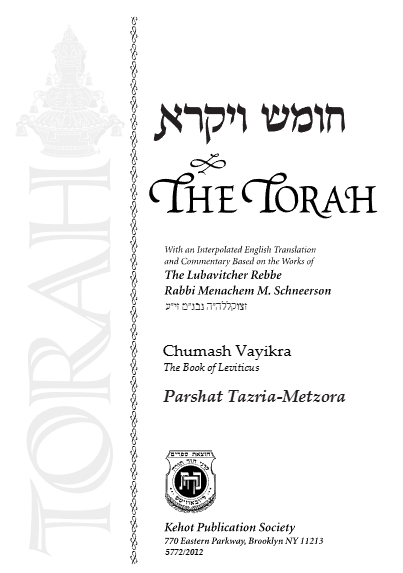
One of the signs given by the sages that the Messiah’s arrival is imminent is that “the entire government has become heretical, with none to rebuke them.” This notion, they say, is alluded to in the law that if tzara’at covers the entire body, the person is undefiled.

There are two ways of understanding this sign given by the sages:

  • Negatively, i.e., that heresy will infect all the world’s governments. None of them will acknowledge God as Master of the world and its lawgiver, promoting instead licentiousness and barbaric behavior. In this entrenched, depraved condition, the Messiah is the world’s only hope; it is therefore a sign of his imminent arrival. But since the world will not be worthy of redemption, God will redeem it “by force”—for His own sake, as it were, fulfilling the verse, “For My own sake, for My own sake I will do this, for how can I let My Name be profaned?”
  • Positively, i.e., that the truth of the Torah will become so self-evident that it will be universally acknowledged that any government that does not submit to the Torah’s rules is “heretical,” i.e., based on the delusion that it is possible to create a just and moral society any other way. Accordingly, the Jewish people will be esteemed as the preservers of the Torah’s message of true monotheism. In this enlightened condition, the Messiah’s imminent arrival will be a natural outgrowth of the world’s desire for moral perfection. God will not have to “impose” the redemption on the world.

Inasmuch as the sages cite the law given in this verse as support for their sign, it follows that the two ways of understanding their sign parallel the two ways of understanding this law, namely:

  • Negatively: The spread of tzara’at over the entire body does not intrinsically indicate that the person is undefiled; the fact that it does so is simply another one of the Torah’s rules that are not grounded in logic or reason, just like the rest of the laws governing tzara’at. The Torah here “imposes” its will on reality, irrespective of natural causes or processes. This, indeed, is the position adopted by Jewish legal (i.e., halachic) exegesis, which therefore limits this rule to the case stated specifically in this verse: when tzara’at spreads out from a lesion that had been pronounced defiled or suspected of being so. In contrast, when tzara’at spreads over the entire body from the outset or from a lesion that was pronounced undefiled, the person must be declared defiled.
  • Positively: The spread of tzara’at over the entire body indicates that it is the natural condition of the person’s skin; this is why it does not render the person defiled. This is the position that Rashi adopts as the contextual understanding of this passage, according to which it makes no difference under what circumstances the spread occurs—in all cases it indicates that the person is undefiled.

Clearly, it is preferable that redemption occur the second way, obviating the need for universal moral degeneration and the forceful imposition of God’s will on an antagonistic world. The Torah therefore promises that prior to the Redemption, the Jewish people will return to God and His Torah, and the world will be ready for the Messiah’s arrival in a positive, enlightened manner.

PDF Preview