Correcting the Outermost Garment
Print This Article
View Original PDF

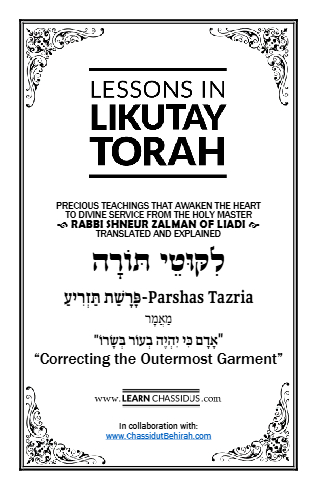
Correcting the Outermost Garment

Lessons in Likutay Torah | June 27, 2025

In Parshas Tazria, the Torah starts the explanation of the laws of Tzaraas, which it continues into the next Parsha, Metzora. Tzaraas is a spiritual “illness,” which is manifest in the miraculous changing of color of a person’s skin, (or clothing, or house). When some of a person’s skin turns white in color, without any physical explanation, he goes to the Kohen. The Kohen determines if it is impure, and if it is, then it is called Tzaraas. Then the person must quarantine outside of the city until his skin reverts to the regular color, and go through a purification process described in Parshas Metzora.

The maamar begins by quoting the first verse about the laws of Tzaraas:

“When an אָדָם-Man will have in his skin a white discoloration similar to that of wool, lime or an eggshell, or snow, then it will be Tzaraas in the skin of his flesh, and he will go to Aharon the Kohen, or to one of his sons, who are the Kohanim.” (Vayikra 13:2)

The term “אָדָם-Man” means someone on a very great level, since it refers to someone who has attained completion in all aspects. Meaning: Because he has included in himself all of the various aspects (of the service of Hashem) of Chesed-Kindness, of Gevura-Severity, and of Rachamim-Mercy. He also has in himself all of the good character traits and upright conduct which are appropriate for someone who rules over the world.

The first man, אָדָם-Adam, was created by Hashem, and was the ruler of the world for the time being. Anyone who has perfected himself to the level of Adam before he ate from the Tree of Knowledge, is also like Adam, and is spiritually in control of the world. Such an elevated person must contain all good aspects of holiness before reaching this level. This is not the case with someone who is only connected to one or two aspects (of holiness), then he is not referred to as “אָדָם-Man.”

For example, Moshe was referred to as “the אִיש-person Moshe,” and “the אִיש-person of (devotion to) Hashem.” (Shemos 32:1, and Devarim 33:1) The term “אִיש-person” is a lower level than “אָדָם-Man.” Even though Moshe was on a very high level, nonetheless, the level of “אָדָם-Man,” is even higher than that. This is because that level has all the possible good aspects of holiness, and in all of his aspects and actions he can ascend to the highest spiritual levels and to bring down those revelations to the physical world, and the entire world is dependent on his service of Hashem.

The Tzemach Tzedek explains in his maamar that is based on this maamar: There are four names for people: אדם, איש, גבר, אנוש. These four names are four levels of people: אדם-Man refers to someone who has all different aspects of holiness together in himself. איש-person refers to someone who is complete in one aspect. Moshe was complete in his connection to Hashem in a way of fiery devotion, which is the letter of איש= אש י', the fire of teaching Torah. Even though his fiery devotion to Hashem was the most complete, and he was the greatest prophet of all time, nonetheless, this extraordinary greatness was only in certain aspects of holiness. Whereas אדם-Man refers to someone who has all aspects of holiness. (Even though some of his aspects may not be as complete as those in איש who specializes in certain aspects, nonetheless, since the אדם-Man contains all aspects, he has a general advantage over the level of איש-person.) The level גבר-Strong person refers to someone who works to overcome his own personal limitations. The level אנוש-mortal man refers to someone with weaknesses of character or intellect.

Now, this “אָדָם-Man” who has corrected and fixed up his actions and all of the higher levels of his soul, it’s possible that “in the skin of his flesh,” which is his lowest aspect, there is still as aspect of unholiness and something unwanted, that was not yet fully removed.

And this produces “signs” (of white discoloration) in his physical flesh, however, these symptoms appear and disappear in a supernatural manner, and these “signs” are the spiritual ailment of Tzaraas, which are not created from the commonly found imbalance of bodily fluids or infections.

As the Rambam writes (Tumas Tzaraas 16:10):

“Tzara'at is a collective term including many afflictions that do not resemble each other. For the whitening of a person's skin is called tzara'at, as is the falling out of some of the hair of his head or beard, and the change of the color of clothes or houses. This change that affects clothes and houses which the Torah described with the general term of tzara'at is not a natural occurrence. Instead, it is a sign and a wonder prevalent among the Jewish people to warn them against lashon hora, ‘undesirable speech.’”

Based on this premise of the Rambam, that Tzaraas is a supernatural occurrence, the Alter Rebbe will explain why it is not usually found in our times:

This is why the mitzvah of purifying Tzaraas is not generally practiced in our current times which are after the Destruction of the Beis Hamikdash, since it is not found at all that there should be a change in the color of someone’s skin without any imbalance of bodily fluids or infection. Since Tzaraas appears deeper than the skin, like a place in the shade that appears deeper than a place in direct sunlight. Because of the contrast of the dark and light, when standing in the sunlight and looking at something in the shade, it appears “deeper.” Similarly, the white discoloration on the skin that is Tzaraas doesn’t appear to be on the same level as the rest of the skin around it, but “deeper,” somehow. (Meaning, it doesn’t look like someone who has white paint on his skin. Instead, it has some type of supernatural properties in how it appeared.) Rather, it was something miraculous.

A person can only receive Tzaraas because in his spiritual service of Hashem he has already corrected all of his actions, and he has separated the bad from the good in all of his aspects, and only the negative aspect which is on the edges of his “garments” weren’t yet fully refined, this is why those negative aspects come out in his skin.

See in the Hosafa-Addendum from Likutei Sichos, that the “garments” referred to here means the soul “garment” of speech. The person has refined everything except for some aspect of his speech which still needs correction. This imperfection in his “outermost garment” of speech becomes manifest on the surface of his skin in Tzaraas.

Also, the ailment of Tzaraas is a very lofty spiritual matter, since they are not considered impure until the Kohen declares them impure, and until he declares it impure, the Tzaraas does not generate any impurity, in fact, to the contrary, they represent lofty spiritual Lights, it’s just that those Lights are “the Strict Judgements of Holiness,” as it says in Eitz Chayim.

When it says about Tzaras “and he should be brought to Aharon the Kohein,” this means that the “strict judgements” become elevated through the Kohein, since he is a vehicle for the Chesed-Kindness of Above in Atzilus to be manifest, which is also referred to as “the Right Arm,” which is Kindness, and therefore, he has the power to “sweeten” the “severities.” This is why when he (the Kohein) declares it (the Tzaraas that has diminished) as pure, then the Tzaraas becomes purified and transformed into something completely good.

However, there are types of Tzaraas that the Kohein is not able to elevate and “sweeten.” For example, if the Tzaraas gets larger or has addition “signs” of impurity, such as new white hair growing in the affected area, as explained in the Parsha and in the Mishnayos (Negaim) and Rambam (Tumas Tzaraas). In these cases, the Kohein cannot purify and transform the Tzaraas until the affected area diminishes and the other “signs of impurity” disappear.

Therefore, cases of Tzaraas do not happen nowadays, since it is not found in anyone, because it only happens to someone who has already removed all the unholiness from inside of his body and soul, and only on the outer surface of the person is there a trace of something negative that needs to be transformed, and this is not found among anyone amongst us, since even someone who is righteous and good, still has some minute aspect of unholiness inside of himself. This explanation will suffice for the understanding.

Summary:

Now we will understand why the term “אָדָם-Man” is used in the context of Tzaraas. Tzaraas is a spiritual affliction that only occurs to tremendously great people who have perfected everything inside of themselves except their most superficial aspect. In order to remove that negative aspect that remains on the surface, Hashem sends a supernatural sign on the person’s skin. This shows the person how to correct the final negative aspect in his or her service of Hashem. After completing that last spiritual correction, the sign disappears. They then return to the Kohen who transforms that sign into something good and holy. Since we still have a lot of work to do in correcting our actions and inner selves, there is no need for supernatural signs to complete the last spiritual correction. That is why there is no Tzaraas nowadays.

In Parshas Tazria, the Torah starts the explanation of the laws of Tzaraas, which it continues into the next Parsha, Metzora. Tzaraas is a spiritual “illness,” which is manifest in the miraculous changing of color of a person’s skin, (or clothing, or house). When some of a person’s skin turns white in color, without any physical explanation, he goes to the Kohen. The Kohen determines if it is impure, and if it is, then it is called Tzaraas. Then the person must quarantine outside of the city until his skin reverts to the regular color, and go through a purification process described in Parshas Metzora.

The maamar begins by quoting the first verse about the laws of Tzaraas:

“When an אָדָם-Man will have in his skin a white discoloration similar to that of wool, lime or an eggshell, or snow, then it will be Tzaraas in the skin of his flesh, and he will go to Aharon the Kohen, or to one of his sons, who are the Kohanim.” (Vayikra 13:2)

The term “אָדָם-Man” means someone on a very great level, since it refers to someone who has attained completion in all aspects. Meaning: Because he has included in himself all of the various aspects (of the service of Hashem) of Chesed-Kindness, of Gevura-Severity, and of Rachamim-Mercy. He also has in himself all of the good character traits and upright conduct which are appropriate for someone who rules over the world.

The first man, אָדָם-Adam, was created by Hashem, and was the ruler of the world for the time being. Anyone who has perfected himself to the level of Adam before he ate from the Tree of Knowledge, is also like Adam, and is spiritually in control of the world. Such an elevated person must contain all good aspects of holiness before reaching this level. This is not the case with someone who is only connected to one or two aspects (of holiness), then he is not referred to as “אָדָם-Man.”

For example, Moshe was referred to as “the אִיש-person Moshe,” and “the אִיש-person of (devotion to) Hashem.” (Shemos 32:1, and Devarim 33:1) The term “אִיש-person” is a lower level than “אָדָם-Man.” Even though Moshe was on a very high level, nonetheless, the level of “אָדָם-Man,” is even higher than that. This is because that level has all the possible good aspects of holiness, and in all of his aspects and actions he can ascend to the highest spiritual levels and to bring down those revelations to the physical world, and the entire world is dependent on his service of Hashem.

The Tzemach Tzedek explains in his maamar that is based on this maamar: There are four names for people: אדם, איש, גבר, אנוש. These four names are four levels of people: אדם-Man refers to someone who has all different aspects of holiness together in himself. איש-person refers to someone who is complete in one aspect. Moshe was complete in his connection to Hashem in a way of fiery devotion, which is the letter of איש= אש י', the fire of teaching Torah. Even though his fiery devotion to Hashem was the most complete, and he was the greatest prophet of all time, nonetheless, this extraordinary greatness was only in certain aspects of holiness. Whereas אדם-Man refers to someone who has all aspects of holiness. (Even though some of his aspects may not be as complete as those in איש who specializes in certain aspects, nonetheless, since the אדם-Man contains all aspects, he has a general advantage over the level of איש-person.) The level גבר-Strong person refers to someone who works to overcome his own personal limitations. The level אנוש-mortal man refers to someone with weaknesses of character or intellect.

Now, this “אָדָם-Man” who has corrected and fixed up his actions and all of the higher levels of his soul, it’s possible that “in the skin of his flesh,” which is his lowest aspect, there is still as aspect of unholiness and something unwanted, that was not yet fully removed.

And this produces “signs” (of white discoloration) in his physical flesh, however, these symptoms appear and disappear in a supernatural manner, and these “signs” are the spiritual ailment of Tzaraas, which are not created from the commonly found imbalance of bodily fluids or infections.

As the Rambam writes (Tumas Tzaraas 16:10):

“Tzara'at is a collective term including many afflictions that do not resemble each other. For the whitening of a person's skin is called tzara'at, as is the falling out of some of the hair of his head or beard, and the change of the color of clothes or houses. This change that affects clothes and houses which the Torah described with the general term of tzara'at is not a natural occurrence. Instead, it is a sign and a wonder prevalent among the Jewish people to warn them against lashon hora, ‘undesirable speech.’”

Based on this premise of the Rambam, that Tzaraas is a supernatural occurrence, the Alter Rebbe will explain why it is not usually found in our times:

This is why the mitzvah of purifying Tzaraas is not generally practiced in our current times which are after the Destruction of the Beis Hamikdash, since it is not found at all that there should be a change in the color of someone’s skin without any imbalance of bodily fluids or infection. Since Tzaraas appears deeper than the skin, like a place in the shade that appears deeper than a place in direct sunlight. Because of the contrast of the dark and light, when standing in the sunlight and looking at something in the shade, it appears “deeper.” Similarly, the white discoloration on the skin that is Tzaraas doesn’t appear to be on the same level as the rest of the skin around it, but “deeper,” somehow. (Meaning, it doesn’t look like someone who has white paint on his skin. Instead, it has some type of supernatural properties in how it appeared.) Rather, it was something miraculous.

A person can only receive Tzaraas because in his spiritual service of Hashem he has already corrected all of his actions, and he has separated the bad from the good in all of his aspects, and only the negative aspect which is on the edges of his “garments” weren’t yet fully refined, this is why those negative aspects come out in his skin.

See in the Hosafa-Addendum from Likutei Sichos, that the “garments” referred to here means the soul “garment” of speech. The person has refined everything except for some aspect of his speech which still needs correction. This imperfection in his “outermost garment” of speech becomes manifest on the surface of his skin in Tzaraas.

Also, the ailment of Tzaraas is a very lofty spiritual matter, since they are not considered impure until the Kohen declares them impure, and until he declares it impure, the Tzaraas does not generate any impurity, in fact, to the contrary, they represent lofty spiritual Lights, it’s just that those Lights are “the Strict Judgements of Holiness,” as it says in Eitz Chayim.

When it says about Tzaras “and he should be brought to Aharon the Kohein,” this means that the “strict judgements” become elevated through the Kohein, since he is a vehicle for the Chesed-Kindness of Above in Atzilus to be manifest, which is also referred to as “the Right Arm,” which is Kindness, and therefore, he has the power to “sweeten” the “severities.” This is why when he (the Kohein) declares it (the Tzaraas that has diminished) as pure, then the Tzaraas becomes purified and transformed into something completely good.

However, there are types of Tzaraas that the Kohein is not able to elevate and “sweeten.” For example, if the Tzaraas gets larger or has addition “signs” of impurity, such as new white hair growing in the affected area, as explained in the Parsha and in the Mishnayos (Negaim) and Rambam (Tumas Tzaraas). In these cases, the Kohein cannot purify and transform the Tzaraas until the affected area diminishes and the other “signs of impurity” disappear.

Therefore, cases of Tzaraas do not happen nowadays, since it is not found in anyone, because it only happens to someone who has already removed all the unholiness from inside of his body and soul, and only on the outer surface of the person is there a trace of something negative that needs to be transformed, and this is not found among anyone amongst us, since even someone who is righteous and good, still has some minute aspect of unholiness inside of himself. This explanation will suffice for the understanding.

Summary:

Now we will understand why the term “אָדָם-Man” is used in the context of Tzaraas. Tzaraas is a spiritual affliction that only occurs to tremendously great people who have perfected everything inside of themselves except their most superficial aspect. In order to remove that negative aspect that remains on the surface, Hashem sends a supernatural sign on the person’s skin. This shows the person how to correct the final negative aspect in his or her service of Hashem. After completing that last spiritual correction, the sign disappears. They then return to the Kohen who transforms that sign into something good and holy. Since we still have a lot of work to do in correcting our actions and inner selves, there is no need for supernatural signs to complete the last spiritual correction. That is why there is no Tzaraas nowadays.

PDF Preview