The Significance of Tzaraat, Lashon Hara, and the Egyptian Exile
Torah Papers | April 12, 2024
Print This Article
View Original PDF

The Significance of Tzaraat, Lashon Hara, and the Egyptian Exile

Torah Papers | June 27, 2025

The act of a Metzorah taking two birds (Vayikra 14:4):

וְצִוָּה הַכֹּהֵן וְלָקַח לַמִּטַּהֵר שְׁתֵּי־צִפֳּרִים חַיּוֹת טְהֹרוֹת וְעֵץ אֶרֶז וּשְׁנִי תוֹלַעַת וְאֵזֹב׃

The Kohen shall command to take for the person undergoing purification two live, pure [kosher] birds, cedar wood, crimson thread and hyssop.

The Ibn Ezra comments that the cedar wood and hyssop are the biggest and smallest among all plants, and there is no reason to search for the meaning of the word אֵזֹב, since it is known by way of kabbalah (tradition). He then adds one final point that ties us back to Pesach:

וְהִנֵּה הַמְּצֹרָע וְהַבַּיִת הַמְּנֻגָּע וְטֻמְאַת הַמֵּת קְרוֹבִים כִּדְמוּת פֶּסַח מִצְרַיִם:

Note, the leper, plagued house and uncleanness caused by a corpse are similar. They’re also similar to the Egyptian Passover.

His intent pivots on the impurity caused by Tzara’at of the body and of the house, and the impurity caused by coming into contact with a dead body, all lasting seven days. And what they also have in common is that their remedies all involve usage of the אֵזֹב – hyssop, whose first occurrence appears when Bnei Yisrael are commanded to use a bundle of hyssop to dip in the blood of the Korban Pesach and spread it on their doorposts and lintel the night of Yetziat Mitzrayim.

The Shelah HaKadosh expands on this idea (Pesachim, Matza Ashirah 3:8). The first time Tzara’at is found in the Torah is with regards to Moshe Rabbeinu – whose hand turned snow-like white (מְצֹרַעַת כַּשָּׁלֶג) during one of the signs he requested of Hakadosh Baruch Hu. (The Midrash details one previous instance of Tzara’at, back in Gan Eden when the snake approached Chava and persuaded her to eat from the Eitz HaDa’at. The Midrash says the snake was guilty of speaking lashon hara against Hakadosh Baruch Hu and was punished with Tzara’at – evidenced by the spots which appear on the snake’s skin to this very day.) The Shelah adds, not only do we see Tzara’at in the case of Bnei Yisrael’s greatest prophet – Moshe Rabbeinu – but also in Pharoah, who denied Hakadosh Baruch Hu’s role in Creation and took personal credit for it.

וַיָּמָת מֶלֶךְ מִצְרַיִם does not mean he literally died, but rather he was stricken with Tzara’at and considered as dead.

Finally, the Shelah says, Bnei Yisrael themselves were like once stricken by Tzara’at.

וְכֵן לְעִנְיַן טָהֳרָה, יִשְׂרָאֵל הָיוּ בְּמִצְרַיִם כִּמְצוֹרָע מֻסְגָּר, שֶׁאֵין עֶבֶד יָכוֹל לִבְרֹחַ. וּבְטָהֳרָה בְּפֶסַח מִצְרַיִם כְּתִיב וּלְקַחְתֶּם אֲגֻדַּת אֵזוֹב כְּמוֹ בִּמְצוֹרָע, וּבְזֹהַר תַּנָּא (ח"ב לה, ב) כְּתִיב וּלְקַחְתֶּם אֲגֻדַּת אֵזוֹב וּטְבַלְתֶּם בַּדָּם אֲשֶׁר בַּסַּף וְהִגַּעְתֶּם אֶל הַמַּשְׁקוֹף וְאֶל שְׁתֵּי הַמְּזוּזֹת.

And likewise with the matter of purity: The Jewish people in Egypt were like someone quarantined with Tzara’at, since no slave could escape. And with the purification, it is written about the Passover of Egypt, “And you shall take a bundle of hyssop,” like someone with Tzara’at. And in the Zohar, it taught: It is written, “And you shall take a bunch of hyssop, and dip it in the blood in the basin; touch the lintel and the two side doorposts with some of the blood in the basin.”

The four hundred years spent in Egypt were spent like one stricken by Tzara’at – outside the camp, or outside their land in this case. He then goes on to explain the kabbalistic significance of the hyssop, which we won’t go into right now.

The Shelah continues: Bnei Yisrael descended down to Egypt because of lashon hara, and Moshe Rabbeinu received Tzara’at because he spoke negatively of Bnei Yisrael, suggesting they would not believe him. Miriam, too, was stricken with Tzara’at after speaking lashon hara about her brother. Speaking lashon hara leads directly to Tzara’at. However, we also find cases of people who spoke lashon hara and were not stricken. These, the Shelah HaKadosh says, are to be considered even more severe because if the affliction was not directed to their possessions or skin, it was directed straight to their neshama, where no remedy exists. He then shifts to Bnei Yisrael’s exodus from Egypt, which was on account on four things: they did not change their names, nor their clothing, nor their language, and they did not have informers and gossipers – וּמְסַפְּרֵי לָשׁוֹן הָרַע דָּלְטוֹרִין – among them. This final point contrasts Moshe Rabbeinu’s conclusion years earlier, when he stepped outside after having killed the Egyptian taskmaster, and exclaimed, “אָכֵן נוֹדַע הַדָּבָר – Surely, the matter is known.” Chazal say, it was at that juncture that Moshe figured out why Bnei Yisrael were enslaved and oppressed more than any other nation. It was because they had among them informers and gossipers. The Shelah digs into the meaning of this, suggesting it may mean other informers and gossipers were present, aside from Datan and Aviram. Given that the pair were still alive, and in fine form, during the exodus from Egypt when such gossipers were no longer present, it likely means Moshe Rabbeinu discovered more than just the two of them. The others either died during the plague of darkness or they performed Teshuva.

The Shelah HaKadosh sums up his commentary by reaffirming that the descent of Bnei Yisrael to Egypt was on account of lashon hara, an opinion also held by the Kli Yakar, as discussed last week. In his sefer Shmirat HaLashon, the Chafetz Chaim presents the same opinion, emphasizing that it was also the first sin to occur after Creation. Even prior to Adam and Chava eating from the tree, the snake was guilty of this sin, speaking negatively about Hakadosh Baruch Hu and inventing reasons as to why He did not want anyone eating from the tree and becoming powerful like Him. The snake was punished just like Moshe was punished after telling Hakadosh Baruch Hu that Bnei Yisrael would not believe him or listen to him – both with Tzara’at. The stick that Moshe Rabbeinu threw down to the ground moments before his hand became leprous, turned into a snake. Why a snake? For this exact reason – Moshe mimicked the snake, and his speech was tied back to that of the serpent of Gan Eden.

The Chafetz Chaim adds, not only was it on account of lashon hara that we descended to Egypt, but this sin remains with us until this very day. That we descended to Egypt, and to a ruler named Pharoah, was not a coincidence, nor a geographical convenience. The Arizal says פַּרְעֹה is in essence פֶּה רַע – an evil mouth, because that was his dominant trait. He was afflicted by Tzara’at as a result and he looked to bath in a pool of Jewish children’s blood as his cure. When we left Egypt, it was only after we cleaned up our mouths and our speech, going from פֶּה רַע to פֶּה סָח, and becoming a different people: וּלְכֹל בְּנֵי יִשְׂרָאֵל לֹא יֶחֱרַץ כֶּלֶב לְשֹׁנוֹ – But against any of the children of Yisrael not a dog shall sharpen its tongue.

One of the שֵׁשׁ זְכִירוֹת – Six Remembrances recited after Shacharit, is based on the commandment found in Ki Teitze:

זָכוֹר אֵת אֲשֶׁר־עָשָׂה ה' אֱ-לֹהֶיךָ לְמִרְיָם בַּדֶּרֶךְ בְּצֵאתְכֶם מִמִּצְרָיִם

Remember what Hashem, your G-d, did to Miriam on the way, when you came out of Egypt.

The final three words in the pasuk are left out by Bnei Sepharad on a daily basis, and only by Bnei Ashkenaz include the reference to Egypt, leading Chazal to ask why the words are even present and what their relevance is. The incident with Miriam speaking lashon hara and being punished occurred well after Bnei Yisrael were out of Egypt and if the context of location is important, why not say to remember what was done to Miriam in the desert? The answer relates to the presence of Tzara’at over the years. Moshe Rabbeinu was stricken by it years earlier, and even Bnei Yisrael themselves were stricken at Cheit Ha’Eigel according to the Midrash. Moshe saw the people כִּי פָרוּעַ הוּא – they were in disorder; or afflicted by Tzara’at. Aharon, too, received Tzara’at at the same time as Miriam, but was healed on the spot without having to leave the camp for seven days. How does this context link us to בְּצֵאתְכֶם מִמִּצְרָיִם בַּדֶּרֶךְ? It is because Bnei Yisrael left Egypt with clean mouths and Miriam was the first to speak lashon hara since the time they were slaves in Egypt. This is why we remember not only Miriam each day but also how we were able to clean our mouths in Egypt and place ourselves in a position where they were used for purity and holiness, such as on the holiday of Pesach.

We are left with one final loose end to tie up. Why did we descend to Egypt for four hundred years? Yes, Hakadosh Baruch Hu revealed to Avraham Avinu that they’d descend and be oppressed for four hundred years and that is more than enough of a reason, but the Gemara (Nedarim 32a) also asks the question of why and provides suggestions as to why they ended up there. Thus, the question is fair game.

What is the significance of the number four hundred? Rabbeinu Bachya says, the number four hundred is prominent in matters concerning עַיִן רַע – the evil eye. When we see this number, it is with regards to people who see narrowly; they see everything with a negative spin. Why is that guy building? Why did the other guy extend his balcony? Why is this one moving to a bigger house? Each question asked from a pessimistic and negative place. What difference does it make to you? Live the way you want and let others live the way they want! How does it affect you what they do? Such people are always looking out around the corner, suspecting, accusing, worrying. When we find such people, says Rabbeinu Bachya, we find the number four hundred.

The first time this number appears in the Torah is in Brit Bein HaBetarim, when Hakadosh Baruch Hu told Avraham that his children will dwell in a foreign land for four hundred years and be enslaved there. The next occurrence is when Avraham bought the plot of land in Chevron – Me’arat HaMachpela – from Efron. עֶפְרוֹן, whose name equals four hundred, at first offered anything Avraham wanted – on the house, no charge, an honor for him to provide it. But when it came time for the transaction involving a piece of barren land that was unusable and unsellable because the noises of demons could be heard from below it, he added the nominal amount of four hundred shekel to the bill. Efron had an evil eye.

Where else do we find this number? When Eisav approached Yaacov to confront him, he brought with him four hundred men. Eisav, the archetype of an evil eye, could have deployed any other number but went with four hundred. Also, David HaMelech was forced to confront Naval HaCarmeli with four hundred men, because Naval was a menuval – an evil man.

The Kli Yakar adds one more instance to those of Rabbeinu Bachya: We find the number four hundred in the exile to Egypt because Bnei Yisrael possessed that trait as well. They were of an evil eye. The brothers were jealous of Yosef and could not speak peacefully with him. They spoke lashon hara about him, and this trait was rampant at the time, according to the Kli Yakar. What was the result? They sold him down to Egypt and followed him down shortly thereafter – officially beginning the exile because of lashon hara (and baseless hatred).

Ori V’Yishi says, if after six years of servitude, a Jewish slave chooses to remain with their master rather than being set free – we piece his ear. Why the ear? The Gemara asks this question and provides two answers as to what the person heard at Har Sinai but was now ignoring or contravening. And why do we pin him to the doorpost? Why not on a table or on the couch in the living room? The Gemara says, the doorposts are the witnesses to Hakadosh Baruch Hu skipping over the houses during the final plague that preceded Bnei Yisrael’s freedom, and here is this person choosing slavery once more. The Gemara asks about the ear and about the doorpost, both great questions, but why does it not ask about the מַּרְצֵעַ (awl)? Why not use a nail? Why an awl? Tosfot says, the numerical value of מַּרְצֵעַ is four hundred! The awl is a tool used to remind the person they were already slaves in Egypt for four hundred years, and it wasn’t so that they come out and choose slavery anew! Ori V’Yishi points out, מַּרְצֵעַ is also the same word as מְּצֹרָע – one stricken with Tzara’at, because the four hundred years of oppression in Egypt were to correct the sins which lead to Tzara’at – namely, lashon hara.

Rabbeinu Bachya sums up the topic by pointing out that the number four hundred is represented by the letter ת – the final letter in the aleph bet. As the Gemara says, ת can be a letter of תְּחִיָה or a letter of תָּמוּת – to live or die. As the Rama MiPano teaches us: מָוֶת וְחַיִים בְּיַד לָשׁוֹן – the difference between life and death lies in the power of our tongue and speech. יַד לָשׁוֹן is also equal to four hundred.

We were in Egypt and our Avodah was to focus on our tongue and speech. We came out and now can either focus on the ת of life through תּוֹרָה, or the ת of death through an עַיִן רַע and lashon hara. Our Avodah on Pesach is to understand the mission in Egypt, and to direct the two pipes in our mouths towards kedusha, and most importantly – proper speech.
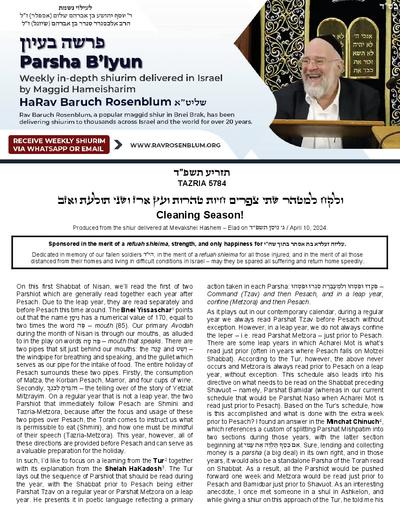

The act of a Metzorah taking two birds (Vayikra 14:4):

וְצִוָּה הַכֹּהֵן וְלָקַח לַמִּטַּהֵר שְׁתֵּי־צִפֳּרִים חַיּוֹת טְהֹרוֹת וְעֵץ אֶרֶז וּשְׁנִי תוֹלַעַת וְאֵזֹב׃

The Kohen shall command to take for the person undergoing purification two live, pure [kosher] birds, cedar wood, crimson thread and hyssop.

The Ibn Ezra comments that the cedar wood and hyssop are the biggest and smallest among all plants, and there is no reason to search for the meaning of the word אֵזֹב, since it is known by way of kabbalah (tradition). He then adds one final point that ties us back to Pesach:

וְהִנֵּה הַמְּצֹרָע וְהַבַּיִת הַמְּנֻגָּע וְטֻמְאַת הַמֵּת קְרוֹבִים כִּדְמוּת פֶּסַח מִצְרַיִם:

Note, the leper, plagued house and uncleanness caused by a corpse are similar. They’re also similar to the Egyptian Passover.

His intent pivots on the impurity caused by Tzara’at of the body and of the house, and the impurity caused by coming into contact with a dead body, all lasting seven days. And what they also have in common is that their remedies all involve usage of the אֵזֹב – hyssop, whose first occurrence appears when Bnei Yisrael are commanded to use a bundle of hyssop to dip in the blood of the Korban Pesach and spread it on their doorposts and lintel the night of Yetziat Mitzrayim.

The Shelah HaKadosh expands on this idea (Pesachim, Matza Ashirah 3:8). The first time Tzara’at is found in the Torah is with regards to Moshe Rabbeinu – whose hand turned snow-like white (מְצֹרַעַת כַּשָּׁלֶג) during one of the signs he requested of Hakadosh Baruch Hu. (The Midrash details one previous instance of Tzara’at, back in Gan Eden when the snake approached Chava and persuaded her to eat from the Eitz HaDa’at. The Midrash says the snake was guilty of speaking lashon hara against Hakadosh Baruch Hu and was punished with Tzara’at – evidenced by the spots which appear on the snake’s skin to this very day.) The Shelah adds, not only do we see Tzara’at in the case of Bnei Yisrael’s greatest prophet – Moshe Rabbeinu – but also in Pharoah, who denied Hakadosh Baruch Hu’s role in Creation and took personal credit for it.

וַיָּמָת מֶלֶךְ מִצְרַיִם does not mean he literally died, but rather he was stricken with Tzara’at and considered as dead.

Finally, the Shelah says, Bnei Yisrael themselves were like once stricken by Tzara’at.

וְכֵן לְעִנְיַן טָהֳרָה, יִשְׂרָאֵל הָיוּ בְּמִצְרַיִם כִּמְצוֹרָע מֻסְגָּר, שֶׁאֵין עֶבֶד יָכוֹל לִבְרֹחַ. וּבְטָהֳרָה בְּפֶסַח מִצְרַיִם כְּתִיב וּלְקַחְתֶּם אֲגֻדַּת אֵזוֹב כְּמוֹ בִּמְצוֹרָע, וּבְזֹהַר תַּנָּא (ח"ב לה, ב) כְּתִיב וּלְקַחְתֶּם אֲגֻדַּת אֵזוֹב וּטְבַלְתֶּם בַּדָּם אֲשֶׁר בַּסַּף וְהִגַּעְתֶּם אֶל הַמַּשְׁקוֹף וְאֶל שְׁתֵּי הַמְּזוּזֹת.

And likewise with the matter of purity: The Jewish people in Egypt were like someone quarantined with Tzara’at, since no slave could escape. And with the purification, it is written about the Passover of Egypt, “And you shall take a bundle of hyssop,” like someone with Tzara’at. And in the Zohar, it taught: It is written, “And you shall take a bunch of hyssop, and dip it in the blood in the basin; touch the lintel and the two side doorposts with some of the blood in the basin.”

The four hundred years spent in Egypt were spent like one stricken by Tzara’at – outside the camp, or outside their land in this case. He then goes on to explain the kabbalistic significance of the hyssop, which we won’t go into right now.

The Shelah continues: Bnei Yisrael descended down to Egypt because of lashon hara, and Moshe Rabbeinu received Tzara’at because he spoke negatively of Bnei Yisrael, suggesting they would not believe him. Miriam, too, was stricken with Tzara’at after speaking lashon hara about her brother. Speaking lashon hara leads directly to Tzara’at. However, we also find cases of people who spoke lashon hara and were not stricken. These, the Shelah HaKadosh says, are to be considered even more severe because if the affliction was not directed to their possessions or skin, it was directed straight to their neshama, where no remedy exists. He then shifts to Bnei Yisrael’s exodus from Egypt, which was on account on four things: they did not change their names, nor their clothing, nor their language, and they did not have informers and gossipers – וּמְסַפְּרֵי לָשׁוֹן הָרַע דָּלְטוֹרִין – among them. This final point contrasts Moshe Rabbeinu’s conclusion years earlier, when he stepped outside after having killed the Egyptian taskmaster, and exclaimed, “אָכֵן נוֹדַע הַדָּבָר – Surely, the matter is known.” Chazal say, it was at that juncture that Moshe figured out why Bnei Yisrael were enslaved and oppressed more than any other nation. It was because they had among them informers and gossipers. The Shelah digs into the meaning of this, suggesting it may mean other informers and gossipers were present, aside from Datan and Aviram. Given that the pair were still alive, and in fine form, during the exodus from Egypt when such gossipers were no longer present, it likely means Moshe Rabbeinu discovered more than just the two of them. The others either died during the plague of darkness or they performed Teshuva.

The Shelah HaKadosh sums up his commentary by reaffirming that the descent of Bnei Yisrael to Egypt was on account of lashon hara, an opinion also held by the Kli Yakar, as discussed last week. In his sefer Shmirat HaLashon, the Chafetz Chaim presents the same opinion, emphasizing that it was also the first sin to occur after Creation. Even prior to Adam and Chava eating from the tree, the snake was guilty of this sin, speaking negatively about Hakadosh Baruch Hu and inventing reasons as to why He did not want anyone eating from the tree and becoming powerful like Him. The snake was punished just like Moshe was punished after telling Hakadosh Baruch Hu that Bnei Yisrael would not believe him or listen to him – both with Tzara’at. The stick that Moshe Rabbeinu threw down to the ground moments before his hand became leprous, turned into a snake. Why a snake? For this exact reason – Moshe mimicked the snake, and his speech was tied back to that of the serpent of Gan Eden.

The Chafetz Chaim adds, not only was it on account of lashon hara that we descended to Egypt, but this sin remains with us until this very day. That we descended to Egypt, and to a ruler named Pharoah, was not a coincidence, nor a geographical convenience. The Arizal says פַּרְעֹה is in essence פֶּה רַע – an evil mouth, because that was his dominant trait. He was afflicted by Tzara’at as a result and he looked to bath in a pool of Jewish children’s blood as his cure. When we left Egypt, it was only after we cleaned up our mouths and our speech, going from פֶּה רַע to פֶּה סָח, and becoming a different people: וּלְכֹל בְּנֵי יִשְׂרָאֵל לֹא יֶחֱרַץ כֶּלֶב לְשֹׁנוֹ – But against any of the children of Yisrael not a dog shall sharpen its tongue.

One of the שֵׁשׁ זְכִירוֹת – Six Remembrances recited after Shacharit, is based on the commandment found in Ki Teitze:

זָכוֹר אֵת אֲשֶׁר־עָשָׂה ה' אֱ-לֹהֶיךָ לְמִרְיָם בַּדֶּרֶךְ בְּצֵאתְכֶם מִמִּצְרָיִם

Remember what Hashem, your G-d, did to Miriam on the way, when you came out of Egypt.

The final three words in the pasuk are left out by Bnei Sepharad on a daily basis, and only by Bnei Ashkenaz include the reference to Egypt, leading Chazal to ask why the words are even present and what their relevance is. The incident with Miriam speaking lashon hara and being punished occurred well after Bnei Yisrael were out of Egypt and if the context of location is important, why not say to remember what was done to Miriam in the desert? The answer relates to the presence of Tzara’at over the years. Moshe Rabbeinu was stricken by it years earlier, and even Bnei Yisrael themselves were stricken at Cheit Ha’Eigel according to the Midrash. Moshe saw the people כִּי פָרוּעַ הוּא – they were in disorder; or afflicted by Tzara’at. Aharon, too, received Tzara’at at the same time as Miriam, but was healed on the spot without having to leave the camp for seven days. How does this context link us to בְּצֵאתְכֶם מִמִּצְרָיִם בַּדֶּרֶךְ? It is because Bnei Yisrael left Egypt with clean mouths and Miriam was the first to speak lashon hara since the time they were slaves in Egypt. This is why we remember not only Miriam each day but also how we were able to clean our mouths in Egypt and place ourselves in a position where they were used for purity and holiness, such as on the holiday of Pesach.

We are left with one final loose end to tie up. Why did we descend to Egypt for four hundred years? Yes, Hakadosh Baruch Hu revealed to Avraham Avinu that they’d descend and be oppressed for four hundred years and that is more than enough of a reason, but the Gemara (Nedarim 32a) also asks the question of why and provides suggestions as to why they ended up there. Thus, the question is fair game.

What is the significance of the number four hundred? Rabbeinu Bachya says, the number four hundred is prominent in matters concerning עַיִן רַע – the evil eye. When we see this number, it is with regards to people who see narrowly; they see everything with a negative spin. Why is that guy building? Why did the other guy extend his balcony? Why is this one moving to a bigger house? Each question asked from a pessimistic and negative place. What difference does it make to you? Live the way you want and let others live the way they want! How does it affect you what they do? Such people are always looking out around the corner, suspecting, accusing, worrying. When we find such people, says Rabbeinu Bachya, we find the number four hundred.

The first time this number appears in the Torah is in Brit Bein HaBetarim, when Hakadosh Baruch Hu told Avraham that his children will dwell in a foreign land for four hundred years and be enslaved there. The next occurrence is when Avraham bought the plot of land in Chevron – Me’arat HaMachpela – from Efron. עֶפְרוֹן, whose name equals four hundred, at first offered anything Avraham wanted – on the house, no charge, an honor for him to provide it. But when it came time for the transaction involving a piece of barren land that was unusable and unsellable because the noises of demons could be heard from below it, he added the nominal amount of four hundred shekel to the bill. Efron had an evil eye.

Where else do we find this number? When Eisav approached Yaacov to confront him, he brought with him four hundred men. Eisav, the archetype of an evil eye, could have deployed any other number but went with four hundred. Also, David HaMelech was forced to confront Naval HaCarmeli with four hundred men, because Naval was a menuval – an evil man.

The Kli Yakar adds one more instance to those of Rabbeinu Bachya: We find the number four hundred in the exile to Egypt because Bnei Yisrael possessed that trait as well. They were of an evil eye. The brothers were jealous of Yosef and could not speak peacefully with him. They spoke lashon hara about him, and this trait was rampant at the time, according to the Kli Yakar. What was the result? They sold him down to Egypt and followed him down shortly thereafter – officially beginning the exile because of lashon hara (and baseless hatred).

Ori V’Yishi says, if after six years of servitude, a Jewish slave chooses to remain with their master rather than being set free – we piece his ear. Why the ear? The Gemara asks this question and provides two answers as to what the person heard at Har Sinai but was now ignoring or contravening. And why do we pin him to the doorpost? Why not on a table or on the couch in the living room? The Gemara says, the doorposts are the witnesses to Hakadosh Baruch Hu skipping over the houses during the final plague that preceded Bnei Yisrael’s freedom, and here is this person choosing slavery once more. The Gemara asks about the ear and about the doorpost, both great questions, but why does it not ask about the מַּרְצֵעַ (awl)? Why not use a nail? Why an awl? Tosfot says, the numerical value of מַּרְצֵעַ is four hundred! The awl is a tool used to remind the person they were already slaves in Egypt for four hundred years, and it wasn’t so that they come out and choose slavery anew! Ori V’Yishi points out, מַּרְצֵעַ is also the same word as מְּצֹרָע – one stricken with Tzara’at, because the four hundred years of oppression in Egypt were to correct the sins which lead to Tzara’at – namely, lashon hara.

Rabbeinu Bachya sums up the topic by pointing out that the number four hundred is represented by the letter ת – the final letter in the aleph bet. As the Gemara says, ת can be a letter of תְּחִיָה or a letter of תָּמוּת – to live or die. As the Rama MiPano teaches us: מָוֶת וְחַיִים בְּיַד לָשׁוֹן – the difference between life and death lies in the power of our tongue and speech. יַד לָשׁוֹן is also equal to four hundred.

We were in Egypt and our Avodah was to focus on our tongue and speech. We came out and now can either focus on the ת of life through תּוֹרָה, or the ת of death through an עַיִן רַע and lashon hara. Our Avodah on Pesach is to understand the mission in Egypt, and to direct the two pipes in our mouths towards kedusha, and most importantly – proper speech.

PDF Preview