A Yid Must Be Mekabel and Mashpiah
Havineini | February 21, 2026
Print This Article
View Original PDF

A Yid Must Be Mekabel and Mashpiah

Havineini | February 21, 2026

If a father is angry at his child because the child has a different personality from his own, or because his child woke him in middle of the night, or for any other reason, there’s an eitzah to quell the anger: give and give to this child, and the father will see his heart transformed into love for his child.

Indeed, so many parents will tell you that they feel the greatest love to a child who took the most of out of them; they needed to give the most to that child. This is because “a piece of their heart” went into this child. When a parent gives themselves away with mesirus nefesh for a child, it elicits and fosters great feelings of love for that child. This is the mehalech of האדם נפעל כפי פעולותיו, and it is the precise reason that Hashem gave us so many mitzvos—so that we will become permeated with ahavas Hashem.

The Purpose of Mitzvos Is for Them to Permeate Our Neshamos

If we think about it a bit more deeply, we will discover that the Ribbono shel Olam desires us to instill in our hearts the deveikus that we will need for the World to Come davka by engaging in deveikus in This World through Torah and mitzvos. When we carry out the Torah and mitzvos, it leaves an indelible impression in our hearts, and it prepares us for our journey to Heaven. Our bodies remain here, and if a person engaged with Yiddishkeit only in a superficial manner, the Torah and mitzvos will, chas v’shalom, remain with the guf, while the neshamah will arrive to the Olam HaEmes emptyhanded, R”l.

The proper approach is to engage in Torah and mitzvos with intensity—qualitatively and quantitatively—until they penetrate to the deepest place within our neshamos, which will enable our neshamos to take their final journey with full valises, because they have toiled for this reward.

This is essentially the concept of נהמא דכיסופא (literally, bread of shame, when we receive a reward we have not earned). The Ribbono shel Olam wants us to earn our reward, and therefore, He gives us the reward only if it came to us with toil. When it’s difficult and the going is hard, but this Yid nevertheless works and works until he’s successful—then it becomes his own. Prior to learning Torah, it is called תורת ה' and afterward it is called תורתו. It becomes his forever, because he has toiled for it and thus rightfully earned it; it cost him blood, sweat, and tears.

Deveikus Can Happen Only When There’s a Mashpiah and a Mekabel

There’s an important principle in creation. When we want two things to become united, there must be a mashpiah-mekabel relationship between them. That is, one bequeaths and the other receives from it. Only when there’s such a connection can there be offspring and other new creations that come from this union. If we place two tables alongside each other, they have not become one table; they happen to be situated next to each other. But if we want a true connection, there must be a mashpiah and mekabel—one gives and the other receives. This requires great toil and humility, but that is the only way to חיבור, connection, and only in this way can something new come forth from this union.

The entire creation works in this way of mashpiah and mekabel. The Gemara (Ta’anis 7a) tells us, גדול יום הגשמים, great is a day of rain, for rain is an manifestation of mashpiah and mekabel—the water gives and the earth receives—and only this way can plant life grow. The entire creation works this way; there must be a חיבור of one giving and the other taking.

It works the same way in the spiritual realm. When a father learns with his son, or the rebbi learns with his talmid, the child or the talmid must be a receptacle of acceptance. He must be humble and he must accept, and the rebbi must be a mashpiah who truly seeks to impart. If the talmid doesn’t understand what he is being taught, the rebbi or father must be willing to break it down even more—even dozens of times—because this is what a mashpiah does. Neither of them has his own interest in mind; they’re both focused on the singular endeavor of internalizing the Torah.

That is why this relationship/connection works so well. For, as noted, everything in the world works with the mashpiah/mekabel relationship.

Utilizing Both

For this reason, we have been commanded to utilize both strengths.

One the one hand, we must be a mekabel. Whatever the Ribbono shel Olam says: נעשה ונשמע! I need only hear what Hashem wants of me, and I will do it. I want to learn Torah. I want to internalize it and understand it. And if I don’t understand it, I will toil to understand it.

On the other hand, every Yid must also be a mashpiah: Take the Torah that you have learned and transmit it to others, to your children, your acquaintances, and those who haven’t yet merited its light.

One cannot be a Yid who’s davuk to Torah except if he takes on the role of both mashpiah and mekabel. If we have one without the other, we will never be able to properly attain deveikus in Hashem. Every Yid must be both.

Toiling to Get and Give

The mehalech of mekabel is called ללמוד, to learn and take in. Such a Yid is humble. He toils in Torah with humility and devotion until he understands it... he invests untold diligence and meditation, and he always seeks to understand his mistakes. He overcomes his shame, because “one who is bashful cannot learn.” I have made 100 mistakes, but I will attempt another time. Maybe now I will be successful. This Yid lives with abundant bitachon, and he will ultimately merit to understand Torah——because he’s a mekabel, an accepting vessel.

Then comes the exhortation of ללמד, to teach and transmit. Now, after he has learned, the Ribbono shel Olam says: Draw on the aspects of your nefesh of השפעה, transmission. Teach Torah and Yiddishkeit to other Yidden. Give, even though it’s difficult. Give, even if you don’t like that person very much. Don’t give apathetically; rather, invest your love and your nefesh into giving to him. Draw out your inner, natural משפיע.

When a Yid hones both his משפיע ומקבל aspects, he becomes ripe for properly accepting and internalizing the light of Torah.

“Receiving and Transmitting” On Pesach Night

The Seder night is a perfect example of how these two modes complete the nefesh of a Yid—but in truth it applies to every mitzvah. When a Yid sits down to the Seder, the Ribbono shel Olam asks him to draw out both his inner משפיע and מקבל.

First, we’re a מקבל. We look around and we contemplate the exaltedness of the night. We think thoughts of teshuvah and purification during Kadeish and Urchatz, and we cry out to the Ribbono shel Olam that we want to internalize His Torah and mitzvos. But at the same time, during the entire night, we’re functioning in the role of a משפיע. We tell the story of יציאת מצרים; we attempt to really understand and empathize with the “four sons” with a smile, with a story, with feeling and joy. Thus, the Seder becomes a perfect fusion of משפיע ומקבל.

If a Yid draws on these two modes as he goes about his mitzvos, they will enter and permeate his neshamah. He will internalize the reality that the Ribbono shel Olam has taken him out of Mitzrayim, and that He can likewise help him out of every challenge—for He controls every aspect in Creation.

The Mitzvos HaYom Instill New Understanding into Our Hearts

The Mitzvos of Purim Encompass Both Modes

With these introductions in mind, let us return to Purim. The Chasam Sofer states that the primary purpose of Purim is to teach us the extent of Hashem’s love for every Yid, no matter which level he is on. Hashem’s love isn’t negated by anything. And for this reason, we have been given four mitzvos on this day—two of which are aligned with “receiving” and the other two of which are aligned with “transmitting.”

The קריאת המגילה is an act of receiving, and so is the mitzvah of משתה ושמחה. As you eat and drink and dance, you must reflect—utilizing your דעת—on how much the Ribbono shel Olam loves you, and how much He loves every single Yid, and how He prepares salvation for us even when we’re so very distant. Say it. Sing it. Dance it... with another glass of wine... take it in. Internalize it into your heart in every way that you can.

At the same time, we tell this Yid: Now you must give to others. Be a משפיע through משלוח מנות ומתנות לאביונים. Go over to a disadvantaged person and give to him. The Yerushalmi tells us that on Purim we do not discern need. We give to everyone who stretches out their hands.

By Giving, We’re Really Taking

Throughout the year, there’s a principle that we do not give to a needy person who’s unworthy. But on Purim, we give to everyone. We don’t check their tzitzis on Purim. On this day, we increase in friendship and brotherhood even to those with whom it is difficult.

This is not solely so we should accomplish the incredible chessed of increasing brotherhood in Klal Yisrael—but that our own hearts should internalize how much Hashem loves us! One of the most critically important things we must do is to give to others without discrimination. This is a tool to enable our own hearts to become permeated with Hashem’s love—because האדם נפעל כפי פעולותיו.

It’s not enough to work merely with the tool of מח שליט על הלב; it’s not enough to study the Megillah and eat and drink, because this won’t allow the truth to permeate properly, and it won’t bring this Purim along with us to Olam Haba. The only way to conquer our hearts with this message is to do both: the קבלה of the mind, and the actions of משפיע. Then we will internalize it.

Only a Giver Can Understand

We see this concept in children who have merited to have their own children, as that’s when they appreciate what their parents have done for them all the years. It took until her fifth child for the thirty-year-old daughter to write poems to her mother in appreciation and awe for what she did for her. Only now does she grasp what parents do for their child.

When we think about it, is it that difficult to grasp this at seventeen?! Don’t we know that our mothers stay up entire night with us, clothe us, feed us, diaper us, etc.?! Why does it take having our own children to appreciate this?

The reason it takes parenthood to appreciate it is that until we’re a משפיע, until we ourselves are givers, we don’t understand it. Our hearts cannot understand the extent of it. Only after experiencing being a משפיע do we understand what it’s really like.

The Joy of Giving

When we manage to break our hubris a bit, and we learn to give to others—for the sake of giving, expecting nothing in return—that is when we begin to appreciate the light of kirvas Elokim. If a person, chas v’shalom, leaves This World without this knowledge, he will never be able to attain it in the Next World, and it will be difficult for him to be close to the Ribbono shel Olam there. But when a person internalizes the joy and the pleasure of closeness to Hashem in This World, he will have a sweet and pleasant life in both worlds.

If we look, we will see that it is always this way, without exception. People who are true givers, people who give with their whole hearts, even when it’s difficult for them to give, are the happiest people on earth. They weren’t born this way. They also started out having difficulty in giving—but they fought themselves, and they learned to give with a smile, and this transformed them into happy and joyful people.

The reason is that every Yiddishe neshamah is wired to want to give. This is what brings us joy. A person who isn’t a giver, even when he has wonderful excuses, will be unhappy. He may be able to soothe himself externally, but inside, he will be unhappy. If we want our neshamos to be happy and comfortable, we must bend the guf and accommodate our neshamaos This is a life’s work; it doesn’t happen overnight. But we must advance in this slowly and carefully, working at it again and again—davka when it’s hard—and then we will become transformed into “givers.”

The Shattered People

When we think about it, the mitzvah of מתנות לאביונים isn’t מתנות לעניים, and there’s a great difference between them. An אביון, according to Rashi, is someone who’s desperate and craves every kindness. An עני lacks one thing (be it money, wisdom, etc.), while an אביון lacks everything—he doesn’t know what to do with himself because he has so many problems.

The אביון doesn’t have money, he struggles wit his children, he has three daughters in shidduchim, he has a difficult personality, and he grew up in a complicated home.... Name the dilemma and this אביון has it.

Seek Him Out

Come Chazal and tell you to seek out this אביון on Purim. If you find an עני and you give him money, it’s wonderful—but you have satisfied his need. The אביון, on the other hand, isn’t stable... he’s suffering in his mind and soul, not necessarily in his wallet. He’s a shattered, broken person.

When a person is in such a state, he will generally inform us of it. He doesn’t just ask for money in a refined manner... “Maybe, if it’s possible....” He may often become aggressive and demanding and ask why you gave him so little.

But this is why the mitzvah is to give davka to such a person. When this אביון reacts negatively, yet you give him again with a smile, you have acquired something in your nefesh.

Through this, you’re able to tap into the great love that Hashem feels for His children always.
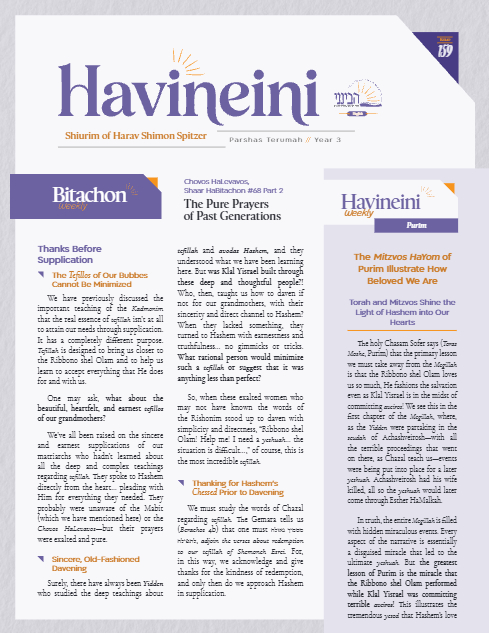
If a father is angry at his child because the child has a different personality from his own, or because his child woke him in middle of the night, or for any other reason, there’s an eitzah to quell the anger: give and give to this child, and the father will see his heart transformed into love for his child.

Indeed, so many parents will tell you that they feel the greatest love to a child who took the most of out of them; they needed to give the most to that child. This is because “a piece of their heart” went into this child. When a parent gives themselves away with mesirus nefesh for a child, it elicits and fosters great feelings of love for that child. This is the mehalech of האדם נפעל כפי פעולותיו, and it is the precise reason that Hashem gave us so many mitzvos—so that we will become permeated with ahavas Hashem.

The Purpose of Mitzvos Is for Them to Permeate Our Neshamos

If we think about it a bit more deeply, we will discover that the Ribbono shel Olam desires us to instill in our hearts the deveikus that we will need for the World to Come davka by engaging in deveikus in This World through Torah and mitzvos. When we carry out the Torah and mitzvos, it leaves an indelible impression in our hearts, and it prepares us for our journey to Heaven. Our bodies remain here, and if a person engaged with Yiddishkeit only in a superficial manner, the Torah and mitzvos will, chas v’shalom, remain with the guf, while the neshamah will arrive to the Olam HaEmes emptyhanded, R”l.

The proper approach is to engage in Torah and mitzvos with intensity—qualitatively and quantitatively—until they penetrate to the deepest place within our neshamos, which will enable our neshamos to take their final journey with full valises, because they have toiled for this reward.

This is essentially the concept of נהמא דכיסופא (literally, bread of shame, when we receive a reward we have not earned). The Ribbono shel Olam wants us to earn our reward, and therefore, He gives us the reward only if it came to us with toil. When it’s difficult and the going is hard, but this Yid nevertheless works and works until he’s successful—then it becomes his own. Prior to learning Torah, it is called תורת ה' and afterward it is called תורתו. It becomes his forever, because he has toiled for it and thus rightfully earned it; it cost him blood, sweat, and tears.

Deveikus Can Happen Only When There’s a Mashpiah and a Mekabel

There’s an important principle in creation. When we want two things to become united, there must be a mashpiah-mekabel relationship between them. That is, one bequeaths and the other receives from it. Only when there’s such a connection can there be offspring and other new creations that come from this union. If we place two tables alongside each other, they have not become one table; they happen to be situated next to each other. But if we want a true connection, there must be a mashpiah and mekabel—one gives and the other receives. This requires great toil and humility, but that is the only way to חיבור, connection, and only in this way can something new come forth from this union.

The entire creation works in this way of mashpiah and mekabel. The Gemara (Ta’anis 7a) tells us, גדול יום הגשמים, great is a day of rain, for rain is an manifestation of mashpiah and mekabel—the water gives and the earth receives—and only this way can plant life grow. The entire creation works this way; there must be a חיבור of one giving and the other taking.

It works the same way in the spiritual realm. When a father learns with his son, or the rebbi learns with his talmid, the child or the talmid must be a receptacle of acceptance. He must be humble and he must accept, and the rebbi must be a mashpiah who truly seeks to impart. If the talmid doesn’t understand what he is being taught, the rebbi or father must be willing to break it down even more—even dozens of times—because this is what a mashpiah does. Neither of them has his own interest in mind; they’re both focused on the singular endeavor of internalizing the Torah.

That is why this relationship/connection works so well. For, as noted, everything in the world works with the mashpiah/mekabel relationship.

Utilizing Both

For this reason, we have been commanded to utilize both strengths.

One the one hand, we must be a mekabel. Whatever the Ribbono shel Olam says: נעשה ונשמע! I need only hear what Hashem wants of me, and I will do it. I want to learn Torah. I want to internalize it and understand it. And if I don’t understand it, I will toil to understand it.

On the other hand, every Yid must also be a mashpiah: Take the Torah that you have learned and transmit it to others, to your children, your acquaintances, and those who haven’t yet merited its light.

One cannot be a Yid who’s davuk to Torah except if he takes on the role of both mashpiah and mekabel. If we have one without the other, we will never be able to properly attain deveikus in Hashem. Every Yid must be both.

Toiling to Get and Give

The mehalech of mekabel is called ללמוד, to learn and take in. Such a Yid is humble. He toils in Torah with humility and devotion until he understands it... he invests untold diligence and meditation, and he always seeks to understand his mistakes. He overcomes his shame, because “one who is bashful cannot learn.” I have made 100 mistakes, but I will attempt another time. Maybe now I will be successful. This Yid lives with abundant bitachon, and he will ultimately merit to understand Torah——because he’s a mekabel, an accepting vessel.

Then comes the exhortation of ללמד, to teach and transmit. Now, after he has learned, the Ribbono shel Olam says: Draw on the aspects of your nefesh of השפעה, transmission. Teach Torah and Yiddishkeit to other Yidden. Give, even though it’s difficult. Give, even if you don’t like that person very much. Don’t give apathetically; rather, invest your love and your nefesh into giving to him. Draw out your inner, natural משפיע.

When a Yid hones both his משפיע ומקבל aspects, he becomes ripe for properly accepting and internalizing the light of Torah.

“Receiving and Transmitting” On Pesach Night

The Seder night is a perfect example of how these two modes complete the nefesh of a Yid—but in truth it applies to every mitzvah. When a Yid sits down to the Seder, the Ribbono shel Olam asks him to draw out both his inner משפיע and מקבל.

First, we’re a מקבל. We look around and we contemplate the exaltedness of the night. We think thoughts of teshuvah and purification during Kadeish and Urchatz, and we cry out to the Ribbono shel Olam that we want to internalize His Torah and mitzvos. But at the same time, during the entire night, we’re functioning in the role of a משפיע. We tell the story of יציאת מצרים; we attempt to really understand and empathize with the “four sons” with a smile, with a story, with feeling and joy. Thus, the Seder becomes a perfect fusion of משפיע ומקבל.

If a Yid draws on these two modes as he goes about his mitzvos, they will enter and permeate his neshamah. He will internalize the reality that the Ribbono shel Olam has taken him out of Mitzrayim, and that He can likewise help him out of every challenge—for He controls every aspect in Creation.

The Mitzvos HaYom Instill New Understanding into Our Hearts

The Mitzvos of Purim Encompass Both Modes

With these introductions in mind, let us return to Purim. The Chasam Sofer states that the primary purpose of Purim is to teach us the extent of Hashem’s love for every Yid, no matter which level he is on. Hashem’s love isn’t negated by anything. And for this reason, we have been given four mitzvos on this day—two of which are aligned with “receiving” and the other two of which are aligned with “transmitting.”

The קריאת המגילה is an act of receiving, and so is the mitzvah of משתה ושמחה. As you eat and drink and dance, you must reflect—utilizing your דעת—on how much the Ribbono shel Olam loves you, and how much He loves every single Yid, and how He prepares salvation for us even when we’re so very distant. Say it. Sing it. Dance it... with another glass of wine... take it in. Internalize it into your heart in every way that you can.

At the same time, we tell this Yid: Now you must give to others. Be a משפיע through משלוח מנות ומתנות לאביונים. Go over to a disadvantaged person and give to him. The Yerushalmi tells us that on Purim we do not discern need. We give to everyone who stretches out their hands.

By Giving, We’re Really Taking

Throughout the year, there’s a principle that we do not give to a needy person who’s unworthy. But on Purim, we give to everyone. We don’t check their tzitzis on Purim. On this day, we increase in friendship and brotherhood even to those with whom it is difficult.

This is not solely so we should accomplish the incredible chessed of increasing brotherhood in Klal Yisrael—but that our own hearts should internalize how much Hashem loves us! One of the most critically important things we must do is to give to others without discrimination. This is a tool to enable our own hearts to become permeated with Hashem’s love—because האדם נפעל כפי פעולותיו.

It’s not enough to work merely with the tool of מח שליט על הלב; it’s not enough to study the Megillah and eat and drink, because this won’t allow the truth to permeate properly, and it won’t bring this Purim along with us to Olam Haba. The only way to conquer our hearts with this message is to do both: the קבלה of the mind, and the actions of משפיע. Then we will internalize it.

Only a Giver Can Understand

We see this concept in children who have merited to have their own children, as that’s when they appreciate what their parents have done for them all the years. It took until her fifth child for the thirty-year-old daughter to write poems to her mother in appreciation and awe for what she did for her. Only now does she grasp what parents do for their child.

When we think about it, is it that difficult to grasp this at seventeen?! Don’t we know that our mothers stay up entire night with us, clothe us, feed us, diaper us, etc.?! Why does it take having our own children to appreciate this?

The reason it takes parenthood to appreciate it is that until we’re a משפיע, until we ourselves are givers, we don’t understand it. Our hearts cannot understand the extent of it. Only after experiencing being a משפיע do we understand what it’s really like.

The Joy of Giving

When we manage to break our hubris a bit, and we learn to give to others—for the sake of giving, expecting nothing in return—that is when we begin to appreciate the light of kirvas Elokim. If a person, chas v’shalom, leaves This World without this knowledge, he will never be able to attain it in the Next World, and it will be difficult for him to be close to the Ribbono shel Olam there. But when a person internalizes the joy and the pleasure of closeness to Hashem in This World, he will have a sweet and pleasant life in both worlds.

If we look, we will see that it is always this way, without exception. People who are true givers, people who give with their whole hearts, even when it’s difficult for them to give, are the happiest people on earth. They weren’t born this way. They also started out having difficulty in giving—but they fought themselves, and they learned to give with a smile, and this transformed them into happy and joyful people.

The reason is that every Yiddishe neshamah is wired to want to give. This is what brings us joy. A person who isn’t a giver, even when he has wonderful excuses, will be unhappy. He may be able to soothe himself externally, but inside, he will be unhappy. If we want our neshamos to be happy and comfortable, we must bend the guf and accommodate our neshamaos This is a life’s work; it doesn’t happen overnight. But we must advance in this slowly and carefully, working at it again and again—davka when it’s hard—and then we will become transformed into “givers.”

The Shattered People

When we think about it, the mitzvah of מתנות לאביונים isn’t מתנות לעניים, and there’s a great difference between them. An אביון, according to Rashi, is someone who’s desperate and craves every kindness. An עני lacks one thing (be it money, wisdom, etc.), while an אביון lacks everything—he doesn’t know what to do with himself because he has so many problems.

The אביון doesn’t have money, he struggles wit his children, he has three daughters in shidduchim, he has a difficult personality, and he grew up in a complicated home.... Name the dilemma and this אביון has it.

Seek Him Out

Come Chazal and tell you to seek out this אביון on Purim. If you find an עני and you give him money, it’s wonderful—but you have satisfied his need. The אביון, on the other hand, isn’t stable... he’s suffering in his mind and soul, not necessarily in his wallet. He’s a shattered, broken person.

When a person is in such a state, he will generally inform us of it. He doesn’t just ask for money in a refined manner... “Maybe, if it’s possible....” He may often become aggressive and demanding and ask why you gave him so little.

But this is why the mitzvah is to give davka to such a person. When this אביון reacts negatively, yet you give him again with a smile, you have acquired something in your nefesh.

Through this, you’re able to tap into the great love that Hashem feels for His children always.

PDF Preview