Charity and Wine in Adar
Wonders | February 20, 2026
Print This Article
View Original PDF

Charity and Wine in Adar

Wonders | February 20, 2026

Kabbalah provides us with two options for the permutation of God’s essential Name Havayah that illuminates the month of Adar. One permutation directs us to give abundant charity, the other calls for abundant wine.

Why choose one when you can do both?

In this excerpt from a very jovial post-fundraising event, HaRav Ginsburgh invites us to increase our joy in the month of Adar through both charity and farbrengens and explains the need for a superposition of both.

Excerpted from a farbrengen from the 5th of Adar, 5781.

Two Permutations of God's Name for Adar

Because God’s essential Name, Havayah (י־הוה) contains 4 letters but only 3 are unique, we can permute them in 12 different ways, one for each of the months of the year. This is also alluded to by the word “month” (שֶדֹח), whose value is 12 times Havayah (־י הוה), the value of all 12 permutations!

When it comes to permutations, known as Chochmat HaTziruf, there are two systems regarding the twelve permutations and their parallel to the months. Both systems start from the month of Nissan, “This month shall be unto you the head of months” and all the correspondences are identical in both except for the sixth month (Elul) and the twelfth (Adar), whose permutations are interchanged between the systems. According to the first system, the permutation corresponding to Elul is ההוי, whose letters are found as the final letters of the words, “And it shall be charity for us, for [we shall diligently keep all of these commandments]” (ּנוָּה לֶיְהִּה תָקָדְצּויִכּ), and the permutation corresponding and illuminating the month of Adar is ההיו, which emerges from the final letters of the verse “... his donkey, and his foal to a choice vine” (ֹנוֹתֲי אִנְּה בָקֵרֹּׂשַלְה וֹירִע).

According to the second system, these two permutations are reversed: “And it shall be charity for us, for [we shall diligently keep all of these commandments]” (ההוי) belongs to Adar and “...his donkey, and his foal to a choice vine” (ההיו) to Nissan.

In practice, we follow the first system, but both are the words of the living God. And so, as we stand in the month of Adar, let us look at the inner meaning of both verses.

The plain meaning of the verse “And it shall be [considered] charity for us, for we shall diligently keep all of these commandments before Havayah our God, as He has commanded us” refers to the reward for performing the commandments. However, it describes our reward as tzedakah (charity); indeed tzedakah is used to refer to all the commandments. It follows that this verse is referring to the general reward for all the commandments and refers to it as tzedakah, in-line with the statement that, “the reward of a mitzvah is a mitzvah.” The verse, “He tethers his donkey to a vine, his foal to a choice vine, he washes his garment in wine, his robe in blood of grapes” refers to the abundance of wine in the lands of the tribe of Judah.

Thus, if the permutation of Adar emerges from “...his donkey, and his foal to a choice vine” (ההיו) then Adar is about “increasing our joy” by drinking wine “until one does not know” (ad delo yada). However, if the permutation of Adar emerges from “And it shall be charity for us, for [we shall diligently keep all of these commandments]” (ההוי) then we should increase our joy through giving an abundance of charity, also “until one does not know,” which is the essence of the joy of Adar and Purim, as ruled by Maimonides.

Lechaim, Tzedakah, and Lechaim

Indeed, “these and those are the words of the living God,” but which should be prioritized: drinking wine, which is the joy of the body, or giving charity, which is the joy of the soul? The joy of the body is the joy of the psyche (the nefesh). When we give tzedakah, the soul resembles God—the essential Bestower.

Truthfully, even regarding the question of what to prioritize, one must first reach a state of ad delo yada. Nevertheless, according to the well-known Chassidic aphorism that all commandments are merely a means for a farbrengen—since after fulfilling a mitzvah we merit gathering together amidst the joy of the mitzvah—it is fitting to prioritize charity. When we reach the peak of achieving his donations to the poor than to be lavish in his preparation of the Purim feast or in sending portions to his friends. For there is no greater and more splendid happiness than to gladden the hearts of the poor, the orphans, the widows, and the converts. One who brings happiness to the hearts of these unfortunate individuals resembles the Divine Presence, as it is written, “to revive the spirit of the lowly and to revive those with broken hearts” (Isaiah 57:15).

All the goals for which charity was intended, up to and including the main goal captured in the verse, “Zion shall be redeemed with judgment, and her returnees through tzedakah,” then we should gather and say LeChaim until one does not know, ad delo yada.

Preceding a LeChaim to tzedakah is the secret of the verse “[Likewise,] tzedakah is to life” (יםִּיַחְה לָקָדְן צֵכּ). The plain meaning is that tzedakah gives life and so tzedakah comes before saying LeChaim. However, one can also interpret these words to mean that the preparation for giving tzedakah is a LeChaim. Therefore, it is fitting to take a little drink and say LeChaim before giving charity, and to continue saying LeChaim (a little more) after.

And by way of gematria: mashkeh-tzedakah-mashkeh (הֶקְׁשַה מָקָדְה צֵקְׁשַמ) equals “Open [my eyes...]” (33 ,(לַּג, s qu are d. Through this, one merits the fulfillment of “Open my eyes so that I may see the wonders of Your Torah” (ָךֶתָרֹוּתִת מֹאוָלְפִה נָיטִּבַאְי וַינֵל עַּג), which also equals “the dwelling of the Divine Presence within Israel (לֵאָרְׂשִיְּה בָינִכְּׁשַת הַאָרְׁשַה)!
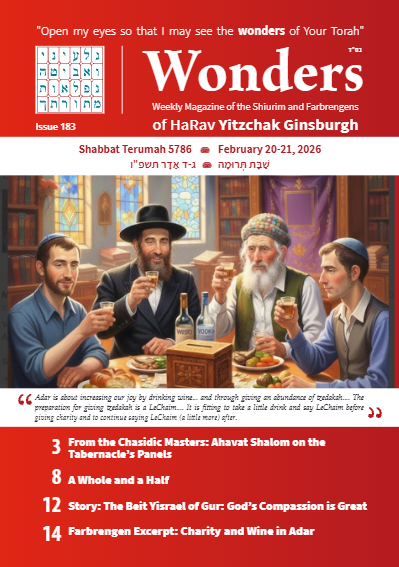
Kabbalah provides us with two options for the permutation of God’s essential Name Havayah that illuminates the month of Adar. One permutation directs us to give abundant charity, the other calls for abundant wine.

Why choose one when you can do both?

In this excerpt from a very jovial post-fundraising event, HaRav Ginsburgh invites us to increase our joy in the month of Adar through both charity and farbrengens and explains the need for a superposition of both.

Excerpted from a farbrengen from the 5th of Adar, 5781.

Two Permutations of God's Name for Adar

Because God’s essential Name, Havayah (י־הוה) contains 4 letters but only 3 are unique, we can permute them in 12 different ways, one for each of the months of the year. This is also alluded to by the word “month” (שֶדֹח), whose value is 12 times Havayah (־י הוה), the value of all 12 permutations!

When it comes to permutations, known as Chochmat HaTziruf, there are two systems regarding the twelve permutations and their parallel to the months. Both systems start from the month of Nissan, “This month shall be unto you the head of months” and all the correspondences are identical in both except for the sixth month (Elul) and the twelfth (Adar), whose permutations are interchanged between the systems. According to the first system, the permutation corresponding to Elul is ההוי, whose letters are found as the final letters of the words, “And it shall be charity for us, for [we shall diligently keep all of these commandments]” (ּנוָּה לֶיְהִּה תָקָדְצּויִכּ), and the permutation corresponding and illuminating the month of Adar is ההיו, which emerges from the final letters of the verse “... his donkey, and his foal to a choice vine” (ֹנוֹתֲי אִנְּה בָקֵרֹּׂשַלְה וֹירִע).

According to the second system, these two permutations are reversed: “And it shall be charity for us, for [we shall diligently keep all of these commandments]” (ההוי) belongs to Adar and “...his donkey, and his foal to a choice vine” (ההיו) to Nissan.

In practice, we follow the first system, but both are the words of the living God. And so, as we stand in the month of Adar, let us look at the inner meaning of both verses.

The plain meaning of the verse “And it shall be [considered] charity for us, for we shall diligently keep all of these commandments before Havayah our God, as He has commanded us” refers to the reward for performing the commandments. However, it describes our reward as tzedakah (charity); indeed tzedakah is used to refer to all the commandments. It follows that this verse is referring to the general reward for all the commandments and refers to it as tzedakah, in-line with the statement that, “the reward of a mitzvah is a mitzvah.” The verse, “He tethers his donkey to a vine, his foal to a choice vine, he washes his garment in wine, his robe in blood of grapes” refers to the abundance of wine in the lands of the tribe of Judah.

Thus, if the permutation of Adar emerges from “...his donkey, and his foal to a choice vine” (ההיו) then Adar is about “increasing our joy” by drinking wine “until one does not know” (ad delo yada). However, if the permutation of Adar emerges from “And it shall be charity for us, for [we shall diligently keep all of these commandments]” (ההוי) then we should increase our joy through giving an abundance of charity, also “until one does not know,” which is the essence of the joy of Adar and Purim, as ruled by Maimonides.

Lechaim, Tzedakah, and Lechaim

Indeed, “these and those are the words of the living God,” but which should be prioritized: drinking wine, which is the joy of the body, or giving charity, which is the joy of the soul? The joy of the body is the joy of the psyche (the nefesh). When we give tzedakah, the soul resembles God—the essential Bestower.

Truthfully, even regarding the question of what to prioritize, one must first reach a state of ad delo yada. Nevertheless, according to the well-known Chassidic aphorism that all commandments are merely a means for a farbrengen—since after fulfilling a mitzvah we merit gathering together amidst the joy of the mitzvah—it is fitting to prioritize charity. When we reach the peak of achieving his donations to the poor than to be lavish in his preparation of the Purim feast or in sending portions to his friends. For there is no greater and more splendid happiness than to gladden the hearts of the poor, the orphans, the widows, and the converts. One who brings happiness to the hearts of these unfortunate individuals resembles the Divine Presence, as it is written, “to revive the spirit of the lowly and to revive those with broken hearts” (Isaiah 57:15).

All the goals for which charity was intended, up to and including the main goal captured in the verse, “Zion shall be redeemed with judgment, and her returnees through tzedakah,” then we should gather and say LeChaim until one does not know, ad delo yada.

Preceding a LeChaim to tzedakah is the secret of the verse “[Likewise,] tzedakah is to life” (יםִּיַחְה לָקָדְן צֵכּ). The plain meaning is that tzedakah gives life and so tzedakah comes before saying LeChaim. However, one can also interpret these words to mean that the preparation for giving tzedakah is a LeChaim. Therefore, it is fitting to take a little drink and say LeChaim before giving charity, and to continue saying LeChaim (a little more) after.

And by way of gematria: mashkeh-tzedakah-mashkeh (הֶקְׁשַה מָקָדְה צֵקְׁשַמ) equals “Open [my eyes...]” (33 ,(לַּג, s qu are d. Through this, one merits the fulfillment of “Open my eyes so that I may see the wonders of Your Torah” (ָךֶתָרֹוּתִת מֹאוָלְפִה נָיטִּבַאְי וַינֵל עַּג), which also equals “the dwelling of the Divine Presence within Israel (לֵאָרְׂשִיְּה בָינִכְּׁשַת הַאָרְׁשַה)!

PDF Preview