How Will the Treasurers Know That It Was Given with a Generous Heart
Pardes Yehuda | February 20, 2026
Print This Article
View Original PDF

How Will the Treasurers Know That It Was Given with a Generous Heart

Pardes Yehuda | February 20, 2026

“Let them take for Me a contribution from every man who gives it willingly in his heart. You shall take My contribution, and this is the contribution that you shall take from them.” (25:2–3) There are a few difficulties to analyze in this verse. Rashi explains i¦l “to Me” as i ¦n§y¦l i¦l “to My name” — that it should be given for the sake of God’s name. But how will the treasurers know that the gift is intended for God’s sake? And it is also difficult with the phrase FA¦l EP¤a §C¦i x¤W£` “who gives it willingly in his heart” — how can they know what is in someone’s heart, that he is donating with a generous spirit? People also ask about the two different verbs used: first Eg§w¦i§e “let them take” (v’yikchu) and then i ¦z ̈nEx §Y z¤` Eg§w ¦Y “you shall take his contribution” (tikchu) — what is the difference between these expressions? The Meforshim ask further why the verse says d ̈nEx §Y i¦l Eg§w¦i§e “let them take for Me” (v’yikchu li) rather than i¦l Ep §Y¦i§e “let them give to Me” Since the Yidden are giving the contributions (v’yitnu li). And why does the verse repeat i ¦z ̈nEx §Y z¤` Eg§w ¦Y “you shall take My contribution” again after it already said i¦l Eg§w¦i§e d ̈nEx §Y “let them take for Me a contribution”?

All of this can be understood from the words of the Tur, Rabbi written by Rabbi Yaakov ben Asher (1270–1340 the son of the commentary on Shas the “Rosh”.( in Yoreh De’ah, laws of charity), where he brings the Rambam’s teaching that there are 3 levels in giving charity. The one who gives freely and willingly — without having to be asked — is the highest level. The second is one who gives tzedakka only when approached and is asked to donate. The third and lowest level, is the one who has to be coerced to give tzedakka.

The first level is when a person comes forward and offers his gift rather than waiting to be asked; that is the strongest form of charity. Accordingly, the verse’s marvel is explained: Hashem says d ̈nEx §Y i¦l Eg§w¦i§e “let them take for Me a contribution” — you should accept from Me those contributions that are truly for Me, given for My name. How will the treasurers know this? From x¤W£` Wi ¦` l ̈M z¥`¥n FA¦l EP¤a §C¦i “from every man who gives it willingly in his heart” — someone who gives from the full intent of his heart. How will you know that he is giving with his full intent? From the words i ¦z ̈nEx §Y z¤` Eg§w ¦Y “you shall take My contribution” — because such people come forward and ask the treasurers to take from them; therefore, if a person gives a contribution for My name, you will take his contribution, because his giving is freely and gladly offered.

But the other people, who give only when asked, are covered by :m ̈Y ¦`¥n Eg§w ¦Y x¤W£` d ̈nEx §Y©d z` Ÿ f§e “and this is the contribution that you shall take from them” — you must go to them and request from them and take their contribution; even though it is not given wholeheartedly, it is still called d ̈nEx §Y©d a contribution.

We find the same idea when Eliezer went to Aramean of Padan-Aram to find a suitable wife for Yitzchok. Eliezer came to a well and asked the girl to draw some water from the well for him. Rifka had a holy soul, and had great Middos and a feeling for doing Chesed as the Torah attests, After he finishes drinking m³©B x¤n` À Ÿ Y©e Ÿ e®z Ÿ w§W©d§l l−©k §Y©e :z Ÿ «Y§W¦l E−N¦M m ¦` c¬©r a ½ ̈`§W¤` ÆLi ̧¤N©n§b¦l And she finished giving him to drink, and she said, "I will also draw for your camels, until they will have finished drinking." When Eliezer asked her to fill a jug of water for him, and she offered on her own instinct to feed the camels too!

The Beer Mayim Chaim, from Harav Chaim of Chernowitz, asks what was the omen that Rifka was suitable for Yitzchok? If by her giving him water, that alone would not be proof, since she had respect for an elderly man who asked her to draw water for him. Says the Beer Mayim Chayim, the proof was that she offered to draw water for the camels, even though she wasn’t asked so. This showed that she had the tract of Chesed by offering to do a Chesed without being asked for.

This is the Middah of the highest level of chesed as the Rambam says, and this is what Eliezer saw in the house of Avraham who was the master of Chesed. He was always on the outlook to see who he can help. Therefore, Eliezer knew this was the right girl for Yitzchok, and he took out the jewelry and gave it to her, because Hashem guided him to the right girl.

The Beer Mayim Chaim concludes that there is a difference between a Baal Chesed and a Baal Rachamim, someone who has mercy. The Baal Chesed is always looking to help. The Baal Rachamin helps only when he is asked to help. A Yid has to always be smart and lookout to help others before they ask for help. Be like Avraham the pillar of Chesed.

(Yehuda Z. Klitnick)
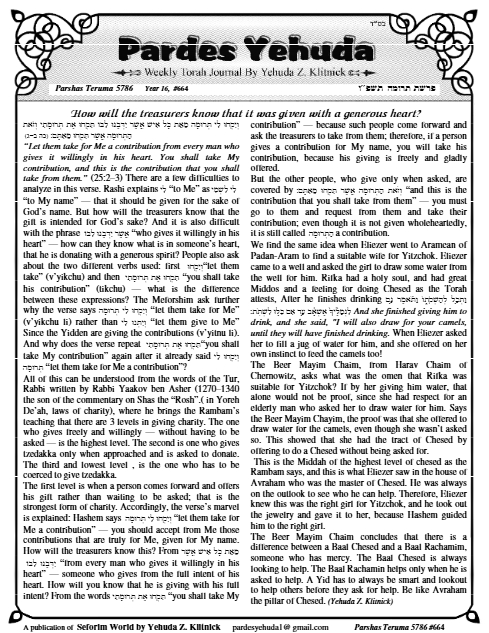
“Let them take for Me a contribution from every man who gives it willingly in his heart. You shall take My contribution, and this is the contribution that you shall take from them.” (25:2–3) There are a few difficulties to analyze in this verse. Rashi explains i¦l “to Me” as i ¦n§y¦l i¦l “to My name” — that it should be given for the sake of God’s name. But how will the treasurers know that the gift is intended for God’s sake? And it is also difficult with the phrase FA¦l EP¤a §C¦i x¤W£` “who gives it willingly in his heart” — how can they know what is in someone’s heart, that he is donating with a generous spirit? People also ask about the two different verbs used: first Eg§w¦i§e “let them take” (v’yikchu) and then i ¦z ̈nEx §Y z¤` Eg§w ¦Y “you shall take his contribution” (tikchu) — what is the difference between these expressions? The Meforshim ask further why the verse says d ̈nEx §Y i¦l Eg§w¦i§e “let them take for Me” (v’yikchu li) rather than i¦l Ep §Y¦i§e “let them give to Me” Since the Yidden are giving the contributions (v’yitnu li). And why does the verse repeat i ¦z ̈nEx §Y z¤` Eg§w ¦Y “you shall take My contribution” again after it already said i¦l Eg§w¦i§e d ̈nEx §Y “let them take for Me a contribution”?

All of this can be understood from the words of the Tur, Rabbi written by Rabbi Yaakov ben Asher (1270–1340 the son of the commentary on Shas the “Rosh”.( in Yoreh De’ah, laws of charity), where he brings the Rambam’s teaching that there are 3 levels in giving charity. The one who gives freely and willingly — without having to be asked — is the highest level. The second is one who gives tzedakka only when approached and is asked to donate. The third and lowest level, is the one who has to be coerced to give tzedakka.

The first level is when a person comes forward and offers his gift rather than waiting to be asked; that is the strongest form of charity. Accordingly, the verse’s marvel is explained: Hashem says d ̈nEx §Y i¦l Eg§w¦i§e “let them take for Me a contribution” — you should accept from Me those contributions that are truly for Me, given for My name. How will the treasurers know this? From x¤W£` Wi ¦` l ̈M z¥`¥n FA¦l EP¤a §C¦i “from every man who gives it willingly in his heart” — someone who gives from the full intent of his heart. How will you know that he is giving with his full intent? From the words i ¦z ̈nEx §Y z¤` Eg§w ¦Y “you shall take My contribution” — because such people come forward and ask the treasurers to take from them; therefore, if a person gives a contribution for My name, you will take his contribution, because his giving is freely and gladly offered.

But the other people, who give only when asked, are covered by :m ̈Y ¦`¥n Eg§w ¦Y x¤W£` d ̈nEx §Y©d z` Ÿ f§e “and this is the contribution that you shall take from them” — you must go to them and request from them and take their contribution; even though it is not given wholeheartedly, it is still called d ̈nEx §Y©d a contribution.

We find the same idea when Eliezer went to Aramean of Padan-Aram to find a suitable wife for Yitzchok. Eliezer came to a well and asked the girl to draw some water from the well for him. Rifka had a holy soul, and had great Middos and a feeling for doing Chesed as the Torah attests, After he finishes drinking m³©B x¤n` À Ÿ Y©e Ÿ e®z Ÿ w§W©d§l l−©k §Y©e :z Ÿ «Y§W¦l E−N¦M m ¦` c¬©r a ½ ̈`§W¤` ÆLi ̧¤N©n§b¦l And she finished giving him to drink, and she said, "I will also draw for your camels, until they will have finished drinking." When Eliezer asked her to fill a jug of water for him, and she offered on her own instinct to feed the camels too!

The Beer Mayim Chaim, from Harav Chaim of Chernowitz, asks what was the omen that Rifka was suitable for Yitzchok? If by her giving him water, that alone would not be proof, since she had respect for an elderly man who asked her to draw water for him. Says the Beer Mayim Chayim, the proof was that she offered to draw water for the camels, even though she wasn’t asked so. This showed that she had the tract of Chesed by offering to do a Chesed without being asked for.

This is the Middah of the highest level of chesed as the Rambam says, and this is what Eliezer saw in the house of Avraham who was the master of Chesed. He was always on the outlook to see who he can help. Therefore, Eliezer knew this was the right girl for Yitzchok, and he took out the jewelry and gave it to her, because Hashem guided him to the right girl.

The Beer Mayim Chaim concludes that there is a difference between a Baal Chesed and a Baal Rachamim, someone who has mercy. The Baal Chesed is always looking to help. The Baal Rachamin helps only when he is asked to help. A Yid has to always be smart and lookout to help others before they ask for help. Be like Avraham the pillar of Chesed.

(Yehuda Z. Klitnick)

PDF Preview


