The dwelling of Hashem is with Klal Yisrael because of His love for the Torah
Pardes Yehuda | February 15, 2024
Print This Article
View Original PDF

The dwelling of Hashem is with Klal Yisrael because of His love for the Torah

Pardes Yehuda | December 10, 2025

Speak to the children of Israel, and have them take for Me an offering; from every person whose heart inspires him to generosity, you shall take my offering. (25:2) Rashi explains the words.

Rashi: dedicated to My name. The Midrash Rabbah Shemos 33:1 says that the words allude to a Posuk in Mishlei 4:2: “For a good lesson I have given you: My Torah, do not forsake it.” Do not forsake the acquisition that I gave to you. You have an acquisition that the one who sold it is sold with it. The Holy One blessed be He said to Klal Yisrael: I sold you the Torah; as it were, I was sold with it, as it is stated: “And they shall take Me a gift.”

This is analogous to a king who had an only daughter who was of age. One king came and wanted to take her as his wife. The father was happy to give his daughter as a wife. However, the son-in-law insisted on moving to his land after the wedding. The father of the girl said to his son-in-law: ‘My daughter whom I gave to you is an only child. To part from her, I am unable; yet to say to you do not take her, I am unable, because she is your wife. Rather, do this favor for me; wherever you go, prepare a small home for me, so I can live with you, as I cannot forsake my daughter.’ So too, Hashem said to Klal Yisrael: ‘I gave you the Torah because it was meant for you. Therefore, I cannot leave it with me and I cannot say to you do not take it. Rather, every place you go, build a house for Me so I may live in it,’ as it is stated: “They shall craft a Sanctuary for Me, and I will dwell among them” (25:8).

This is a powerful Midrash stating that the purpose of the Mishkan and Bais Hamikdash was to be a dwelling, as so Hashem would be close to the Torah that he gave his children. This is fine when there was a Bais Hamikdash. However, where does Hashem dwell while we are in exile? For this we find in the Gemara Berachos 8:

And this concept, that halakha is the most sublime pursuit, is expressed in that which Rabbi Chiyya bar Ami said in the name of Ulla: Since the day the Temple, where the Divine Presence rested in this world, was destroyed, the Holy One, Blessed be He, has only one place in His world where he reveals His presence only; only the four cubits where the study of halacha is undertaken. Hashem rests His Divine Presence in Shul and Yeshivos where Torah is being studied.

The Holy Chida teaches a powerful point based on the Gemara Kiddushin 30b:

A Sage from the school of Rabbi Yishmael taught: My son, if this wretched one, the evil inclination, encounters you, pull it into the study hall, study Torah. If it is a stone it will melt, and if it is iron it will break, as it is stated regarding the Torah: “Is not My word like fire, says the Lord, and like a hammer that breaks the rock in pieces?” (Yermiah 23:29). Says the Chida, since Hashem dwells in the Yeshiva or Shul where Torah is studied, the Kedusha of Hashem nullifies the impurity of the Yetzer Hara, and a person would overcome his lusts. Therefore, one must act with respect in a shul as Hashem dwells there.

We see in the Gemara Berachos above: Abaye said: At first I studied in the house and prayed in the synagogue. Once I heard what Rabbi Chiyya bar Ami said in the name of Ulla: Since the day the Temple was destroyed, the Holy One, Blessed be He, has only one place in His world, only the four cubits of Halacha alone, from which I understood the significance of the four cubits of halakha, and I pray only where I study. The reason is beautiful, since Hashem dwells where they learn, it was easier for them to have their prayers answered being so close to Hashem.

With this introduction we can understand how sweet are the words of Rashi in Posuk 9:

According to all that I show you, the pattern of the Mishkan and the pattern of all its vessels; and so shall you do. Rashi stresses the words “and so shall you do: in future generations.” The future generations are when we are in exile. Hashem is asking us to continue preparing Him a place to dwell, that is our Yeshivos and Shuls. Let us appreciate the holy places and pour our hearts to Hashem, who is with us in exile, to build the eternal dwelling for the Shechina, with the building of the third Bais Hamikdash, Amein.

(Yehuda Z. Klitnick)
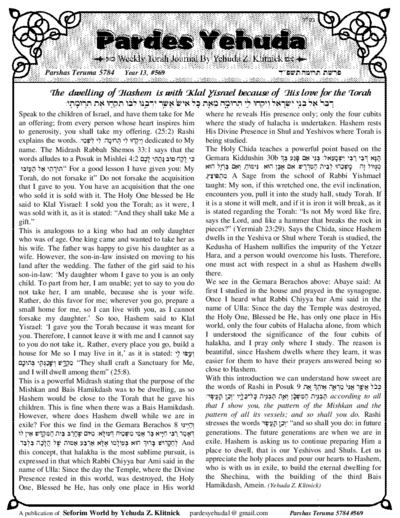
Speak to the children of Israel, and have them take for Me an offering; from every person whose heart inspires him to generosity, you shall take my offering. (25:2) Rashi explains the words.

Rashi: dedicated to My name. The Midrash Rabbah Shemos 33:1 says that the words allude to a Posuk in Mishlei 4:2: “For a good lesson I have given you: My Torah, do not forsake it.” Do not forsake the acquisition that I gave to you. You have an acquisition that the one who sold it is sold with it. The Holy One blessed be He said to Klal Yisrael: I sold you the Torah; as it were, I was sold with it, as it is stated: “And they shall take Me a gift.”

This is analogous to a king who had an only daughter who was of age. One king came and wanted to take her as his wife. The father was happy to give his daughter as a wife. However, the son-in-law insisted on moving to his land after the wedding. The father of the girl said to his son-in-law: ‘My daughter whom I gave to you is an only child. To part from her, I am unable; yet to say to you do not take her, I am unable, because she is your wife. Rather, do this favor for me; wherever you go, prepare a small home for me, so I can live with you, as I cannot forsake my daughter.’ So too, Hashem said to Klal Yisrael: ‘I gave you the Torah because it was meant for you. Therefore, I cannot leave it with me and I cannot say to you do not take it. Rather, every place you go, build a house for Me so I may live in it,’ as it is stated: “They shall craft a Sanctuary for Me, and I will dwell among them” (25:8).

This is a powerful Midrash stating that the purpose of the Mishkan and Bais Hamikdash was to be a dwelling, as so Hashem would be close to the Torah that he gave his children. This is fine when there was a Bais Hamikdash. However, where does Hashem dwell while we are in exile? For this we find in the Gemara Berachos 8:

And this concept, that halakha is the most sublime pursuit, is expressed in that which Rabbi Chiyya bar Ami said in the name of Ulla: Since the day the Temple, where the Divine Presence rested in this world, was destroyed, the Holy One, Blessed be He, has only one place in His world where he reveals His presence only; only the four cubits where the study of halacha is undertaken. Hashem rests His Divine Presence in Shul and Yeshivos where Torah is being studied.

The Holy Chida teaches a powerful point based on the Gemara Kiddushin 30b:

A Sage from the school of Rabbi Yishmael taught: My son, if this wretched one, the evil inclination, encounters you, pull it into the study hall, study Torah. If it is a stone it will melt, and if it is iron it will break, as it is stated regarding the Torah: “Is not My word like fire, says the Lord, and like a hammer that breaks the rock in pieces?” (Yermiah 23:29). Says the Chida, since Hashem dwells in the Yeshiva or Shul where Torah is studied, the Kedusha of Hashem nullifies the impurity of the Yetzer Hara, and a person would overcome his lusts. Therefore, one must act with respect in a shul as Hashem dwells there.

We see in the Gemara Berachos above: Abaye said: At first I studied in the house and prayed in the synagogue. Once I heard what Rabbi Chiyya bar Ami said in the name of Ulla: Since the day the Temple was destroyed, the Holy One, Blessed be He, has only one place in His world, only the four cubits of Halacha alone, from which I understood the significance of the four cubits of halakha, and I pray only where I study. The reason is beautiful, since Hashem dwells where they learn, it was easier for them to have their prayers answered being so close to Hashem.

With this introduction we can understand how sweet are the words of Rashi in Posuk 9:

According to all that I show you, the pattern of the Mishkan and the pattern of all its vessels; and so shall you do. Rashi stresses the words “and so shall you do: in future generations.” The future generations are when we are in exile. Hashem is asking us to continue preparing Him a place to dwell, that is our Yeshivos and Shuls. Let us appreciate the holy places and pour our hearts to Hashem, who is with us in exile, to build the eternal dwelling for the Shechina, with the building of the third Bais Hamikdash, Amein.

(Yehuda Z. Klitnick)

PDF Preview