Those Who Give
BET Journal | February 16, 2024
Print This Article
View Original PDF

Those Who Give

BET Journal | December 10, 2025

Rabbi Jonathan Sacks

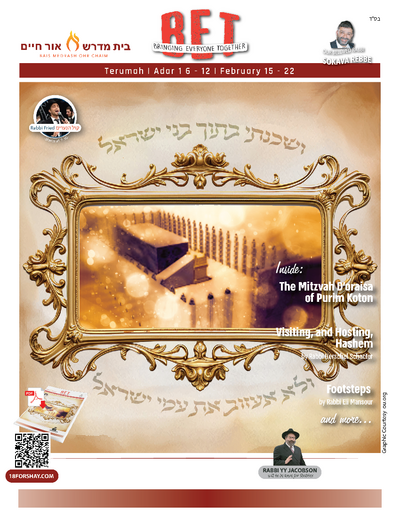
It was the first Israelite house of worship, the first home Jews made for God. But the very idea is fraught with paradox, even contradiction. How can you build a house for God? He is bigger than anything we can imagine, let alone build.

King Solomon made this point when he inaugurated another house of God, the First Temple:

“But will God really dwell on earth? The heavens, even the highest heaven, cannot contain You. How much less this house I have built!” I Kings 8:27

Not only does it seem impossible to build a home for God. It should be unnecessary. The God of everywhere can be accessed anywhere, as readily in the deepest pit as on the highest mountain, in a city slum as in a palace lined with marble and gold.

The answer, and it is fundamental, is that God does not live in buildings. He lives in builders. He lives not in structures of stone but in the human heart. What the Jewish Sages and mystics pointed was that in our parsha God says, “Let them build Me a sanctuary that I may dwell in them” (Ex. 25:8), not “that I may dwell in it.”

God said to Moses, “Let them build Me a sanctuary that I may dwell among them.” The key word here is the verb sh-ch-n, to dwell. Never before had it been used in connection with God. It eventually became a keyword of Judaism itself. From it came the word Mishkan meaning a sanctuary, and Shechinah, the Divine Presence.

Central to its meaning is the idea of closeness. Shachen in Hebrew means a neighbor, the person who lives next door. What the Israelites needed and what God gave them was a way of feeling as close to God as to our next-door neighbor.

So for God to be accessible, not just to the pioneers of faith – the patriarchs and matriarchs – but to every member of a large nation, was a challenge, as it were, for God Himself. He had to do what the Jewish mystics called tzimtzum, “contract” Himself, screen His light, soften His voice, hide His glory within a thick cloud, and allow the infinite to take on the dimensions of the finite.

But how do you feel the presence of God in the midst of everyday life?

That is the life-transforming secret of the name of the parsha, Terumah. It means “a contribution.” God said to Moses: “Tell the Israelites to take for Me a contribution. You are to receive the contribution for Me from everyone whose heart prompts them to give” (Ex. 25:2). The best way of encountering God is to give.

The very act of giving flows from, or leads to, the understanding that what we give is part of what we were given. It is a way of giving thanks, an act of gratitude. That is the difference in the human mind between the presence of God and the absence of God.

If God is present, it means that what we have is His. He created the universe. He made us. He gave us life. He breathed into us the very air we breathe. All around us is the majesty, the plenitude, of God’s generosity: the light of the sun, the gold of the stone, the green of the leaves, the song of the birds. This is what we feel reading the great creation psalms we recite every day in the morning service. The world is God’s art gallery and His masterpieces are everywhere.

When life is a given, you acknowledge this by giving back.

God doesn’t live in a house of stone. He lives in the hearts of those who give.
Rabbi Jonathan Sacks

It was the first Israelite house of worship, the first home Jews made for God. But the very idea is fraught with paradox, even contradiction. How can you build a house for God? He is bigger than anything we can imagine, let alone build.

King Solomon made this point when he inaugurated another house of God, the First Temple:

“But will God really dwell on earth? The heavens, even the highest heaven, cannot contain You. How much less this house I have built!” I Kings 8:27

Not only does it seem impossible to build a home for God. It should be unnecessary. The God of everywhere can be accessed anywhere, as readily in the deepest pit as on the highest mountain, in a city slum as in a palace lined with marble and gold.

The answer, and it is fundamental, is that God does not live in buildings. He lives in builders. He lives not in structures of stone but in the human heart. What the Jewish Sages and mystics pointed was that in our parsha God says, “Let them build Me a sanctuary that I may dwell in them” (Ex. 25:8), not “that I may dwell in it.”

God said to Moses, “Let them build Me a sanctuary that I may dwell among them.” The key word here is the verb sh-ch-n, to dwell. Never before had it been used in connection with God. It eventually became a keyword of Judaism itself. From it came the word Mishkan meaning a sanctuary, and Shechinah, the Divine Presence.

Central to its meaning is the idea of closeness. Shachen in Hebrew means a neighbor, the person who lives next door. What the Israelites needed and what God gave them was a way of feeling as close to God as to our next-door neighbor.

So for God to be accessible, not just to the pioneers of faith – the patriarchs and matriarchs – but to every member of a large nation, was a challenge, as it were, for God Himself. He had to do what the Jewish mystics called tzimtzum, “contract” Himself, screen His light, soften His voice, hide His glory within a thick cloud, and allow the infinite to take on the dimensions of the finite.

But how do you feel the presence of God in the midst of everyday life?

That is the life-transforming secret of the name of the parsha, Terumah. It means “a contribution.” God said to Moses: “Tell the Israelites to take for Me a contribution. You are to receive the contribution for Me from everyone whose heart prompts them to give” (Ex. 25:2). The best way of encountering God is to give.

The very act of giving flows from, or leads to, the understanding that what we give is part of what we were given. It is a way of giving thanks, an act of gratitude. That is the difference in the human mind between the presence of God and the absence of God.

If God is present, it means that what we have is His. He created the universe. He made us. He gave us life. He breathed into us the very air we breathe. All around us is the majesty, the plenitude, of God’s generosity: the light of the sun, the gold of the stone, the green of the leaves, the song of the birds. This is what we feel reading the great creation psalms we recite every day in the morning service. The world is God’s art gallery and His masterpieces are everywhere.

When life is a given, you acknowledge this by giving back.

God doesn’t live in a house of stone. He lives in the hearts of those who give.

PDF Preview