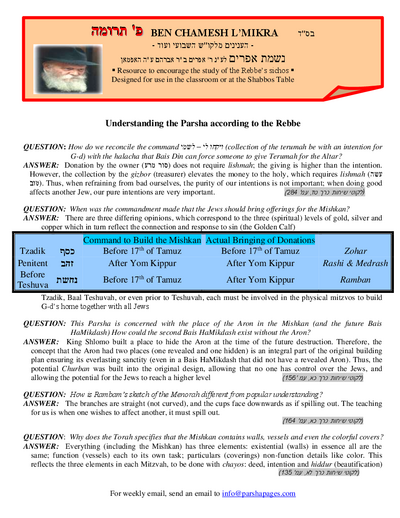
Understanding the Parsha according to the Rebbe
QUESTION: How do we reconcile the command ויקחו לי – לשמי (collection of the terumah be with an intention for G-d) with the halacha that Bais Din can force someone to give Terumah for the Altar?
ANSWER: Donation by the owner (סור מרע) does not require lishmah; the giving is higher than the intention. However, the collection by the gizbor (treasurer) elevates the money to the holy, which requires lishmah (עשה טוב). Thus, when refraining from bad ourselves, the purity of our intentions is not important; when doing good affects another Jew, our pure intentions are very important. (284, עמ' זט לקוטי שיחות כרך)
QUESTION: When was the commandment made that the Jews should bring offerings for the Mishkan?
ANSWER: There are three differing opinions, which correspond to the three (spiritual) levels of gold, silver and copper which in turn reflect the connection and response to sin (the Golden Calf). Tzadik, Baal Teshuvah, or even prior to Teshuvah, each must be involved in the physical mitzvos to build G-d’s home together with all Jews. (152 'עמ ,ו לקוטי שיחות כרך)
QUESTION: This Parsha is concerned with the place of the Aron in the Mishkan (and the future Bais HaMikdash). How could the second Bais HaMikdash exist without the Aron?
ANSWER: King Shlomo built a place to hide the Aron at the time of the future destruction. Therefore, the concept that the Aron had two places (one revealed and one hidden) is an integral part of the original building plan ensuring its everlasting sanctity (even in a Bais HaMikdash that did not have a revealed Aron). Thus, the potential Churban was built into the original design, allowing that no one has control over the Jews, and allowing the potential for the Jews to reach a higher level. (156' , עמ כא לקוטי שיחות כרך)
QUESTION: How is Rambam’s sketch of the Menorah different from popular understanding?
ANSWER: The branches are straight (not curved), and the cups face downwards as if spilling out. The teaching for us is when one wishes to affect another, it must spill out. (164 'עמ ,כאלקוטי שיחות כרך)
QUESTION: Why does the Torah specifies that the Mishkan contains walls, vessels and even the colorful covers?
ANSWER: Everything (including the Mishkan) has three elements: existential (walls) in essence all are the same; function (vessels) each to its own task; particulars (coverings) non-function details like color. This reflects the three elements in each Mitzvah, to be done with chayos: deed, intention and hiddur (beautification). (135 , עמ'לא לקוטי שיחות כרך)
Command to Build the Mishkan Actual Bringing of Donations
TzadikכסףBefore 17th of TamuzBefore 17th of TamuzZoharPenitentזהבAfter Yom KippurAfter Yom KippurRashi & MedrashBefore TeshuvaנחשתBefore 17th of TamuzAfter Yom KippurRamban