What We’re Missing
BET Journal | February 16, 2024
Print This Article
View Original PDF

What We’re Missing

BET Journal | December 10, 2025

Whenever we arrive at Parshas Teruma I’m reminded of two ideas that will help us enjoy the parshiyos until Sefer Vayikra.

“Why do we need help?” you might ask. The answer is that naturally after learning and laining in shul the exciting events of Yetzias Mitzrayim and Matan Torah it’s quite challenging to enjoy the intricate descriptions of the building of the Mishkan. Especially that it seems to have no relevance for us today and a big part of it doesn’t seem to apply to our future either.

The answer this challenge, I recall many times hearing from Rav Noach zt”l that Chazal expound on the verse כי לא דבר ריק הוא מכם that says that there is nothing empty, not even one letter, in the Torah. As we say each day in davening Toras chaim – instructions for living – and that means that each letter and word and idea in the Torah, even in the building of the Mishkan, has life-changing insights for us and is relevant today as it was then; we just need the right glasses in order to see them.

Similarly I heard from Rav Noach zt”l as follows regarding the passuk in our parsha ועשו לי מקדש ושכנתי בתוכם: It should have said בתוכו meaning Hashem said build the Mishkan so I will dwell in it. However, it doesn’t say “in it,” it says “in them” which means that Hashem really wanted, and always wants, to dwell inside of every one of us. We need to look at the Mishkan and take all the ingredients and become interior designers of our heart and soul so Hashem will be able to dwell. So, for example, the entrance of the heichal had a curtain that was folded over like the clothes of a modest kallah. In fact, a few places, such as the ramp, were constructed in a way that humility and modesty, which are intertwined, should exist in the Mishkan, because in order to have Hashem dwell in our midst, these two ingredients are vital.

There is another idea, based on the Gemara in Maseches Kesuvos 62b. The Gemara relates that the famed Rebbi, Rav Yehuda Hanasi, who compiled the mishnayos, was looking for a shidduch for his son. They finally agreed to a shidduch with the daughter of Rav Yossi Ben Zimra. The plan was that Rebbi’s son would first learn for ten years, and then they would have the wedding. However, when Rebbi’s son saw the kallah, he requested that it should be only 6 years. Then when they passed the kallah before Rebbi’s son a second time, he asked that the wedding be held first before going to learn. At this point, Rebbi’s son became embarrassed. However, his father, the great Rebbi, instead of reprimanding him, said “You know, you’re exactly like Hashem. Hashem said in Parshas Beshalach that we will build the Bais Hamikdash in Eretz Yisrael, and in Parshas Teruma He changed his mind k‘ivyachol and said ‘build it now.’” This was an amazing way to save the moment, but in truth it was also an amazing message about marriage and our relationship with Hashem. As the Maharsha explains, Rebbi was teaching us that Hashem and the Jewish people are like a chosson and kallah, and He loves us so much that he can’t wait to have a relationship with us.

This is the underlying theme and message of the Mishkan: Hashem loves us and wants a kesher with us. Now once we know this, we’ll see that every detail in the Mishkan is really helping us reach this goal. With this, we can approach these parshiyos with much more excitement, and you will be surprised how many new insights will be discovered.

by Rabbi Daniel Coren
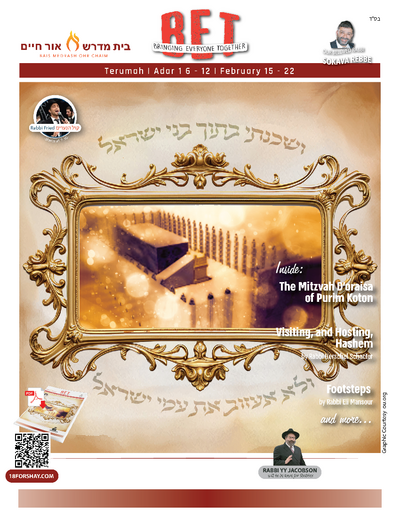
Whenever we arrive at Parshas Teruma I’m reminded of two ideas that will help us enjoy the parshiyos until Sefer Vayikra.

“Why do we need help?” you might ask. The answer is that naturally after learning and laining in shul the exciting events of Yetzias Mitzrayim and Matan Torah it’s quite challenging to enjoy the intricate descriptions of the building of the Mishkan. Especially that it seems to have no relevance for us today and a big part of it doesn’t seem to apply to our future either.

The answer this challenge, I recall many times hearing from Rav Noach zt”l that Chazal expound on the verse כי לא דבר ריק הוא מכם that says that there is nothing empty, not even one letter, in the Torah. As we say each day in davening Toras chaim – instructions for living – and that means that each letter and word and idea in the Torah, even in the building of the Mishkan, has life-changing insights for us and is relevant today as it was then; we just need the right glasses in order to see them.

Similarly I heard from Rav Noach zt”l as follows regarding the passuk in our parsha ועשו לי מקדש ושכנתי בתוכם: It should have said בתוכו meaning Hashem said build the Mishkan so I will dwell in it. However, it doesn’t say “in it,” it says “in them” which means that Hashem really wanted, and always wants, to dwell inside of every one of us. We need to look at the Mishkan and take all the ingredients and become interior designers of our heart and soul so Hashem will be able to dwell. So, for example, the entrance of the heichal had a curtain that was folded over like the clothes of a modest kallah. In fact, a few places, such as the ramp, were constructed in a way that humility and modesty, which are intertwined, should exist in the Mishkan, because in order to have Hashem dwell in our midst, these two ingredients are vital.

There is another idea, based on the Gemara in Maseches Kesuvos 62b. The Gemara relates that the famed Rebbi, Rav Yehuda Hanasi, who compiled the mishnayos, was looking for a shidduch for his son. They finally agreed to a shidduch with the daughter of Rav Yossi Ben Zimra. The plan was that Rebbi’s son would first learn for ten years, and then they would have the wedding. However, when Rebbi’s son saw the kallah, he requested that it should be only 6 years. Then when they passed the kallah before Rebbi’s son a second time, he asked that the wedding be held first before going to learn. At this point, Rebbi’s son became embarrassed. However, his father, the great Rebbi, instead of reprimanding him, said “You know, you’re exactly like Hashem. Hashem said in Parshas Beshalach that we will build the Bais Hamikdash in Eretz Yisrael, and in Parshas Teruma He changed his mind k‘ivyachol and said ‘build it now.’” This was an amazing way to save the moment, but in truth it was also an amazing message about marriage and our relationship with Hashem. As the Maharsha explains, Rebbi was teaching us that Hashem and the Jewish people are like a chosson and kallah, and He loves us so much that he can’t wait to have a relationship with us.

This is the underlying theme and message of the Mishkan: Hashem loves us and wants a kesher with us. Now once we know this, we’ll see that every detail in the Mishkan is really helping us reach this goal. With this, we can approach these parshiyos with much more excitement, and you will be surprised how many new insights will be discovered.

by Rabbi Daniel Coren

PDF Preview