A Megillah Reveals
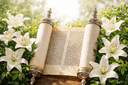
Purim has four mitzvos, and we will explain them one by one. The first mitzvah is reading the Megillah. The word מגילה comes from the word לגלות, which means “revealing.”
All the holidays teach us what Yiddishkeit is, what mitzvos are, and we rise above nature. But Purim is completely different. Purim teaches us about nature. It reveals to us what nature really is, that inherent in every natural event, in every instance of nature, there is the power of our relationship of love with Hakadosh Baruch Hu. This is the focal point of the whole story recounted in the Megillah.
For instance, the beginning of the Megillah tells us when King Achashveirosh ascended his royal throne that was in Shushan the capital. Why did Achashveirosh decide to set up his throne in Shushan, when all previous kings ruled the empire from Bavel? Because he wanted to sit on the throne of Shlomo Hamelech, but he knew that if he tries to climb up on the throne, he will be smitten by the animals.
So Achashveirosh decided to build for himself a throne similar to Shlomo’s. He sent an order to the craftsmen in Persia to build him such a throne, which they did. But it was so heavy that they could not transport it to Bavel. So Achashveirosh got up and moved the capital of the empire to Shushan, instead of Bavel, and it was all so he could sit on this special throne.
What was behind all this? Why did Hakadosh Baruch Hu cause this to transpire? Because Mordechai lived in Shushan. Even when we have just started reading the Megillah, and we hear the words when King Achashveirosh ascended his royal throne, we already know that the whole world revolves around Mordechai Hatzaddik. This is why the Megillah is called Megillah. It reveals, לגלות, the true nature of reality.
No Names
This is the reason that no name of Hashem is mentioned anywhere in the Megillah. Because if Hashem’s Name would be written openly, this would represent leaving the natural world and entering the sphere of the supernatural. Which would be what Pesach is all about. But Purim reveals to us that everything that takes place naturally in this dark world is the peak of Hashem’s love for us. ונהפוך הוא: whatever you observe in the natural world is really the greatest Divine love.
We all have our “feet down.” Where do we think human beings come from? The earth. And where do we aspire to? Heaven. But Yitzchak was set in the opposite position. Rivkah saw him leaving Gan Eden, as stated in the above-mentioned Midrash, with his feet up and his head down. He came from Heaven and his goal was to find Hakadosh Baruch Hu here in this natural world.
This is why Yitzchak is named after laughter, tzechok. He laughs, so to speak, at how most people look at the world. Because everyone thinks the opposite, but Yitzchak knows that Hakadosh Baruch Hu is here, in every breath a person takes. And when things turn out to be the opposite of how they appear, it elicits laughter.
This is how we should look at the natural world and the natural events that take place in it. Hakadosh Baruch Hu wanted to hide Himself, so He gave air to another 500 people around each individual. But the truth is that each individual should feel that the gift is intended for him. For each and every breath, praise Hashem.
To be continued next week.
Related Articles