Answers to this Week’s Riddles
למודי משה | February 28, 2026
Print This Article
View Original PDF

Answers to this Week’s Riddles

למודי משה | February 28, 2026

(For the riddles, please see page 62)

  1. The lights in the menorah should be lit “tamid” (Shemos 27:20). When the kohen gadol is in the Mishkan, he must wear the choshen [breastplate] with the names of the 12 shevotim on his heart as a constant remembrance before Hashem (28:29). He also wears the tzitz [headplate] on his forehead “tamid” to bring favor before Hashem (28:38). The korban tamid was brought twice daily, once in the morning and once in the afternoon (29:38-39). When the menorah is kindled in the afternoon, continual incense shall be burned before Hashem (30:8). (Torah Teasers)
  2. The Ramban (28:30) points out that although Hashem commanded Moshe to place the urim v’tumim, a parchment on which Hashem’s Ineffable Name was written, inside the kohen gadol’s choshen, nowhere did he receive an explicit commandment to make it, nor is its assembly mentioned in Parshas Pekudei together with the other bigdei kehunah. He explains that the urim v’tumim was so holy that its secrets were only known to Moshe, and the craftsmen were unable to be involved in its construction. Instead, it was either produced directly by Hashem or by Moshe, who subsequently placed it inside the choshen prior to Aharon’s investiture as kohen gadol (Vayikra 8:8).
  3. תרשיש
  4. The sefer Sar HaTorah (pg. 216) writes that this question was asked to the Tchebiner Rav and when he heard the question he remarked in amazement, “What’s the question it’s a clear Rashi in Pesachim.” The Mishnah in Pesachim (68a) teaches that michuy krovav (מיחוי רקביו) of the Korban Pesach overrides Shabbos. The Gemara asks, what is michuy krovav? And answers: מנקבן בסכין – “To pierce a hole with a knife.” Rashi explains: מנקבן בסכין - שיצא הרעי שאם יניחנו בתוכן יסריחו וכו' מיחוי לשון נקיבה וחיבול כמו תמחה את זכר עמלק – “Pierce a hole with a knife – To take out the waste, as if it is left inside, it will turn the meat moldy etc. The word ‘michuy’ is an expression of piercing and damaging, like it says timcheh (you shall damage) any remembrance of Amalek.” We see from this Rashi that the mitzvah of mechiyas Amalek means to cause harm, and not specifically to kill. From here the Tchebiner Rav brings a rayah that there is no need to kill an Amaleki to fulfill the mitzvah, and even hurting him and causing him pain is a fulfilment of the mitzvah of mechiyas Amalek.

The above is a big chiddush, as the simple understanding of the mitzvah of mechiyas Amalek is certainly to wipe them out and kill them, and simply hurting them is not enough, as is clear from the Rambam (Hilchos Melachim 6:4) and Chinuch (Mitzvah 604).

Perhaps to understand the above we can explain that the Tchebiner Rav means like what is mentioned in his name in the sefer Daf Al HaDaf (Pesachim 68a). There they bring that he was asked, if one should kill an Amaleki immediately, or if one should torture him and cause lots of pain first. To this question, the Tchebiner Rav brings the Rashi in Pesachim, to show that it is clear that the way to wipe out an Amaleki is by first causing him lots of pain and then killing him, unlike by a Jew where if there is a need for him to be killed, we are ברור לו מיתה יפה – we choose for him a pleasant way of death.

We find precedence to this from the Yalkut (Shmuel 1, remez 123) which brings that when Shmuel killed Aga: מה עשו לו היה מחתך מבשרו זיתים זיתים ומאכילו לנעמיות ברר לו מיתה מרה – “What did he do to him? He cut him into pieces the size of a kezayis, and fed them to a certain type of animal, making sure to choose for him a bitter death. [R’ Tzvi Cheshin explains that the reason Shmuel fed him to namiyus (a type of bird) is because the Gemara in Shabbos 128a tells us that namiyus are able to eat shards of glass, and it doesn’t harm them as they are able to digest hard things. Since Shmuel wanted to completely destroy Agag, he fed him to namiyus as they are able to eat and consume even the hardest of materials.]

We see that there is an idea of hurting and beating up the Amalkei as opposed to simply killing him, and perhaps this is what the Tchebiner Rav means, and that instead of simply killing an Amaleki, one should first cause him lots of pain, and only then kill him. When R’ Chaim Kanievsky zt”l was asked if there a mitzvah to hurt and harm an Amaleki without killing him, he answered: “One fulfils a chatzi shiur [half a measure] of the mitzvah.”

  1. R’ Chaim Kanievsky in Tama Dekra maintains that to fulfill the mitzvah one must kill at least two, and he bases himself on a Yerushalmi in Sotah (3:1). The Yerushalmi asks how much of the megillas sotah – the passage written for a woman who had to drink the waters of the sotah, must be rubbed out to be considered a mechikah [an erasure]. Beis Hillel say that two letters is considered a mechikah but less than that not. The pasuk says: ומחה אל מי המרים - “They should be erased into the bitter waters”. The Torah tells us: תמחה את זכר עמלק – “To obliterate the memory of Amalek”, using the same expression as by the sotah. Therefore, just like by sotah, mechikah means two, similarly by Amalek, in order to fulfill the mitzvah of mechiyas Amalek [obliterating Amalek] one must kill at least two Amalekim.

The Mishmar HaLevi (Kiddushin, siman 132) quotes a letter from R’ Chaim Kanievsky where he writes that killing one member of Amalek is a chatzi shiur of the mitzvah.

  1. The 41 names in the Megillah are: How many of them did you get?...
  2. Seven.

i) The seven days of Achashveirosh’s party, ii) The seven meshorshei pnei Hamelech, iii) The seven advisors of Achashveirosh, iv) The seven maidens of Esther, v) In the seventh year Achashveirosh married Esther.

  1. מדינה מדינה ומדינה (Esther 8:9)
  2. We learn in Megillas Esther that Haman was a צרר כל היהודים – “arch enemy of all the Jews” (Esther 9:24). The question is, how can we say Haman was an enemy of all the Jews, if he didn’t know that Esther was Jewish. Being that he didn’t know about all the Jews, how can we say he hated and was an enemy to all of them? It must be, that the peshat is that if he would have known that Esther was Jewish he would have wanted hated her as well, therefore, we consider it as if he hated and despised all the Jews. Seemingly, we can derive from here that if one recited ha’eitz on a fruit and he didn’t realize that another fruit in front of him was also ha’eitz, the berachah works, as if he would have known it was also ha’eitz he would have wanted the berachah to go on it. Although there is certainly room to differentiate between kavonah of berachos, and giving Haman the title צרר כל היהודים. (Based on a he’orah of R’ Avraham Ganchovski cited in Kovetz Gam Ani Odcha, Kovetz 18, pg.70)
  3. i) The Ran (Megillah 1a) answers that in the time of the Purim story the Jews in the prozim rested on the 14th, whereas the Jews in Shushan only rested on the 15th. Each place celebrated on the day that they rested, therefore, it turned out that in some places they rested on the 14th, and in some (i.e. Shushan) they rested on the 15th. Therefore, when Anshei Knesses HaGedolah established the Yom Tov of Purim for future generations, they established that it be celebrated over two different days like it was originally. And although in the time of the Purim story only Shushan celebrated on the 15th and not all walled cities, since the main place of the miracle was Shushan they gave all walled cities the same status as Shushan.

ii) The Mishnah in Avos (1:2) teaches that the world stands on three pillars, and one of them is Torah. On Purim there is an obligation to drink “ad deloi yoda”, and this leads to less Torah learning. To ensure that there will always be Torah being learnt in the world, Purim was split into two days. (Deroshas Chasam Sofer, Vol. 1. pg. 205).

The Avnei Nezer’s father Reb Berish of Biala related that the reason he merited to have such a special son is because there was certain moment on Purim where he was the only person in the world learning the way one should be, and he kept the entire world going. In this zechus, he merited to have a son who lit up the entire world, the holy of Avnei Nezer.
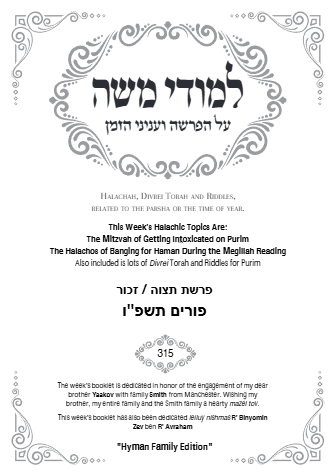

(For the riddles, please see page 62)

  1. The lights in the menorah should be lit “tamid” (Shemos 27:20). When the kohen gadol is in the Mishkan, he must wear the choshen [breastplate] with the names of the 12 shevotim on his heart as a constant remembrance before Hashem (28:29). He also wears the tzitz [headplate] on his forehead “tamid” to bring favor before Hashem (28:38). The korban tamid was brought twice daily, once in the morning and once in the afternoon (29:38-39). When the menorah is kindled in the afternoon, continual incense shall be burned before Hashem (30:8). (Torah Teasers)
  2. The Ramban (28:30) points out that although Hashem commanded Moshe to place the urim v’tumim, a parchment on which Hashem’s Ineffable Name was written, inside the kohen gadol’s choshen, nowhere did he receive an explicit commandment to make it, nor is its assembly mentioned in Parshas Pekudei together with the other bigdei kehunah. He explains that the urim v’tumim was so holy that its secrets were only known to Moshe, and the craftsmen were unable to be involved in its construction. Instead, it was either produced directly by Hashem or by Moshe, who subsequently placed it inside the choshen prior to Aharon’s investiture as kohen gadol (Vayikra 8:8).
  3. תרשיש
  4. The sefer Sar HaTorah (pg. 216) writes that this question was asked to the Tchebiner Rav and when he heard the question he remarked in amazement, “What’s the question it’s a clear Rashi in Pesachim.” The Mishnah in Pesachim (68a) teaches that michuy krovav (מיחוי רקביו) of the Korban Pesach overrides Shabbos. The Gemara asks, what is michuy krovav? And answers: מנקבן בסכין – “To pierce a hole with a knife.” Rashi explains: מנקבן בסכין - שיצא הרעי שאם יניחנו בתוכן יסריחו וכו' מיחוי לשון נקיבה וחיבול כמו תמחה את זכר עמלק – “Pierce a hole with a knife – To take out the waste, as if it is left inside, it will turn the meat moldy etc. The word ‘michuy’ is an expression of piercing and damaging, like it says timcheh (you shall damage) any remembrance of Amalek.” We see from this Rashi that the mitzvah of mechiyas Amalek means to cause harm, and not specifically to kill. From here the Tchebiner Rav brings a rayah that there is no need to kill an Amaleki to fulfill the mitzvah, and even hurting him and causing him pain is a fulfilment of the mitzvah of mechiyas Amalek.

The above is a big chiddush, as the simple understanding of the mitzvah of mechiyas Amalek is certainly to wipe them out and kill them, and simply hurting them is not enough, as is clear from the Rambam (Hilchos Melachim 6:4) and Chinuch (Mitzvah 604).

Perhaps to understand the above we can explain that the Tchebiner Rav means like what is mentioned in his name in the sefer Daf Al HaDaf (Pesachim 68a). There they bring that he was asked, if one should kill an Amaleki immediately, or if one should torture him and cause lots of pain first. To this question, the Tchebiner Rav brings the Rashi in Pesachim, to show that it is clear that the way to wipe out an Amaleki is by first causing him lots of pain and then killing him, unlike by a Jew where if there is a need for him to be killed, we are ברור לו מיתה יפה – we choose for him a pleasant way of death.

We find precedence to this from the Yalkut (Shmuel 1, remez 123) which brings that when Shmuel killed Aga: מה עשו לו היה מחתך מבשרו זיתים זיתים ומאכילו לנעמיות ברר לו מיתה מרה – “What did he do to him? He cut him into pieces the size of a kezayis, and fed them to a certain type of animal, making sure to choose for him a bitter death. [R’ Tzvi Cheshin explains that the reason Shmuel fed him to namiyus (a type of bird) is because the Gemara in Shabbos 128a tells us that namiyus are able to eat shards of glass, and it doesn’t harm them as they are able to digest hard things. Since Shmuel wanted to completely destroy Agag, he fed him to namiyus as they are able to eat and consume even the hardest of materials.]

We see that there is an idea of hurting and beating up the Amalkei as opposed to simply killing him, and perhaps this is what the Tchebiner Rav means, and that instead of simply killing an Amaleki, one should first cause him lots of pain, and only then kill him. When R’ Chaim Kanievsky zt”l was asked if there a mitzvah to hurt and harm an Amaleki without killing him, he answered: “One fulfils a chatzi shiur [half a measure] of the mitzvah.”

  1. R’ Chaim Kanievsky in Tama Dekra maintains that to fulfill the mitzvah one must kill at least two, and he bases himself on a Yerushalmi in Sotah (3:1). The Yerushalmi asks how much of the megillas sotah – the passage written for a woman who had to drink the waters of the sotah, must be rubbed out to be considered a mechikah [an erasure]. Beis Hillel say that two letters is considered a mechikah but less than that not. The pasuk says: ומחה אל מי המרים - “They should be erased into the bitter waters”. The Torah tells us: תמחה את זכר עמלק – “To obliterate the memory of Amalek”, using the same expression as by the sotah. Therefore, just like by sotah, mechikah means two, similarly by Amalek, in order to fulfill the mitzvah of mechiyas Amalek [obliterating Amalek] one must kill at least two Amalekim.

The Mishmar HaLevi (Kiddushin, siman 132) quotes a letter from R’ Chaim Kanievsky where he writes that killing one member of Amalek is a chatzi shiur of the mitzvah.

  1. The 41 names in the Megillah are: How many of them did you get?...
  2. Seven.

i) The seven days of Achashveirosh’s party, ii) The seven meshorshei pnei Hamelech, iii) The seven advisors of Achashveirosh, iv) The seven maidens of Esther, v) In the seventh year Achashveirosh married Esther.

  1. מדינה מדינה ומדינה (Esther 8:9)
  2. We learn in Megillas Esther that Haman was a צרר כל היהודים – “arch enemy of all the Jews” (Esther 9:24). The question is, how can we say Haman was an enemy of all the Jews, if he didn’t know that Esther was Jewish. Being that he didn’t know about all the Jews, how can we say he hated and was an enemy to all of them? It must be, that the peshat is that if he would have known that Esther was Jewish he would have wanted hated her as well, therefore, we consider it as if he hated and despised all the Jews. Seemingly, we can derive from here that if one recited ha’eitz on a fruit and he didn’t realize that another fruit in front of him was also ha’eitz, the berachah works, as if he would have known it was also ha’eitz he would have wanted the berachah to go on it. Although there is certainly room to differentiate between kavonah of berachos, and giving Haman the title צרר כל היהודים. (Based on a he’orah of R’ Avraham Ganchovski cited in Kovetz Gam Ani Odcha, Kovetz 18, pg.70)
  3. i) The Ran (Megillah 1a) answers that in the time of the Purim story the Jews in the prozim rested on the 14th, whereas the Jews in Shushan only rested on the 15th. Each place celebrated on the day that they rested, therefore, it turned out that in some places they rested on the 14th, and in some (i.e. Shushan) they rested on the 15th. Therefore, when Anshei Knesses HaGedolah established the Yom Tov of Purim for future generations, they established that it be celebrated over two different days like it was originally. And although in the time of the Purim story only Shushan celebrated on the 15th and not all walled cities, since the main place of the miracle was Shushan they gave all walled cities the same status as Shushan.

ii) The Mishnah in Avos (1:2) teaches that the world stands on three pillars, and one of them is Torah. On Purim there is an obligation to drink “ad deloi yoda”, and this leads to less Torah learning. To ensure that there will always be Torah being learnt in the world, Purim was split into two days. (Deroshas Chasam Sofer, Vol. 1. pg. 205).

The Avnei Nezer’s father Reb Berish of Biala related that the reason he merited to have such a special son is because there was certain moment on Purim where he was the only person in the world learning the way one should be, and he kept the entire world going. In this zechus, he merited to have a son who lit up the entire world, the holy of Avnei Nezer.

PDF Preview