Hashem Maintains a War with Amalek from Generation to Generation
Shvilei Pinchas | March 05, 2025
Print This Article
View Original PDF

Hashem Maintains a War with Amalek from Generation to Generation

Shvilei Pinchas | June 27, 2025

Mordechai a Gilgul of Yaakov Battled Haman a Descendant of Amalek to Restore the Two Vavs Ensuring that the Torah Would Endure from Generation to Generation

Rabbi Pinches Friedman

Shabbas Zachor 5785

Translation by Dr. Baruch Fox

The upcoming, auspicious Shabbas Kodesh is called Shabbas Zachor. This designation indicates that in addition to the reading of parshas hashavua, our sages (Megillah 29a) instituted the reading of the mitzvah of “remembering Amalek” in parshas Ki Seitzei for Maftir on the Shabbas prior to Purim. Here are the pertinent pesukim (Devarim 25, 17):

"זכור את אשר עשה לך עמלק בדרך בצאתכם ממצרים, אשר קרך בדרך ויזנב בך כל הנחשלים אחריך ואתה עייף ויגע ולא ירא אלקים. והיה בהניח ה' אלקיך לך מכל אויביך מסביב בארץ אשר ה' אלקיך נותן לך נחלה לרשתה, תמחה את זכר עמלק מתחת השמים לא תשכח".

Remember what Amalek did to you while you were departing from Egypt, how he happened upon you on the way, and he attacked at your rear, all the weaklings that straggled behind — while you were tired and exhausted; and he did not fear G-d. It shall be that when Hashem, your G-d, allows you to rest from all of your enemies that surround you, in the land that Hashem, your G-d, gives you as an inheritance, you shall eradicate the memory of Amalek from beneath the heaven — you shall not forget!

Regarding this mitzvah, we learn in the Gemara (ibid. 18a):

"זכור, יכול בלב, כשהוא אומר לא תשכח, הרי שכחת הלב אמור, הא מה אני מקיים זכור, בפה"—one might have thought that it is only necessary to remember mentally, but it already states elsewhere: “You shall not forget.” So, the requirement not to forget mentally is already stated; so what is meant when the passuk says: “Remember”? Remember verbally. Therefore, to also fulfill the mitzvah of remembering Amalek verbally, they instituted the reading of this passage from the Torah. In fact, it would have been possible to fulfill this mitzvah of “remembering Amalek” verbally on the Shabbas when parshas Ki Seitzei is read. Nevertheless, Chazal wanted us to read this passage specifically on the Shabbas preceding Purim in order to emphasize the connection with the miracle that transpired on Purim. On Purim, the Jews vanquished Haman, his sons, and close friends, and waged war against their enemies—who were all descendants of Amalek. Let us refer to what the Chinuch writes in parshas Ki Seitzei (Mitzvah 603):

"מדיני המצוה מה שאמרו זכרונם לברכה שחיוב זכירה זו היא בלב ובפה, וכן הוא בספרי, זכור את אשר עשה וגו', יכול בלבבך, כשהוא אומר לא תשכח הרי שכחת הלב אמורה, הא מה אני מקיים זכור שתהא שונה בפיך... ודי לנו בזה לזכור הענין פעם אחת בשנה או שתי שנים ושלש.

ואולי נאמר כי מנהגן של ישראל בפרשת זכור, לקרותה בשבת מיוחד בכל שנה תורה היא, ומפני מצוה זו היא שקבעו כן, והוא השבת שלפני פורים לעולם, ודין יהיה לקרותה ביום פורים, לפי שהוא מענינו של יום כי המן הרשע היה מזרעו, אבל להודיע שקודם נס זה נצטווינו בזכירה זו, קבעו הפרשה קודם לפורים, אבל סמכוה לפורים".

He states that this mitzvah requires remembering both mentally (in the heart) and verbally (with the mouth). Additionally, remembering once every two or three years would suffice to fulfill this mitzvah. Quite possibly, the Jewish custom to recite this passage specifically on its own special Shabbas annually, Shabbas Zachor, is biblically ordained and was instituted for the sake of this mitzvah. The Shabbas before Purim is always designated as Shabbas Zachor. In truth, the passage should actually be read on the day of Purim, because they share a common theme, since Haman HaRasha was a descendant of Amalek. Nevertheless, to inform us that the command to recall the incident with Amalek predated this miracle, it was instituted to read this passage prior to Purim, but close to the actual festival.

“It shall be that when Hashem, your G-d, allows you to rest” The Day of Rest of Shabbas Is Capable of Eradicating Amalek

It is fitting and gives me great pleasure to introduce the remarks of the brilliant author of the Chiddushei HaRim, zy”a. He analyzes the reason that Chazal instituted the reading of parshas Zachor specifically on the Shabbas preceding Purim. Now, we have learned from the two expressions "זכור" and "לא תשכח" that the mitzvah of “zechirat Amalek” must be fulfilled both mentally and verbally. In truth, the verbal remembering could just as easily have been accomplished with a weekday Torah-reading.

Hence, he refers to that which is written in this special passage: "והיה בהניח ה' אלקיך לך מכל אויביך מסביב... תמחה את זכר עמלק מתחת השמים"—it shall be that when Hashem, your G-d, allows you to rest from all of your enemies . . . you shall eradicate the memory of Amalek from beneath the heaven. In other words, the day of rest, Shabbas, is the optimal time for every Jew to fulfill the mitzvah of “eradicating Amalek” thoroughly.

It is worth noting that an explicit connection between Shabbas-observance and the perennial battle with Amalek can be found in the Gemara. The Gemara comments on the juxtaposition toward the end of parshas Beshalach of the episode of those who desecrated the Shabbas by going out to gather “mahn” and the confrontation with Amalek (Shabbas 118a): "אמר רב יהודה אמר רב אלמלי שמרו ישראל שבת ראשונה לא שלטה בהן אומה ולשון שנאמר ויהי ביום השביעי יצאו מן העם ללקוט, וכתיב בתריה ויבא עמלק "—Rav Yehudah said in the name of Rav: If the people of Yisrael had only kept the first Shabbas, no nation or people would have ever ruled over them, as it says (Shemos 16, 27): “It happened on the seventh day that some of the people went out to gather,” and it is written after that: “And Amalek came.” Notwithstanding, it still behooves us to explore the deeper connection between Shabbas Kodesh and “mechias Amalek.”
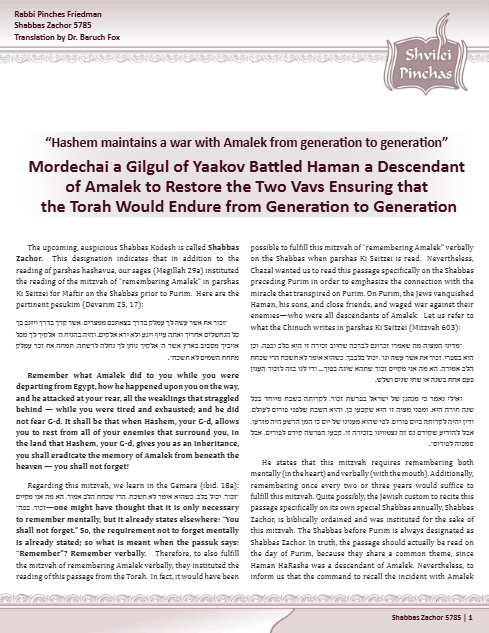
Mordechai a Gilgul of Yaakov Battled Haman a Descendant of Amalek to Restore the Two Vavs Ensuring that the Torah Would Endure from Generation to Generation

Rabbi Pinches Friedman

Shabbas Zachor 5785

Translation by Dr. Baruch Fox

The upcoming, auspicious Shabbas Kodesh is called Shabbas Zachor. This designation indicates that in addition to the reading of parshas hashavua, our sages (Megillah 29a) instituted the reading of the mitzvah of “remembering Amalek” in parshas Ki Seitzei for Maftir on the Shabbas prior to Purim. Here are the pertinent pesukim (Devarim 25, 17):

"זכור את אשר עשה לך עמלק בדרך בצאתכם ממצרים, אשר קרך בדרך ויזנב בך כל הנחשלים אחריך ואתה עייף ויגע ולא ירא אלקים. והיה בהניח ה' אלקיך לך מכל אויביך מסביב בארץ אשר ה' אלקיך נותן לך נחלה לרשתה, תמחה את זכר עמלק מתחת השמים לא תשכח".

Remember what Amalek did to you while you were departing from Egypt, how he happened upon you on the way, and he attacked at your rear, all the weaklings that straggled behind — while you were tired and exhausted; and he did not fear G-d. It shall be that when Hashem, your G-d, allows you to rest from all of your enemies that surround you, in the land that Hashem, your G-d, gives you as an inheritance, you shall eradicate the memory of Amalek from beneath the heaven — you shall not forget!

Regarding this mitzvah, we learn in the Gemara (ibid. 18a):

"זכור, יכול בלב, כשהוא אומר לא תשכח, הרי שכחת הלב אמור, הא מה אני מקיים זכור, בפה"—one might have thought that it is only necessary to remember mentally, but it already states elsewhere: “You shall not forget.” So, the requirement not to forget mentally is already stated; so what is meant when the passuk says: “Remember”? Remember verbally. Therefore, to also fulfill the mitzvah of remembering Amalek verbally, they instituted the reading of this passage from the Torah. In fact, it would have been possible to fulfill this mitzvah of “remembering Amalek” verbally on the Shabbas when parshas Ki Seitzei is read. Nevertheless, Chazal wanted us to read this passage specifically on the Shabbas preceding Purim in order to emphasize the connection with the miracle that transpired on Purim. On Purim, the Jews vanquished Haman, his sons, and close friends, and waged war against their enemies—who were all descendants of Amalek. Let us refer to what the Chinuch writes in parshas Ki Seitzei (Mitzvah 603):

"מדיני המצוה מה שאמרו זכרונם לברכה שחיוב זכירה זו היא בלב ובפה, וכן הוא בספרי, זכור את אשר עשה וגו', יכול בלבבך, כשהוא אומר לא תשכח הרי שכחת הלב אמורה, הא מה אני מקיים זכור שתהא שונה בפיך... ודי לנו בזה לזכור הענין פעם אחת בשנה או שתי שנים ושלש.

ואולי נאמר כי מנהגן של ישראל בפרשת זכור, לקרותה בשבת מיוחד בכל שנה תורה היא, ומפני מצוה זו היא שקבעו כן, והוא השבת שלפני פורים לעולם, ודין יהיה לקרותה ביום פורים, לפי שהוא מענינו של יום כי המן הרשע היה מזרעו, אבל להודיע שקודם נס זה נצטווינו בזכירה זו, קבעו הפרשה קודם לפורים, אבל סמכוה לפורים".

He states that this mitzvah requires remembering both mentally (in the heart) and verbally (with the mouth). Additionally, remembering once every two or three years would suffice to fulfill this mitzvah. Quite possibly, the Jewish custom to recite this passage specifically on its own special Shabbas annually, Shabbas Zachor, is biblically ordained and was instituted for the sake of this mitzvah. The Shabbas before Purim is always designated as Shabbas Zachor. In truth, the passage should actually be read on the day of Purim, because they share a common theme, since Haman HaRasha was a descendant of Amalek. Nevertheless, to inform us that the command to recall the incident with Amalek predated this miracle, it was instituted to read this passage prior to Purim, but close to the actual festival.

“It shall be that when Hashem, your G-d, allows you to rest” The Day of Rest of Shabbas Is Capable of Eradicating Amalek

It is fitting and gives me great pleasure to introduce the remarks of the brilliant author of the Chiddushei HaRim, zy”a. He analyzes the reason that Chazal instituted the reading of parshas Zachor specifically on the Shabbas preceding Purim. Now, we have learned from the two expressions "זכור" and "לא תשכח" that the mitzvah of “zechirat Amalek” must be fulfilled both mentally and verbally. In truth, the verbal remembering could just as easily have been accomplished with a weekday Torah-reading.

Hence, he refers to that which is written in this special passage: "והיה בהניח ה' אלקיך לך מכל אויביך מסביב... תמחה את זכר עמלק מתחת השמים"—it shall be that when Hashem, your G-d, allows you to rest from all of your enemies . . . you shall eradicate the memory of Amalek from beneath the heaven. In other words, the day of rest, Shabbas, is the optimal time for every Jew to fulfill the mitzvah of “eradicating Amalek” thoroughly.

It is worth noting that an explicit connection between Shabbas-observance and the perennial battle with Amalek can be found in the Gemara. The Gemara comments on the juxtaposition toward the end of parshas Beshalach of the episode of those who desecrated the Shabbas by going out to gather “mahn” and the confrontation with Amalek (Shabbas 118a): "אמר רב יהודה אמר רב אלמלי שמרו ישראל שבת ראשונה לא שלטה בהן אומה ולשון שנאמר ויהי ביום השביעי יצאו מן העם ללקוט, וכתיב בתריה ויבא עמלק "—Rav Yehudah said in the name of Rav: If the people of Yisrael had only kept the first Shabbas, no nation or people would have ever ruled over them, as it says (Shemos 16, 27): “It happened on the seventh day that some of the people went out to gather,” and it is written after that: “And Amalek came.” Notwithstanding, it still behooves us to explore the deeper connection between Shabbas Kodesh and “mechias Amalek.”

PDF Preview