Hashem’s Concern for Injustice
Rabbi Rafi Wolfe
ואלה הבגדים אשר יעשו חשן ואפוד וגו’ לאהרן אחיך וגו’ ועשו את- האפד זהב תכלת וארגמן וגו’ ועשית חשן משפט מעשה חשב וגו’
These are the garments that you shall make for Aharon, your brother: The Choshen and the Eiphod...You shall make the Eiphod out of gold, techeiles, and argaman...You shall make the Choshen of Justice, the work of a craftsman...
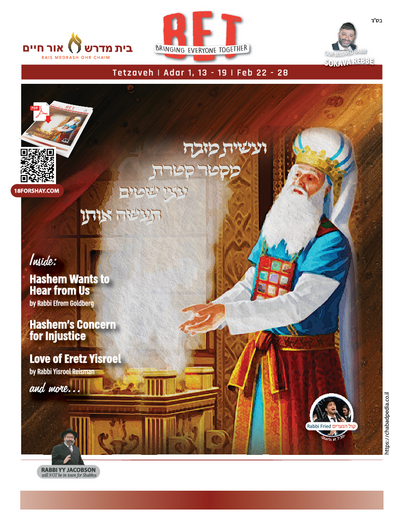
One of the prominent features of parshas Tetzaveh is the focus on the bigdei kehuna, the Priestly garments. The Kohanim had to wear four special articles of clothing for their Temple service to be accepted. The Kohen Gadol had four additional articles of clothing as part of his uniform.
The Torah introduces these special garments by first mentioning the choshen, an ornate breastplate, and then mentions the eiphod, a type of decorative apron. What’s interesting is when the Torah proceeds to describe how to make them, it starts with the eiphod, and only then discusses the choshen. Why is there this switch in the order?
Our Sages ask: why is the topic of Temple offerings juxtaposed to the bigdei kehuna? The answer is to teach us that just like Temple offerings provide atonement, so too do the bigdei kehuna. The Choshen atones for injustice in civil court cases, whereas the eiphod atones for idol worship. Now, based on this, we can understand why the Torah starts off mentioning the choshen first, and only then the eiphod.
Let’s consider for a moment, which upsets Hashem, so-to-speak, more? Idol worship? Or injustice in court? One might think that it would be idol worship, as it’s a direct affront to Hashem’s honor. However, in reality, Hashem cares more about injustice in court. Hashem can forgive His honor, and overlook the idol worship. However, when His children are being wronged, and no one is there to correct it, that’s what really bothers Him.
We see this with the contrast between the generation of the Flood, and the story of the Tower of Bavel. The Tower of Bavel was all about waging war against Hashem. Mankind wanted to be free from G-d’s influence. This was the biggest affront to Hashem’s honor, yet they were simply punished with dispersion. On the other hand, almost the entirety of mankind was wiped out because violent theft was rampant. We see that human injustice is punished more severely than affronts to Hashem Himself.
To demonstrate this priority in Hashem’s eyes, the choshen mishpat, the breastplate of justice, which atoned for unjust courts, was mentioned first. Only then was the eiphod, which atones for idol worship, mentioned. However, that’s from Hashem’s perspective. From our perspective, it’s the other way around. We care more about Hashem’s honor than our own. As such, the actual production of the bigdei kehuna focused on Hashem first, and mentioned the eiphod before the choshen.
Commenting on the pasuk “the sounds of the kohen gadol’s robe were heard as he entered the Mikdash (28:35)” – the Ba’al Ha’turim observes that the word v’nishma appears in only two other places in the entire Tanach. One is Bnei Yisrael’s famous proclamation, naaseh v’nishma (“We will do and we will hear” – Shemos 24:7). The other is a pasuk in Megilas Ester (1:20) in which Achashveirosh’s advisor tells him that the royal edict would be sounded (v’nishma) throughout his vast empire. What might be the connection between these three pesukim?
Rav Shaul Alter shlit”a explained that a person might mistakenly think that the notion of, that God listens to those who approach Him, is reserved for the exceptionally righteous. Some people assume that they are too distant from Hashem, that they are too flawed, that they have strayed too far, for Hashem to have any interest in them. They feel they should not call out to Him because He does not want to hear them. But the truth is that just as el hakodesh the kohen gadol’s sound was heard in the Mikdash, similarly, v’nishma pitgam hamelech b’chol malchuso throughout His vast empire.
Tradition teaches that the word hamelech in the Megilla alludes to Hashem. This pasuk indicates to us that the “King’s” interest extends throughout His “kingdom.” No matter how far a person has wandered, no matter how badly he had stumbled and erred, he is still in Hashem’s kingdom, and Hashem wants a relationship with him.
Once our ancestors proclaimed naaseh v’nishma, their unconditional devotion to Hashem, they secured a position in His kingdom, guaranteeing that He will always listen to them. Anytime we wish to speak to Him, lean on Him, turn to Him for help, or to feel His embrace, He is there waiting for us.
I once met a fellow who had grown up in a chassidishe family but then left religious observance entirely. He ended up getting in trouble with the law. The night before the verdict would be announced, he told me that he felt like praying, asking Hashem for a favorable outcome, but he couldn’t do it. “Why would He want to hear from me now?” he asked. “I haven’t spoken to Him or have had anything to do with Him in many years. Why would He listen to me?” I explained to him that one day, he will be a father, and he will see that there is nothing a child could do that would make his parents not want to hear from them. Even if a child leaves his parents and has no contact with them for years, when he eventually picks up the phone and calls, they would not hesitate to answer the call, and they would be overjoyed to hear from him.
The same is true of Hashem. Ever since the pronouncement of naaseh v’nishma, there is nothing we can do that would make Hashem not want to hear from us. Wherever we are, b’chol malchuso whatever condition we are in, v’nishma kolo – Hashem lovingly and compassionately hears our prayers.